







AFP ready for typhoon season
Published Jun 16, 2025 02:37 pm


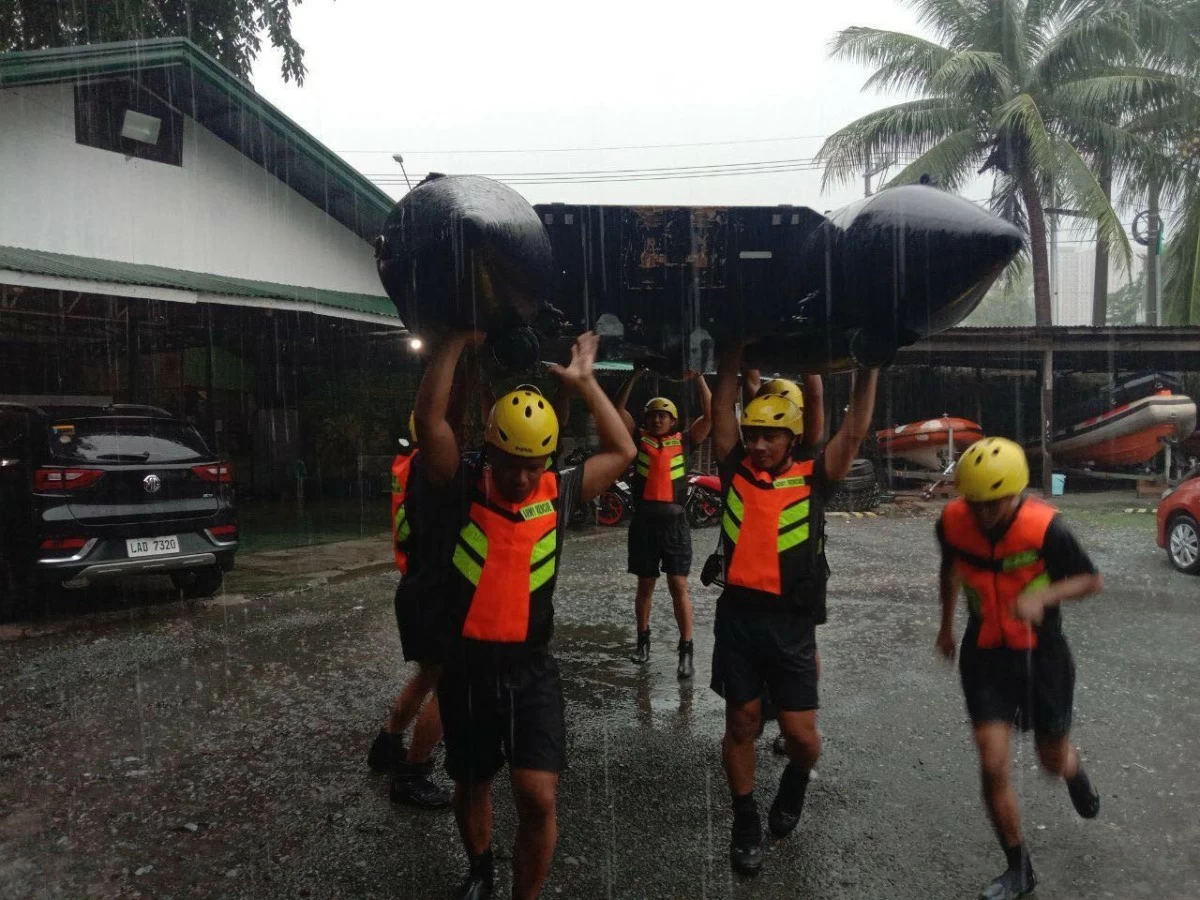
Responders from the Philippine Army's 525th Engineer "Forerunner" Battalion prepare a rubber boat for rescue missions in flood-hit areas in Metro Manila during the onslaught of Typhoon Carina on July 24, 2024. (File photo: AFP)
The Armed Forces of the Philippines (AFP) announced on Monday, June 16, its preparedness to respond to emergencies and support disaster response operations as the typhoon season approaches.
AFP Chief, General Romeo Brawner Jr. ordered the pre-deployment of quick reaction teams, search and rescue units, and humanitarian assistance teams so they could be placed on standby in all unified commands and joint task forces nationwide.
“The order is for them to be pre-deployed in our engineering brigades, CMO (civil-military operations) battalions, and communication teams in high-risk areas to ensure rapid response. Our unified commands are active and the readiness of the AFP is not seasonal. This is a continuing mission to ensure that when a disaster strikes, the soldiers will be there to assist the people,” AFP spokesperson Col. Francel Margareth Padilla said.
The AFP said it has closely coordinated with the National Disaster Risk Reduction and Management Council (NDRRMC) for the deployment of the troops.
“They are the ones who will call the shots for us to deploy but our troops are already pre-positioned in areas that are very prone to disasters. What’s critical here is the prepositioning of relief goods, evacuation assistance, rescue and retrieval, as well as medical and first aid response. After the calamity, there will be troops for road and debris clearing and to restore communication,” Padilla added.
To ensure that the troops are capable to respond, the AFP has equipped the quick reaction teams with adequate assets and equipment.
The AFP has 100 rubber boats, 35 military trucks, military ambulances, satellite phones, and portable generators among others in its inventory.
The AFP also conducts disaster response and rescue operation course, combat lifesaver training, and water search and rescue (WASAR) drills for the troops, cadets, and reservists.
“We also regularly participate in multi-agency simulation exercises along with the NDRRMC and OCD [Office of Civil Defense] to make sure that we are interoperable with different civilian responders,” Padilla said.
The country is visited by about 20 typhoons each year as it is located within the “Typhoon Belt” in the Pacific Ocean, a region where tropical cyclones frequently form and intensify due to the abundance of warm ocean waters.
The typhoon season will begin this month, according to the Philippine Atmospheric, Geophysical and Astronomical Services Administration (PAGASA).