






Manila Bulletin
 Philippines
National
School Year 2025–2026: DepEd projects 27.6 million enrollees in basic education
Philippines
National
School Year 2025–2026: DepEd projects 27.6 million enrollees in basic education
Philippines
National
School Year 2025–2026: DepEd projects 27.6 million enrollees in basic education
School Year 2025–2026: DepEd projects 27.6 million enrollees in basic education
DepEd eyes urgent solutions for classroom, teacher, and resource shortages
Published Jun 15, 2025 02:13 pm


At A Glance
- For School Year 2025–2026, the Department of Education (DepEd) projects that 27.6 million students will enroll in basic education.
- This surge places additional strain on an already overstretched system, which is facing shortages of 165,000 classrooms and 56,000 teachers, along with limited learning resources nationwide.
- Under the leadership of Secretary Sonny Angara, DepEd is spearheading concrete and urgent solutions to address these longstanding shortages in education resources.
- Even as DepEd accelerates reforms, teachers continue to highlight deep-seated government neglect, overcrowded classrooms, and inadequate funding for education.
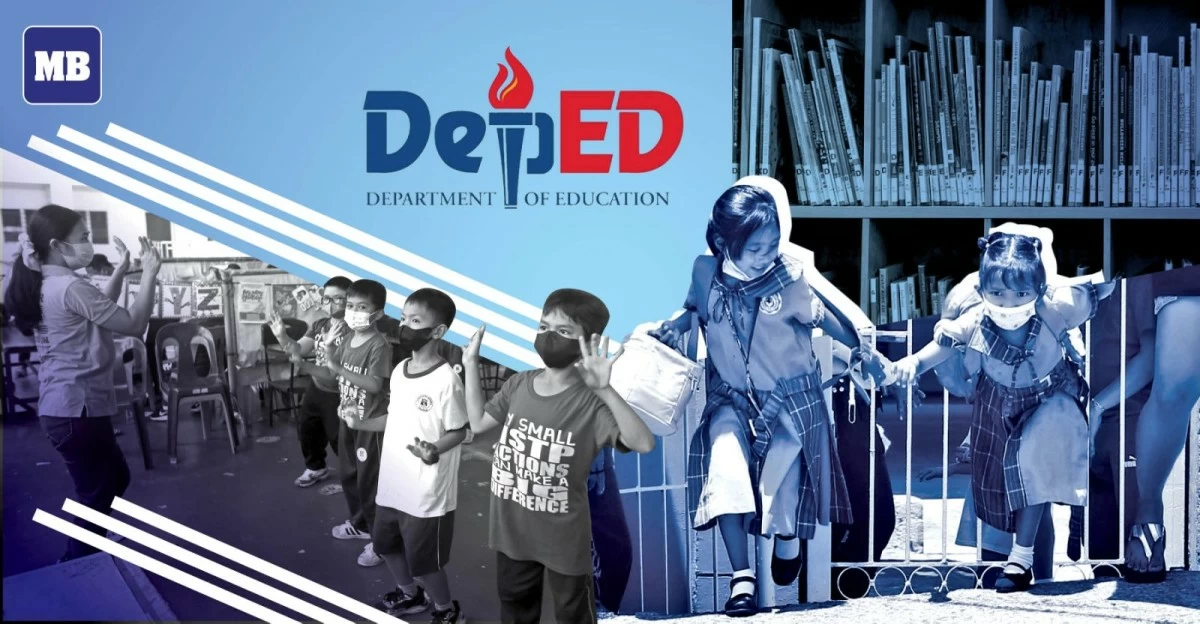
DepEd prepares for a projected enrollment of 27.6 million students in School Year (SY) 2025–2026 amid shortages in classrooms, teachers, and learning tools. (DepEd / MB Visual Content Group)
As School Year 2025–2026 officially opens on Monday, June 16, the Department of Education (DepEd) is preparing to accommodate a projected 27.6 million enrollees in basic education amid persistent challenges—including a nationwide shortage of 165,000 classrooms, a deficit of over 56,000 teachers, and limited learning resources.
To address these longstanding gaps, DepEd is implementing urgent and concrete measures to strengthen the country’s public education system.
(MB Visual Content Group / DepEd)
Education Secretary Sonny Angara, alongside President Ferdinand Marcos Jr., will lead the ceremonial opening of classes at Epifanio Delos Santos Elementary School in Singalong, Manila.
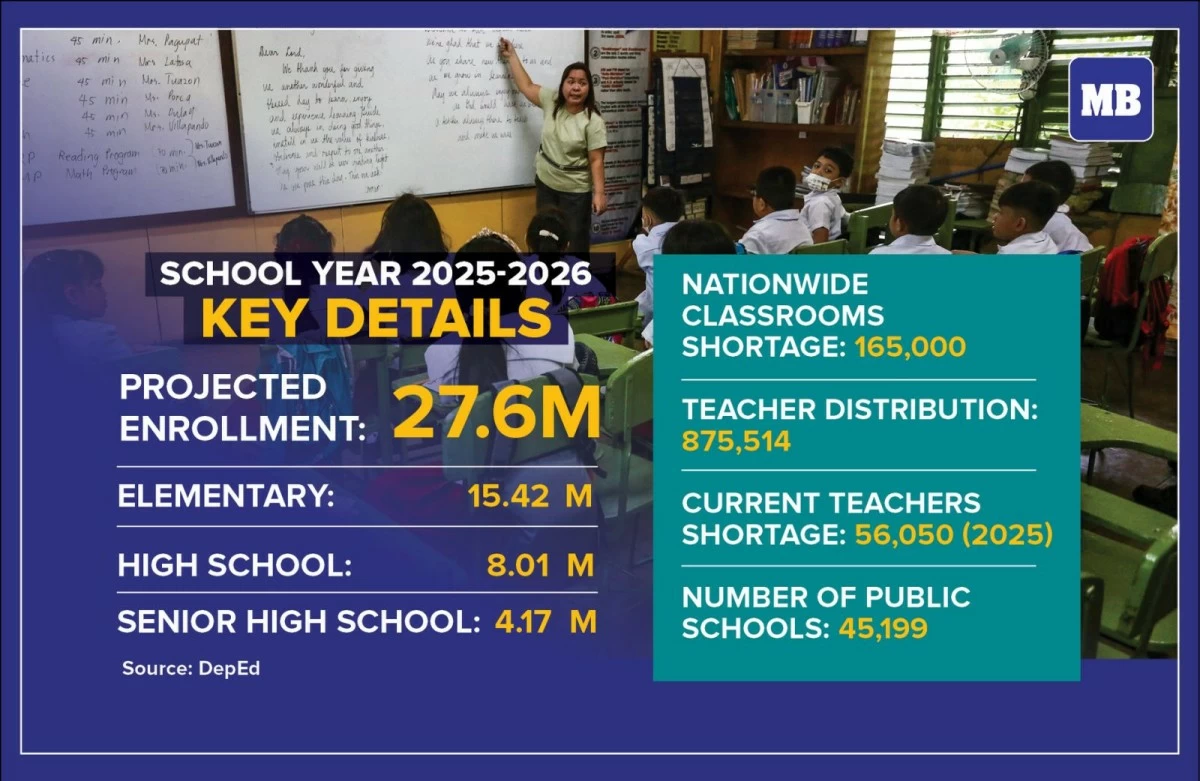
Data from Dennis E. Legaspi, Chief of Media Relations at the Office of the Secretary, showed the projected enrollment breakdown: 15.42 million in elementary, 8.01 million in junior high school (Grades 7 to 10), and 4.17 million in senior high school (Grades 11 and 12).
Worsening classroom crisis
As with previous school openings, school infrastructure—especially classroom availability—remains a major challenge, particularly in densely populated areas.
Latest DepEd data show that the classroom shortage has reached over 165,000. Secretary Angara earlier noted this deficit is “growing” due to population increases.
DepEd said the classroom gap remains a critical bottleneck in delivering quality education.
To address this, Legaspi said DepEd is pursuing a three-pronged response strategy under Angara’s leadership: construction of 105,000 classrooms through Public-Private Partnerships (PPPs); accelerated rollout of infrastructure via early procurement directives; and close coordination with the Department of Public Works and Highways (DPWH) to build climate-resilient school buildings.
With climate change increasingly affecting school facilities, DepEd emphasized its intent to work closely with DPWH to ensure disaster- and climate-resilient classrooms, especially in high-risk areas.
The department is fast-tracking solutions through early procurement and stronger inter-agency coordination to ensure that no learner is left behind.
Teacher gap and public school statistics
DepEd data show 875,514 teachers are currently deployed nationwide.
However, with enrollment on the rise, DepEd estimates a shortage of 56,050 teachers in 2025 alone.
There are 45,199 public schools across the archipelago, many of which operate under cramped or multi-shift arrangements due to space constraints.
Angara’s school opening visits
Following the school opening in Manila, Angara is set to visit Tenement Elementary School in Taguig and two schools in Laguna to personally assess readiness and on-the-ground needs.
Revised enrollment policy
Ahead of the new school year, DepEd introduced a simplified enrollment process.
Under the new policy, parents will only need to submit their child’s birth certificate once for the entire K to 12 education, reducing paperwork and costs.
Angara issued DepEd Order No. 017, s. 2025, or the Revised Basic Education Enrollment Policy, in response to President Marcos’ call for a more efficient and inclusive registration system.
“We’ve heard from parents that enrollment can be difficult due to paper requirements and missing records,” Angara said in a June 15 statement.
“This new policy means less expense and less hassle for families. Parents no longer need to submit the same documents every year, easing financial strain.”
If a birth certificate is unavailable, secondary documents may be submitted until October 31. Accepted IDs include the National ID, PSA-issued Certificate of Live Birth, Barangay Certification, and other official documents. Special provisions apply to Persons Deprived of Liberty (PDLs) and ALS learners.
Enrollment ran from June 9 to 13 and can be completed in person by submitting the Basic Education Enrollment Form (BEEF) or remotely via email or designated drop-off points.
Late enrollees may still be accepted if they meet attendance and academic requirements, with interventions available for catch-up learning.
DepEd reiterated that learner records must be transferred directly between schools and that no voluntary fees should be collected during early registration.
Smart TVs, laptops delivered ahead of opening
Days before classes began on June 16, schools nationwide received Smart TVs, laptops, and textbooks—early deliveries made possible by DepEd’s ramped-up procurement efforts under President Marcos’ directive to build a future-ready, inclusive education system.
Led by Angara, DepEd’s Early Procurement Activities (EPA) for FY 2025 enabled the distribution of: 33,539 laptops for teachers, 5,360 laptops for non-teaching staff, and nearly 26,000 Smart TV packages with external hard drives.
Region VII is set to receive over 2,300 Smart TVs, with deliveries ongoing in other regions. In Metro Manila, 1,340 laptops will be distributed to 268 schools between June 16 and 26.
“This is not just about delivering equipment, but about bringing real opportunities to our classrooms,” said Angara in a mix of English and Filipino.
School heads and teachers welcomed the early arrival of these resources. Principal Jocelyn Reyes of Pagalanggang Elementary School in Bataan noted that Smart TVs will help improve students’ reading skills. Sta. Isabel Elementary School Principal Raffy Abilong praised the initiative as a step toward enhancing classroom learning.
DepEd is also accelerating textbook procurement aligned with the revised K to 10 curriculum. Books for Grades 1, 4, and 7 are nearly fully procured, with other levels to follow.
In addition, schools continue to use diverse learning resources, including printed modules, lesson exemplars, and digital tools such as the DepEd LMS, Learning Resource Portal, and Likha App.
Addressing systemic gaps, mobilizing communities
Weeks ahead of the school opening, Angara acknowledged the complex landscape facing DepEd—balancing infrastructure backlogs with curriculum reforms and partnerships to build a more inclusive and flexible system.
Preparations centered on the annual Brigada Eskwela or National Schools Maintenance Week, which mobilizes communities to clean, repair, and prepare schools for the new academic year.
Parents, teachers, volunteers, and local organizations join forces to improve school environments for students.
Coping with overcrowding: Shift systems and online learning
To manage overcrowding, many public schools are implementing double or triple-shift schedules. Some students only attend classes on certain days due to the lack of classrooms.
“Meron tayong mga lugar na ‘yung mga bata, hindi pumapasok araw-araw dahil wala silang classrooms (We have areas where children don’t go to school every day because there are no classrooms),” Angara said.
To address this, DepEd is improving internet infrastructure to support independent learning—particularly for senior high school students who can study from home.
“‘Yung mga kailangang matuto pa lang magbasa at magsulat—Nursery, Kindergarten, Grade 1—sila talaga ang kailangang nasa classroom (Those just starting to learn to read and write—Nursery, Kindergarten, Grade 1—really need to be in classrooms),” he added.
16,000 new teachers to be hired by end of 2025
DepEd is expediting the hiring of 16,000 new teachers by the end of 2025 to support the growing student population.
Following directives from President Marcos and the Department of Budget and Management (DBM), Angara urged DepEd’s regional and division offices to fast-track recruitment to ensure a smooth school year.
These teaching positions are part of 20,000 new items under the FY 2025 General Appropriations Act (GAA), with 80 percent (16,000) requested for early release.
“Malaking bagay ito (This is a big deal),” Angara said. He explained that student-teacher ratios vary from 1:20 in Kindergarten to 1:40 in higher grades, and the new hires aim to improve this balance.
Senior High School pilot program launched
This year, DepEd is piloting a revised Senior High School (SHS) curriculum in several hundred schools.
Angara said the changes include fewer subjects and more flexibility for students to choose learning tracks that match their interests.
“In Senior High School before, there were 33 subjects over two years. We've reduced that,” Angara said. “Now, students have more freedom to explore their interests before committing to tracks like Business or Science.”
Schools were selected based on readiness in terms of faculty, facilities, and curriculum. Public consultations showed positive feedback, particularly from students who welcomed the opportunity to shape their own learning paths.
Teachers decry shortages, blame government neglect
The Alliance of Concerned Teachers (ACT)-NCR Union earlier sounded the alarm over the 165,000-classroom shortage—nearly triple the number reported 12 years ago.
Calling it a “glaring result of systemic neglect,” ACT-NCR Union President Ruby Bernardo criticized the government for failing to prioritize public education.
“This deepening classroom crisis exposes the long-standing abandonment of our teachers and learners,” Bernardo said.
She added that overcrowded classes, shifting schedules, and crumbling facilities hinder both teaching and learning. The crisis, she said, stems not only from rising population but from “consistent misprioritization” in national spending.
“Every year, billions are allocated elsewhere while classrooms decay and teachers remain overworked and underpaid,” she said.
ACT also rejected the push for Public-Private Partnerships (PPPs), warning they may expose public schools to profit-driven motives.
“What we need is sustained public investment—not stopgap solutions that benefit the few,” Bernardo said.
The union is calling for adequate funding for classroom construction and repair, increased teacher hiring, improved working conditions, and better access to learning materials.
“We urge the public to hold the government accountable,” Bernardo added. “Every child deserves a safe, conducive learning environment, and every teacher deserves humane working conditions.”