

ADVERTISEMENT

South African president visits flood sites with death toll at 78 and expected to climb

Published Jun 13, 2025 06:56 pm

At A Glance

  • South African President Cyril Ramaphosa's visit came amid questions over authorities' early response to the disaster, which was caused by an extreme weather front that brought heavy rain, strong winds and even snow to parts of the province. Forecasters warned about the extreme weather last week.
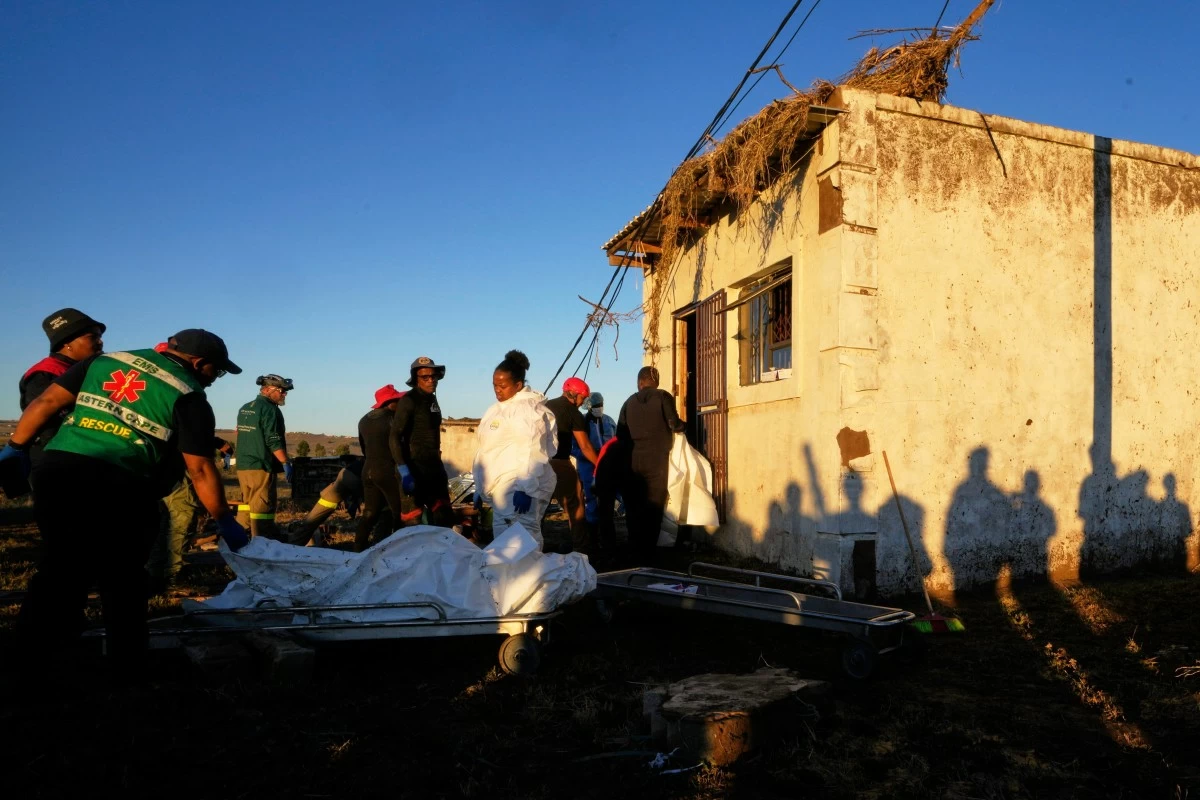
Forensic workers retrieve bodies of a mother and three daughters from inside a one room house after floods swept through the area in Mthatha, South Africa, Thursday, June 12, 2025. (AP Photo/Themba Hadebe)
CAPE TOWN, South Africa (AP) — South Africa's leader visited the region where devastating floods have left at least 78 people dead in the southeast of the country as search and rescue operations continued Friday for a fourth day and authorities said they expected the death toll to rise.
President Cyril Ramaphosa traveled to the town of Mthatha in Eastern Cape province, where the floods hit hardest when they began in early Tuesday.
Ramaphosa attended a briefing by officials from the National Disaster Management Center and also visited a bridge where a school bus was washed away by flooding. Six students, the bus driver and another adult onboard were confirmed dead, while four other schoolchildren were among the missing.
Ramaphosa's visit came amid questions over authorities' response to the disaster, which was caused by an extreme weather front that brought heavy rain, strong winds and snow to parts of the province. Forecasters warned about the bad weather last week.
The head of the provincial government said that the rescue effort was paralyzed in the first few hours of the floods, because of a lack of resources like specialized search and rescue teams, divers and K-9 dog units in one of the country's poorest regions.
Eastern Cape Premier Oscar Mabuyane said that the province of 7.2 million people has just one official rescue helicopter, which had to be brought from another city more than 500 kilometers (310 miles) away.
Ramaphosa defended the response and said that while the government was deeply distressed at the deaths, it could have been much worse.
The floods in the predawn hours caught many unaware, with victims washed away, along with parts of their houses and other debris, or trapped inside as water engulfed their homes. Authorities said that they expected more bodies to be recovered as rescue teams search the floodwaters and what is left of damaged houses and other structures to look for those still missing. Many children are among the dead.
I need psychological help because I saw people dying in front of me. They were being dragged by the water along with the corrugated iron, said Zinathi Vuso, a resident of Mthatha.
Others tried to hold or climb onto something, but it would break and they ended up dead, Vuso said. That is why you are seeing people still getting recovered and others are yet to be found.
Bodies were found by search and rescue teams up to 2 kilometers (more than a mile) away from where the victims were believed to have been during the flooding. The rain had stopped and much of the floodwater was subsiding.
Authorities were appealing for residents to report missing people so rescuers could get a better idea of how many people they were still looking for, Cooperative Governance and Traditional Affairs Minister Velenkosini Hlabisa, who led a national government team deployed to the province earlier in the week, said on national broadcaster SABC late Thursday.
We are in a crisis. A real disaster, Hlabisa said. The more water subsides, the more people will be found.
Some South African coastal areas are vulnerable to extreme weather blowing in from the Indian Ocean and Southern Ocean. More than 400 people died in flooding in and around the east coast city of Durban in 2022.
Many victims of this week's floods in the Eastern Cape were living on flood plains near rivers. Poor areas with informal housing were the worst affected, government officials said.

Related Tags

World news
ADVERTISEMENT
.most-popular .layout-ratio{ padding-bottom: 79.13%; } @media (min-width: 768px) and (max-width: 1024px) { .widget-title { font-size: 15px !important; } }

{{ articles_filter_1561_widget.title }}

.most-popular .layout-ratio{ padding-bottom: 79.13%; } @media (min-width: 768px) and (max-width: 1024px) { .widget-title { font-size: 15px !important; } }

{{ articles_filter_1562_widget.title }}

.most-popular .layout-ratio{ padding-bottom: 79.13%; } @media (min-width: 768px) and (max-width: 1024px) { .widget-title { font-size: 15px !important; } }

{{ articles_filter_1563_widget.title }}

{{ articles_filter_1564_widget.title }}

.mb-article-details { position: relative; } .mb-article-details .article-body-preview, .mb-article-details .article-body-summary{ font-size: 17px; line-height: 30px; font-family: "Libre Caslon Text", serif; color: #000; } .mb-article-details .article-body-preview iframe , .mb-article-details .article-body-summary iframe{ width: 100%; margin: auto; } .read-more-background { background: linear-gradient(180deg, color(display-p3 1.000 1.000 1.000 / 0) 13.75%, color(display-p3 1.000 1.000 1.000 / 0.8) 30.79%, color(display-p3 1.000 1.000 1.000) 72.5%); position: absolute; height: 200px; width: 100%; bottom: 0; display: flex; justify-content: center; align-items: center; padding: 0; } .read-more-background a{ color: #000; } .read-more-btn { padding: 17px 45px; font-family: Inter; font-weight: 700; font-size: 18px; line-height: 16px; text-align: center; vertical-align: middle; border: 1px solid black; background-color: white; } .hidden { display: none; }
function initializeAllSwipers() { // Get all hidden inputs with cms_article_id document.querySelectorAll('[id^="cms_article_id_"]').forEach(function (input) { const cmsArticleId = input.value; const articleSelector = '#article-' + cmsArticleId + ' .body_images'; const swiperElement = document.querySelector(articleSelector); if (swiperElement && !swiperElement.classList.contains('swiper-initialized')) { new Swiper(articleSelector, { loop: true, pagination: false, navigation: { nextEl: '#article-' + cmsArticleId + ' .swiper-button-next', prevEl: '#article-' + cmsArticleId + ' .swiper-button-prev', }, }); } }); } setTimeout(initializeAllSwipers, 3000); const intersectionObserver = new IntersectionObserver( (entries) => { entries.forEach((entry) => { if (entry.isIntersecting) { const newUrl = entry.target.getAttribute("data-url"); if (newUrl) { history.pushState(null, null, newUrl); let article = entry.target; // Extract metadata const author = article.querySelector('.author-section').textContent.replace('By', '').trim(); const section = article.querySelector('.section-info ').textContent.replace(' ', ' '); const title = article.querySelector('.article-title h1').textContent; // Parse URL for Chartbeat path format const parsedUrl = new URL(newUrl, window.location.origin); const cleanUrl = parsedUrl.host + parsedUrl.pathname; // Update Chartbeat configuration if (typeof window._sf_async_config !== 'undefined') { window._sf_async_config.path = cleanUrl; window._sf_async_config.sections = section; window._sf_async_config.authors = author; } // Track virtual page view with Chartbeat if (typeof pSUPERFLY !== 'undefined' && typeof pSUPERFLY.virtualPage === 'function') { try { pSUPERFLY.virtualPage({ path: cleanUrl, title: title, sections: section, authors: author }); } catch (error) { console.error('ping error', error); } } // Optional: Update document title if (title && title !== document.title) { document.title = title; } } } }); }, { threshold: 0.1 } ); function showArticleBody(button) { const article = button.closest("article"); const summary = article.querySelector(".article-body-summary"); const body = article.querySelector(".article-body-preview"); const readMoreSection = article.querySelector(".read-more-background"); // Hide summary and read-more section summary.style.display = "none"; readMoreSection.style.display = "none"; // Show the full article body body.classList.remove("hidden"); } document.addEventListener("DOMContentLoaded", () => { let loadCount = 0; // Track how many times articles are loaded const offset = [1, 2, 3, 4, 5, 6, 7, 8, 9, 10]; // Offset values const currentUrl = window.location.pathname.substring(1); let isLoading = false; // Prevent multiple calls if (!currentUrl) { console.log("Current URL is invalid."); return; } const sentinel = document.getElementById("load-more-sentinel"); if (!sentinel) { console.log("Sentinel element not found."); return; } function isSentinelVisible() { const rect = sentinel.getBoundingClientRect(); return ( rect.top < window.innerHeight && rect.bottom >= 0 ); } function onScroll() { if (isLoading) return; if (isSentinelVisible()) { if (loadCount >= offset.length) { console.log("Maximum load attempts reached."); window.removeEventListener("scroll", onScroll); return; } isLoading = true; const currentOffset = offset[loadCount]; window.loadMoreItems().then(() => { let article = document.querySelector('#widget_1690 > div:nth-last-of-type(2) article'); intersectionObserver.observe(article) loadCount++; }).catch(error => { console.error("Error loading more items:", error); }).finally(() => { isLoading = false; }); } } window.addEventListener("scroll", onScroll); });

Sign up by email to receive news.