ADVERTISEMENT

DBP's Agri-Puhunan, Forest Program recognized for sustainable development

Published Jun 13, 2025 07:00 pm
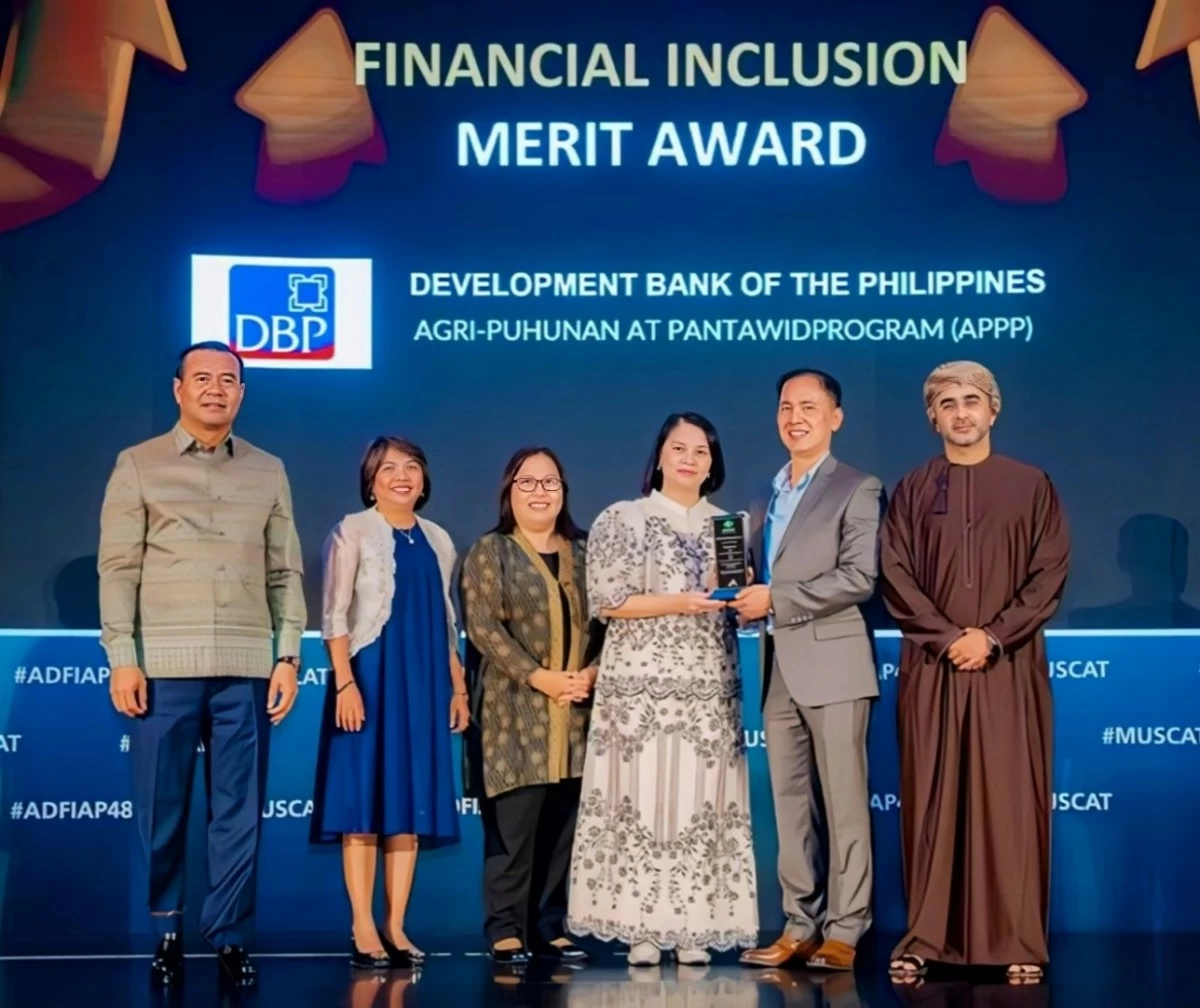
DBP Senior Vice President Ronaldo U. Tepora (second from right) and Senior Vice President Catherine T. Magana (third from right) receive the Merit Award for Financial Inclusion conferred to DBP for its participation in DA’s Agri-Puhunan at Pantawid Program (APP) during the 48th ADFIAP Annual Meeting in Muscat, Oman.  Also in photo are (from left): Agricultural and Rural Development Bank Chief Executive Officer Dr. KAO Thach, DBP First Vice President Atty. Ma. Cristina C. Malab, DBP Senior Vice President Soraya F. Adiong and Development Bank in Sultanate of Oman Chief Executive Officer Mr. Hussain Al Lawati.
DBP Senior Vice President Ronaldo U. Tepora (second from right) and Senior Vice President Catherine T. Magana (third from right) receive the Merit Award for Financial Inclusion conferred to DBP for its participation in DA’s Agri-Puhunan at Pantawid Program (APP) during the 48th ADFIAP Annual Meeting in Muscat, Oman. Also in photo are (from left): Agricultural and Rural Development Bank Chief Executive Officer Dr. KAO Thach, DBP First Vice President Atty. Ma. Cristina C. Malab, DBP Senior Vice President Soraya F. Adiong and Development Bank in Sultanate of Oman Chief Executive Officer Mr. Hussain Al Lawati.
State-owned Development Bank of the Philippines (DBP) has been recognized by an international group of development financial institutions for its programs aimed at advancing financial inclusion in agriculture and restoring forest cover.
DBP President and Chief Executive Officer Michael O. de Jesus said that the Bank was honored for its Forest Program and its participation in the Department of Agriculture’s Agri-Puhunan at Pantawid (APP) Program during the Association of Development Financing Institutions in Asia and the Pacific (ADFIAP) Awards program held in Muscat, Oman. 
De Jesus noted that these accolades further inspire the DBP and affirm the Bank’s efforts to help realize President Ferdinand R. Marcos Jr.’s goals, particularly in the areas of food security, financial inclusion, and environmental protection.
The DBP Forest Program (DFP) received a Merit Award under the Corporate Social Responsibility category. 
De Jesus added that the DFP is the Bank’s CSR program for the environment, with over 50 projects spanning 6,386 hectares across the archipelago. He highlighted ADFIAP's citation of DBP’s Mindanao State University-Buug Forest Project, which involves the rehabilitation of a 100-hectare upland forest in Camp Salman, Tungawan, Zamboanga Sibugay. 
This project has benefitted erstwhile members of the Moro Islamic Liberation Front, with de Jesus stating that it has helped improve the lives of former rebels by offering livelihood opportunities towards achieving peace and economic development in Mindanao.
The APP, which was conferred with a Merit Award for Financial Inclusion, is being undertaken in partnership with the Department of Agriculture (DA) and aims to improve rice productivity, ensure food security, and promote agricultural sustainability in the country. 
De Jesus explained that the APP Program was launched by the DA in 2024 and provides a minimum of P60,000 credit assistance to farmer-beneficiaries through their cooperatives. 
This financial assistance is credited through an Intervention Monitoring Card (IMC) to finance farming capital expenses and provide cash advances for other labor expenses until the harvesting season. 
As of December 2024, a total of ₱127-million has been released to cooperatives to support 1,588 farmers working in more than 2,000 hectares of land in Nueva Ecija. DBP and DA are seeking to expand the program to cover 1.3-million hectares in rice-producing provinces.
De Jesus assured that DBP will continue to work with its stakeholders in pushing for initiatives that will enhance the country’s resilience against climate change and enabling our countrymen, particularly our farmers, to enjoy greater access to financial tools and increase their productivity.
DBP is the 10th largest bank in the country in terms of assets and provides credit support to four priority sectors of the economy: infrastructure and logistics; micro, small and medium enterprises; the environment; and social services and community development. 
ADFIAP, founded in 1976, serves as the focal point of banks and financial institutions engaged in development financing, with 97 member-institutions in 42 countries in the Asia-Pacific region. Its annual awards program recognizes financial institutions that have contributed significantly to sustainable development practices in their respective countries.

Related Tags

Development Bank of the Philippines (DBP)
ADVERTISEMENT
.most-popular .layout-ratio{ padding-bottom: 79.13%; } @media (min-width: 768px) and (max-width: 1024px) { .widget-title { font-size: 15px !important; } }

{{ articles_filter_1561_widget.title }}

.most-popular .layout-ratio{ padding-bottom: 79.13%; } @media (min-width: 768px) and (max-width: 1024px) { .widget-title { font-size: 15px !important; } }

{{ articles_filter_1562_widget.title }}

.most-popular .layout-ratio{ padding-bottom: 79.13%; } @media (min-width: 768px) and (max-width: 1024px) { .widget-title { font-size: 15px !important; } }

{{ articles_filter_1563_widget.title }}

{{ articles_filter_1564_widget.title }}

.mb-article-details { position: relative; } .mb-article-details .article-body-preview, .mb-article-details .article-body-summary{ font-size: 17px; line-height: 30px; font-family: "Libre Caslon Text", serif; color: #000; } .mb-article-details .article-body-preview iframe , .mb-article-details .article-body-summary iframe{ width: 100%; margin: auto; } .read-more-background { background: linear-gradient(180deg, color(display-p3 1.000 1.000 1.000 / 0) 13.75%, color(display-p3 1.000 1.000 1.000 / 0.8) 30.79%, color(display-p3 1.000 1.000 1.000) 72.5%); position: absolute; height: 200px; width: 100%; bottom: 0; display: flex; justify-content: center; align-items: center; padding: 0; } .read-more-background a{ color: #000; } .read-more-btn { padding: 17px 45px; font-family: Inter; font-weight: 700; font-size: 18px; line-height: 16px; text-align: center; vertical-align: middle; border: 1px solid black; background-color: white; } .hidden { display: none; }
function initializeAllSwipers() { // Get all hidden inputs with cms_article_id document.querySelectorAll('[id^="cms_article_id_"]').forEach(function (input) { const cmsArticleId = input.value; const articleSelector = '#article-' + cmsArticleId + ' .body_images'; const swiperElement = document.querySelector(articleSelector); if (swiperElement && !swiperElement.classList.contains('swiper-initialized')) { new Swiper(articleSelector, { loop: true, pagination: false, navigation: { nextEl: '#article-' + cmsArticleId + ' .swiper-button-next', prevEl: '#article-' + cmsArticleId + ' .swiper-button-prev', }, }); } }); } setTimeout(initializeAllSwipers, 3000); const intersectionObserver = new IntersectionObserver( (entries) => { entries.forEach((entry) => { if (entry.isIntersecting) { const newUrl = entry.target.getAttribute("data-url"); if (newUrl) { history.pushState(null, null, newUrl); let article = entry.target; // Extract metadata const author = article.querySelector('.author-section').textContent.replace('By', '').trim(); const section = article.querySelector('.section-info ').textContent.replace(' ', ' '); const title = article.querySelector('.article-title h1').textContent; // Parse URL for Chartbeat path format const parsedUrl = new URL(newUrl, window.location.origin); const cleanUrl = parsedUrl.host + parsedUrl.pathname; // Update Chartbeat configuration if (typeof window._sf_async_config !== 'undefined') { window._sf_async_config.path = cleanUrl; window._sf_async_config.sections = section; window._sf_async_config.authors = author; } // Track virtual page view with Chartbeat if (typeof pSUPERFLY !== 'undefined' && typeof pSUPERFLY.virtualPage === 'function') { try { pSUPERFLY.virtualPage({ path: cleanUrl, title: title, sections: section, authors: author }); } catch (error) { console.error('ping error', error); } } // Optional: Update document title if (title && title !== document.title) { document.title = title; } } } }); }, { threshold: 0.1 } ); function showArticleBody(button) { const article = button.closest("article"); const summary = article.querySelector(".article-body-summary"); const body = article.querySelector(".article-body-preview"); const readMoreSection = article.querySelector(".read-more-background"); // Hide summary and read-more section summary.style.display = "none"; readMoreSection.style.display = "none"; // Show the full article body body.classList.remove("hidden"); } document.addEventListener("DOMContentLoaded", () => { let loadCount = 0; // Track how many times articles are loaded const offset = [1, 2, 3, 4, 5, 6, 7, 8, 9, 10]; // Offset values const currentUrl = window.location.pathname.substring(1); let isLoading = false; // Prevent multiple calls if (!currentUrl) { console.log("Current URL is invalid."); return; } const sentinel = document.getElementById("load-more-sentinel"); if (!sentinel) { console.log("Sentinel element not found."); return; } function isSentinelVisible() { const rect = sentinel.getBoundingClientRect(); return ( rect.top < window.innerHeight && rect.bottom >= 0 ); } function onScroll() { if (isLoading) return; if (isSentinelVisible()) { if (loadCount >= offset.length) { console.log("Maximum load attempts reached."); window.removeEventListener("scroll", onScroll); return; } isLoading = true; const currentOffset = offset[loadCount]; window.loadMoreItems().then(() => { let article = document.querySelector('#widget_1690 > div:nth-last-of-type(2) article'); intersectionObserver.observe(article) loadCount++; }).catch(error => { console.error("Error loading more items:", error); }).finally(() => { isLoading = false; }); } } window.addEventListener("scroll", onScroll); });

Sign up by email to receive news.