






The Makati City government acquired three highly-advanced firefighting robots as alternative to fire suppression and rescue efforts, especially in high-risk incidents such as those involving hazardous materials, thus reducing the risk to rescuers’ lives.
Manila Bulletin
 Philippines
Metro Manila
Makati City acquires firefighting robots to boost emergency response
Philippines
Metro Manila
Makati City acquires firefighting robots to boost emergency response
Philippines
Metro Manila
Makati City acquires firefighting robots to boost emergency response
Makati City acquires firefighting robots to boost emergency response
Published Jun 9, 2025 11:46 am
|
Updated Jun 9, 2025 01:32 pm


At A Glance
- Makati City Mayor Abby Binay on Monday, June 9, said that each Rosenbauer Smart Firefighting Robot is designed to withstand extreme heat, poor visibility, and hazardous environments, and equipped with an acoustic warning device that emits audible signals during operations to alert nearby personnel.
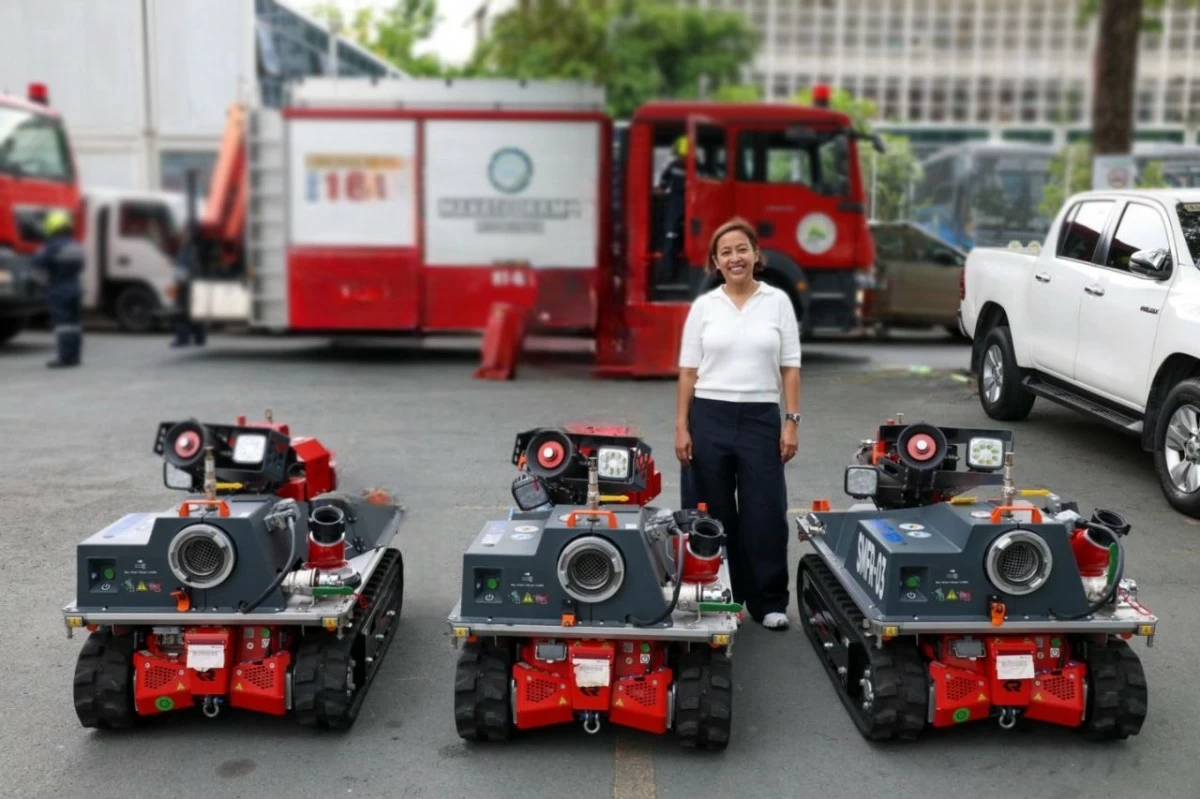
Mayor Abby Binay with the newly purchased Rosenbauer Smart Firefighting Robots.
Makati City Mayor Abby Binay on Monday, June 9, said each Rosenbauer Smart Firefighting Robot is designed to withstand extreme heat, poor visibility, and hazardous environments, and equipped with an acoustic warning device that emits audible signals during operations to alert nearby personnel.
"With a maximum payload capacity of 600 kilograms, the robot can serve as a mobile platform to drag injured responders or trapped civilians out of harm’s way—minimizing the need to send additional personnel into hazardous zones," Binay said.
The robot is also equipped with remote-controlled mobility operated via dual joysticks, which allows for rapid deployment in high-risk scenarios such as commercial fires, confined space rescues, and other complex emergencies.
Its turret can discharge between 1,500 to 3,500 liters of water per minute at 10 bar pressure, with a vertical reach of up to 80 feet.
“We recognize that being a smart city isn’t just about going digital—it’s about using technology to keep people safe and save lives when emergencies happen,” the mayor said.
Under Mayor Abby's administration, the city has continuously modernized its disaster equipment, procuring mobile command and emergency response vehicles and gear.
These include four mobile command vehicles, one advanced mobile emergency communication vehicle, one aerial fire ladder truck, one super tanker, two chemical fire trucks, two rescue trucks, two USAR (Urban Search and Rescue) trailers, 10 rescue boats, two mobile kitchens, 13 basic life support ambulances, three motorcycles, and two mobile clinics.
In 2022, Makati was named the first-ever Resilience Hub in the Philippines and Southeast Asia by the United Nations Office for Disaster Risk Reduction (UNDRR).
The UNDRR defines resilience hubs as cities, municipalities or local authorities that have political and technical commitment to take actions to address disaster and climate risks.
Since 2010, when the city signed up for the Making Cities Resilient Campaign (MCR), Makati has effectively mainstreamed and institutionalized disaster risk reduction in its policies, plans and programs.
Its best practices in DRR have also been shared in a number of international platforms joined by cities all over the region.