






 Philippines
National
LPA may still develop into cyclone; 'habagat' rains to persist in parts of Luzon, Visayas
Philippines
National
LPA may still develop into cyclone; 'habagat' rains to persist in parts of Luzon, Visayas
LPA may still develop into cyclone; 'habagat' rains to persist in parts of Luzon, Visayas


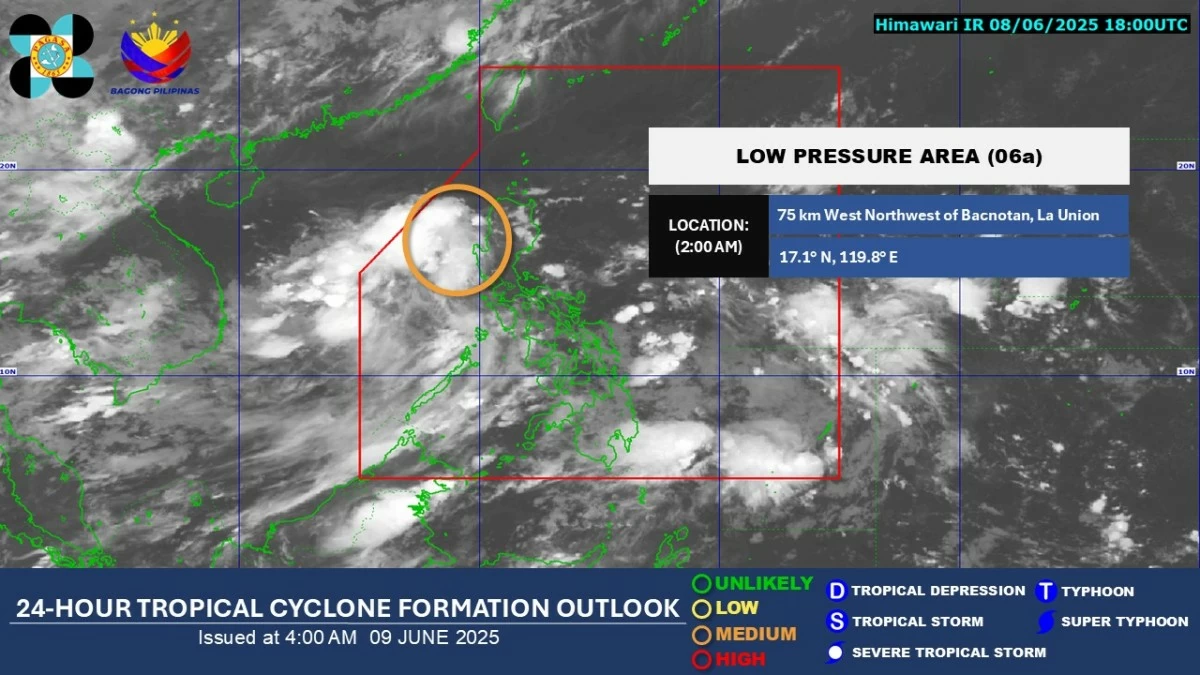
The Low-Pressure Area (LPA) off the coast of La Union still has a chance of developing into a tropical cyclone, while the southwest monsoon (habagat) continues to bring rains over parts of Luzon and Visayas, the Philippine Atmospheric, Geophysical and Astronomical Services Administration (PAGASA) said on Monday, June 9.
As of 3 a.m., the LPA was located 85 kilometers west-northwest of Bacnotan, La Union.
If it strengthens into a tropical depression while still inside the Philippine Area of Responsibility (PAR), it will be named “Auring,” said PAGASA weather specialist Obet Badrina.
The LPA is currently moving westward, away from land, and is expected to exit the PAR within the next few days, he added.
Badrina said no other weather disturbances are being monitored inside or near the PAR as of Monday.
Meanwhile, the southwest monsoon, locally known as “habagat,” continues to bring moderate to heavy rains over parts of Luzon and Visayas, particularly in the western sections.
PAGASA said moderate to heavy rainfall (50 to 100 millimeters) is expected in Pangasinan, Zambales, Bataan, Cavite, Batangas, Occidental Mindoro, Palawan, and Antique throughout Monday.
On Tuesday, June 10, heavy to intense rainfall (100 to 200 millimeters) will likely affect Occidental Mindoro and Zambales, while moderate to heavy rains may persist in Metro Manila, Pangasinan, Bataan, Bulacan, Pampanga, Cavite, Laguna, Batangas, Rizal, Quezon, Oriental Mindoro, Palawan, Romblon, Marinduque, Camarines Sur, Albay, and Antique.
On Wednesday, June 11, heavy to intense rains will persist in Occidental Mindoro and Zambales, while moderate to heavy rainfall is forecast for Metro Manila, Pangasinan, Bataan, Bulacan, Pampanga, Cavite, Laguna, Batangas, Rizal, Quezon, Oriental Mindoro, Palawan, Romblon, Marinduque, Camarines Sur, Albay, and Antique.
PAGASA advised residents, especially in mountainous and elevated areas, to stay alert as heavier rainfall may increase the risk of flooding and landslides.