ADVERTISEMENT

Philippines had advanced maritime culture 35,000 years ago — study

Published Jun 7, 2025 01:56 pm
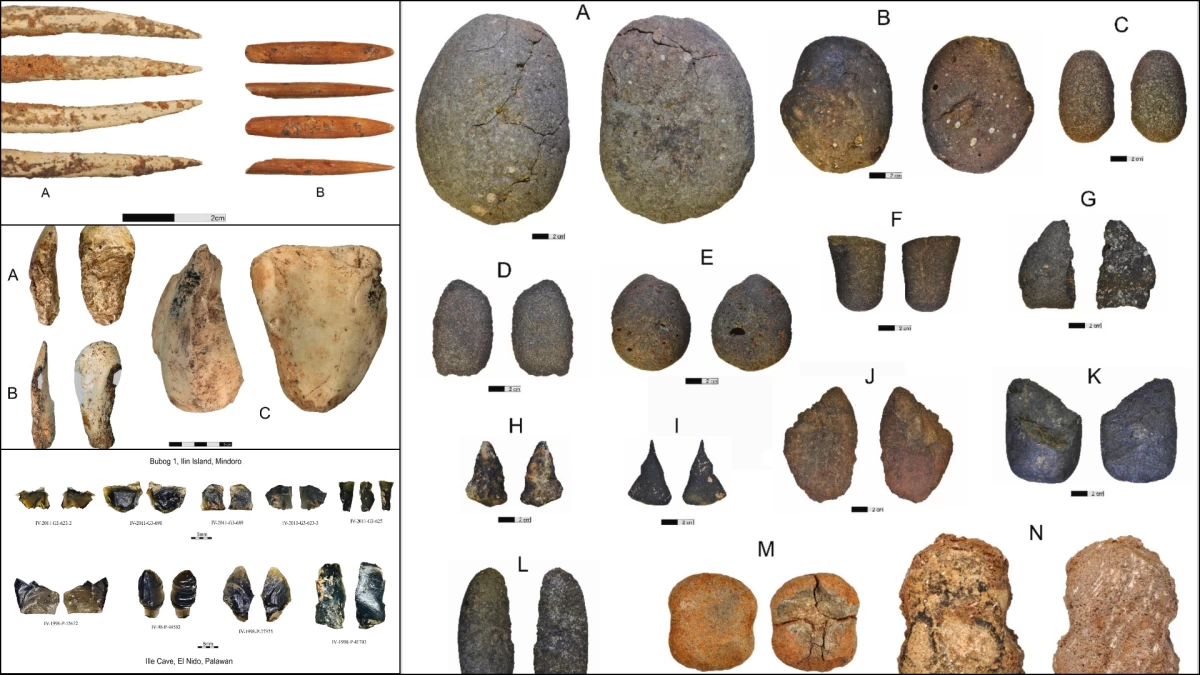
Samples of ancient technology discovered in and around Mindoro. Clockwise, from upper left: a bone fishing gorge (A) and a possible gorge fragment (B); hammer stones (A-F), pebble tools (G-L), and net sinkers (M, N); obsidian cutting tools from Mindoro (top) and Palawan (bottom), exhibiting similar chemical composition; and Tridacna giant clam shell adzes (A,B) and a shell tool (C). (CREDIT: Photos and figures by A. Pawlik; after Pawlik et al. 2025; Pawlik & Piper 2019; Neri et al., 2015)

Groundbreaking archaeological research has found that the Philippine archipelago played a pivotal role in ancient maritime Southeast Asia as early as 35,000 years ago, with strong evidence pointing to advanced technology, seafaring, and intercultural exchange.

In a recently published study, researchers from the Ateneo de Manila University, in collaboration with international scholars, presented findings from the Mindoro Archaeology Project that documented early human presence and innovation in Occidental Mindoro, particularly in Ilin Island, San Jose, and Sta. Teresa, Magsaysay.

Per researchers, Mindoro, unlike Palawan, was never connected to mainland Southeast Asia by land bridges or ice sheets, meaning the sea crossings were always necessary to reach the island, a condition that likely drove the development of sophisticated maritime technologies.

The team uncovered archaeological evidence including human remains, animal bones, and tools made from stone, bone, and shell. 

Such finds suggest that people inhabiting Mindoro more than 30,000 years ago were not only skilled in survival techniques but had already developed seafaring abilities. 

The study noted that these early populations had specific fishing skills enabling them to hunt large, open-sea species like bonito and sharks, and maintain contact with distant populations across the maritime region of Wallacea.

One of the key discoveries involved the manufacture of adzes — woodworking tools — from giant clam shells (Tridacna species). 

The researchers reported that the use of shells as raw material for toolmaking began over 30,000 years ago and became increasingly sophisticated over time. 

It is worth noting that these adzes, dated to between 7,000 and 9,000 years ago, closely resemble those found across Island Southeast Asia and as far as Manus Island in Papua New Guinea, over 3,000 kilometers away.

As such, the team recorded a human grave on Ilin Island, dating to approximately 5,000 years ago. 

The individual, they said, was buried in a fetal position, resting on and covered with limestone slabs. 

Researchers observed that this burial method mirrors flexed burials found throughout Southeast Asia, which they interpreted as evidence of shared ideological beliefs and social complexity across a wide geographical area.

The findings suggest that Mindoro’s early inhabitants were behaviorally and technologically adapted to marine and coastal environments. 

Researchers believe that Mindoro and surrounding islands were part of an extensive prehistoric maritime network that enabled long-distance cultural and technological exchange among early human populations in Island Southeast Asia.

By documenting human habitation over thousands of years, the Mindoro Archaeology Project addresses significant gaps in the prehistoric record of the Philippines. 

The researchers concluded that these results redefine the country’s role in the broader narrative of human migration and adaptation in the region.

The study was authored by Dr. Alfred F. Pawlik, Dr. Riczar B. Fuentes, and Dr. Tanya Uldin of Ateneo de Manila University’s Department of Sociology and Anthropology; Dr. Marie Grace Pamela G. Faylona of the University of the Philippines – Diliman, De La Salle University, and Philippine Normal University; and Trishia Gayle R. Palconit, a PhD student at the University of Ferrara in Italy.

ADVERTISEMENT
.most-popular .layout-ratio{ padding-bottom: 79.13%; } @media (min-width: 768px) and (max-width: 1024px) { .widget-title { font-size: 15px !important; } }

{{ articles_filter_1561_widget.title }}

.most-popular .layout-ratio{ padding-bottom: 79.13%; } @media (min-width: 768px) and (max-width: 1024px) { .widget-title { font-size: 15px !important; } }

{{ articles_filter_1562_widget.title }}

.most-popular .layout-ratio{ padding-bottom: 79.13%; } @media (min-width: 768px) and (max-width: 1024px) { .widget-title { font-size: 15px !important; } }

{{ articles_filter_1563_widget.title }}

{{ articles_filter_1564_widget.title }}

.mb-article-details { position: relative; } .mb-article-details .article-body-preview, .mb-article-details .article-body-summary{ font-size: 17px; line-height: 30px; font-family: "Libre Caslon Text", serif; color: #000; } .mb-article-details .article-body-preview iframe , .mb-article-details .article-body-summary iframe{ width: 100%; margin: auto; } .read-more-background { background: linear-gradient(180deg, color(display-p3 1.000 1.000 1.000 / 0) 13.75%, color(display-p3 1.000 1.000 1.000 / 0.8) 30.79%, color(display-p3 1.000 1.000 1.000) 72.5%); position: absolute; height: 200px; width: 100%; bottom: 0; display: flex; justify-content: center; align-items: center; padding: 0; } .read-more-background a{ color: #000; } .read-more-btn { padding: 17px 45px; font-family: Inter; font-weight: 700; font-size: 18px; line-height: 16px; text-align: center; vertical-align: middle; border: 1px solid black; background-color: white; } .hidden { display: none; }
function initializeAllSwipers() { // Get all hidden inputs with cms_article_id document.querySelectorAll('[id^="cms_article_id_"]').forEach(function (input) { const cmsArticleId = input.value; const articleSelector = '#article-' + cmsArticleId + ' .body_images'; const swiperElement = document.querySelector(articleSelector); if (swiperElement && !swiperElement.classList.contains('swiper-initialized')) { new Swiper(articleSelector, { loop: true, pagination: false, navigation: { nextEl: '#article-' + cmsArticleId + ' .swiper-button-next', prevEl: '#article-' + cmsArticleId + ' .swiper-button-prev', }, }); } }); } setTimeout(initializeAllSwipers, 3000); const intersectionObserver = new IntersectionObserver( (entries) => { entries.forEach((entry) => { if (entry.isIntersecting) { const newUrl = entry.target.getAttribute("data-url"); if (newUrl) { history.pushState(null, null, newUrl); let article = entry.target; // Extract metadata const author = article.querySelector('.author-section').textContent.replace('By', '').trim(); const section = article.querySelector('.section-info ').textContent.replace(' ', ' '); const title = article.querySelector('.article-title h1').textContent; // Parse URL for Chartbeat path format const parsedUrl = new URL(newUrl, window.location.origin); const cleanUrl = parsedUrl.host + parsedUrl.pathname; // Update Chartbeat configuration if (typeof window._sf_async_config !== 'undefined') { window._sf_async_config.path = cleanUrl; window._sf_async_config.sections = section; window._sf_async_config.authors = author; } // Track virtual page view with Chartbeat if (typeof pSUPERFLY !== 'undefined' && typeof pSUPERFLY.virtualPage === 'function') { try { pSUPERFLY.virtualPage({ path: cleanUrl, title: title, sections: section, authors: author }); } catch (error) { console.error('ping error', error); } } // Optional: Update document title if (title && title !== document.title) { document.title = title; } } } }); }, { threshold: 0.1 } ); function showArticleBody(button) { const article = button.closest("article"); const summary = article.querySelector(".article-body-summary"); const body = article.querySelector(".article-body-preview"); const readMoreSection = article.querySelector(".read-more-background"); // Hide summary and read-more section summary.style.display = "none"; readMoreSection.style.display = "none"; // Show the full article body body.classList.remove("hidden"); } document.addEventListener("DOMContentLoaded", () => { let loadCount = 0; // Track how many times articles are loaded const offset = [1, 2, 3, 4, 5, 6, 7, 8, 9, 10]; // Offset values const currentUrl = window.location.pathname.substring(1); let isLoading = false; // Prevent multiple calls if (!currentUrl) { console.log("Current URL is invalid."); return; } const sentinel = document.getElementById("load-more-sentinel"); if (!sentinel) { console.log("Sentinel element not found."); return; } function isSentinelVisible() { const rect = sentinel.getBoundingClientRect(); return ( rect.top < window.innerHeight && rect.bottom >= 0 ); } function onScroll() { if (isLoading) return; if (isSentinelVisible()) { if (loadCount >= offset.length) { console.log("Maximum load attempts reached."); window.removeEventListener("scroll", onScroll); return; } isLoading = true; const currentOffset = offset[loadCount]; window.loadMoreItems().then(() => { let article = document.querySelector('#widget_1690 > div:nth-last-of-type(2) article'); intersectionObserver.observe(article) loadCount++; }).catch(error => { console.error("Error loading more items:", error); }).finally(() => { isLoading = false; }); } } window.addEventListener("scroll", onScroll); });

Sign up by email to receive news.