






To address long-standing issues in the implementation of the Senior High School (SHS) program since its nationwide rollout nearly a decade ago, the Department of Education (DepEd) is set to pilot its strengthened SHS curriculum in 800 schools nationwide for School Year (SY) 2025–2026.
Manila Bulletin
 Philippines
National
DepEd's 2025 revised Senior High School curriculum: What has changed and why?
Philippines
National
DepEd's 2025 revised Senior High School curriculum: What has changed and why?
Philippines
National
DepEd's 2025 revised Senior High School curriculum: What has changed and why?
DepEd's 2025 revised Senior High School curriculum: What has changed and why?
Amid calls for reform, the 'strengthened' SHS curriculum will be piloted in 800 schools in SY 2025–2026
Published Jun 7, 2025 11:50 pm


At A Glance
- As the Philippines recalibrates its SHS program, the Department of Education (DepEd) emphasized that the goal remains clear: to prepare Filipino youth not only for academic success but also for meaningful employment, entrepreneurship, and responsible citizenship in a rapidly evolving world.

Stakeholders from the education, industry, and government sectors will closely monitor the outcomes of the pilot implementation of the Strengthened SHS Curriculum starting in SY 2025–2026. (DepEd file photo)
According to DepEd, the major overhaul of the SHS program will introduce significant changes aimed at better preparing students for higher education and the workforce.
This revision comes amid growing calls for educational reform to address gaps in the current curriculum and to equip learners with more relevant skills and knowledge in an increasingly complex and fast-changing global landscape.
SHS pilot schools
DepEd Secretary Sonny Angara said that starting this June, 800 schools will pilot a streamlined and strengthened SHS curriculum designed to better prepare Filipino learners for higher education, employment, entrepreneurship, and technical careers.
“Hindi maganda ang naging implementation nitong nakaraang dekada (The implementation over the past decade has not been good),” Angara said. “Masyadong marami ang subjects at nakahon masyado ang mga bata [at] hindi sila nakakapili ng subjects (There are too many subjects, and students have been too restricted [and] unable to choose their subjects),” he added.
With classes starting on June 16, Angara said the revised SHS curriculum will be piloted in the selected schools. “So this June, babaguhin na natin in 800 schools na kung saan may pilot implementation ang bagong SHS curriculum (So this June, we will implement changes in 800 schools, where the new Senior High School curriculum will undergo pilot implementation),” he said.
The pilot program aims to give students more flexibility through expanded elective options and a reduction in core subjects—addressing concerns that the current curriculum is overloaded and rigid.
The reforms align with the Strengthened SHS Shaping Paper, a policy framework guiding these updates.
Why the reform?
The SHS program was introduced under the Enhanced Basic Education Act of 2013 (Republic Act 10533), extending basic education to 13 years by adding Grades 11 and 12.
The program’s goals include preparing students for various pathways—higher education, middle-level technical roles, entrepreneurship, and employment.
Despite these intentions, several challenges emerged over the years:
- Curriculum overload: Students faced up to 31 subjects, many of which overlapped or lacked relevance to their career interests.
- Resource gaps: Many schools lacked adequate infrastructure and specialized teachers, especially for technical-vocational tracks.
- Weak industry linkages: A disconnect between education and labor market demands resulted in limited economic benefits for SHS graduates.
- Learning outcomes: National and international assessments showed minimal improvements in student competencies.
A comprehensive curriculum review by the Assessment, Curriculum, and Technology Research Centre (ACTRC) in 2024 recommended streamlining subjects, expanding electives, increasing work immersion hours, and promoting flexibility across learning tracks.
What’s new in the strengthened SHS curriculum?
The revised SHS curriculum focuses on flexibility, relevance, and practical skills:
- Two main tracks: Academic and Technical-Professional (TechPro), replacing the previous four-track system.
- Reduced core subjects: From 15 to 5 interdisciplinary subjects—Effective Communication, General Mathematics, General Science, Life and Career Skills, and Pag-aaral ng Kasaysayan at Lipunang Pilipino.
- Expanded electives: Grouped into clusters that allow students to tailor their learning paths, with options to take subjects across different tracks through a “doorway option.”
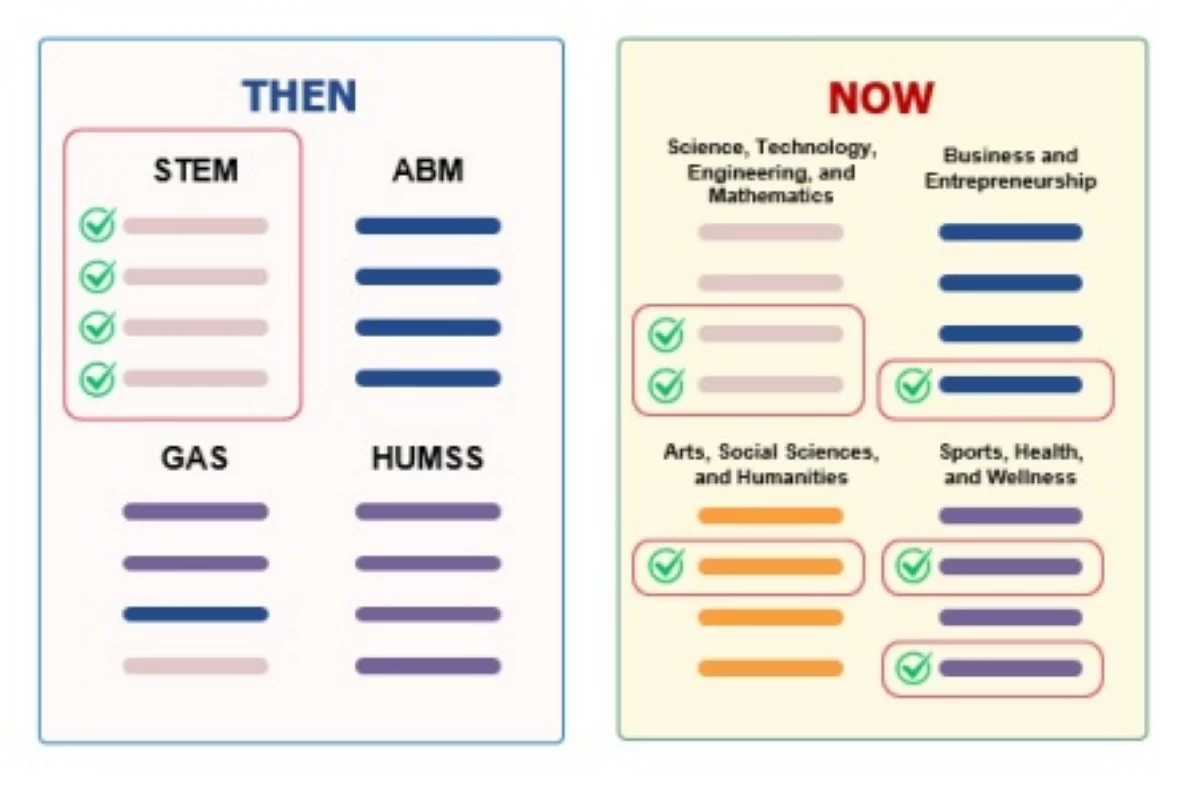
(Courtesy of DepEd / The Strengthened Senior High School Program Shaping Paper)
- Extended work immersion: Increased from 80–320 hours to 320–640 hours to provide more real-world experience and career readiness.
- Streamlined assessment: Aligned with both classroom and national standards, including a proposed standardized exit exam for Alternative Learning System (ALS) learners.
DepEd said these reforms are intended to foster 21st-century skills such as critical thinking, communication, collaboration, creativity, and digital literacy. The updated instructional design emphasizes responsive, relevant, and reflective teaching aligned with global best practices.
National support and future outlook
DepEd said the SHS curriculum reform echoes President Marcos’ call for an education system that promotes critical thinking and future-readiness.
DepEd’s Senior High School National Task Force (NTF) has also released recommendations, including stronger partnerships with technical education agencies like TESDA and an enhanced work immersion program.
While pilot implementation begins this June, Angara noted that the future of the SHS program ultimately depends on lawmakers.
“Ang desisyon kung ipagpapatuloy ang SHS o hindi ay Kongreso lamang po ang makakapagsabi at makakapagpasya (The decision on whether to continue Senior High School or not rests solely with Congress),” he added.