






 Business
The Economy
Offshore wind port plans hit snags: Budget woes, unstable ground delay studies
Business
The Economy
Offshore wind port plans hit snags: Budget woes, unstable ground delay studies
Offshore wind port plans hit snags: Budget woes, unstable ground delay studies


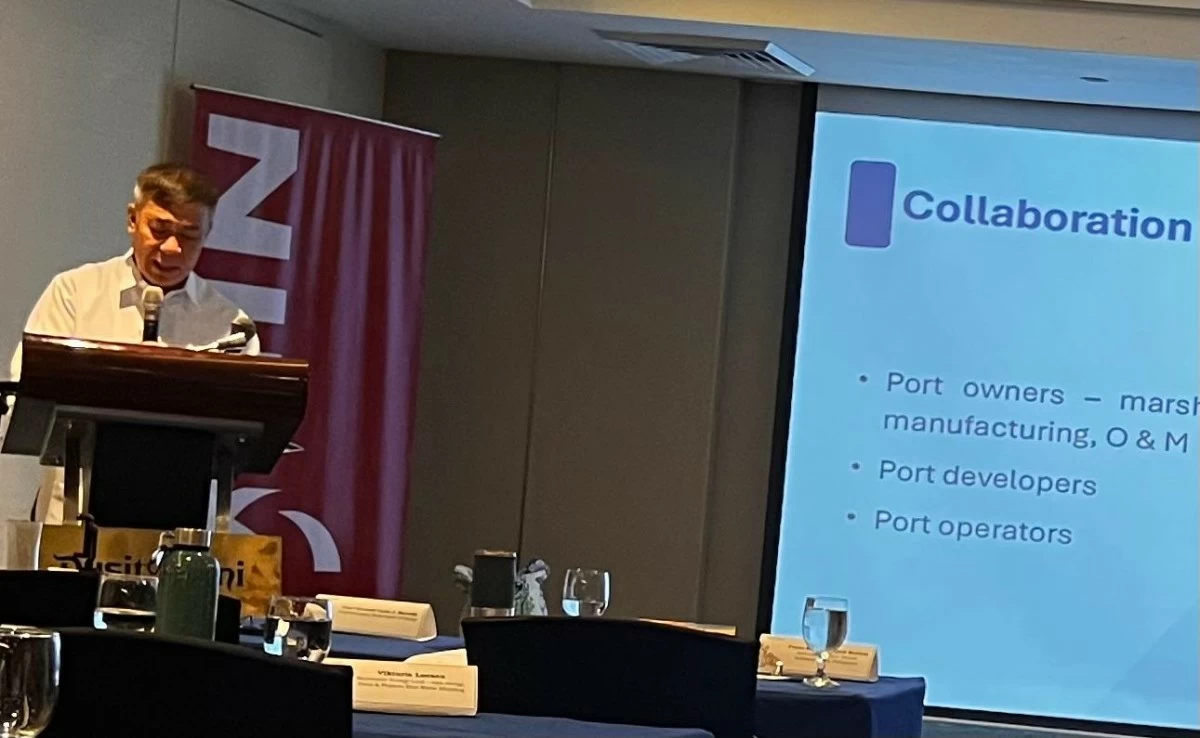
The ongoing study of the Philippine Ports Authority (PPA) on at least three regional port facilities that will serve as support infrastructure to the emerging offshore wind industry in the power sector had hit chokepoints, including budget constraints for two of them; while the plug had been pulled on the other one due to shaky geotechnical foundation.
The update on the ports study was directly shared with relevant industry stakeholders by Energy Undersecretary Giovanni Carlo J. Bacordo in this year’s Wind Energy Forum, convened by the Global Wind Energy Council (GWEC), Danish engineering firm NIRAS, as well as other partners.
In particular, the energy official disclosed that “in Camarines Norte, the original site identified in Jose Panganiban was dropped due to poor soil conditions that rendered it unsuitable for offshore wind-related infrastructure.”
Following the preliminary outcome of the PPA study, he specified that the focus had shifted to another targeted site in Pambuhan, located in the town of Mercedes in the province, with the hope that the planned port support facility in that area could be established on solid and stable load-bearing ground.
For the port of Currimao in Ilocos Norte, Bacordo emphasized that the proposed port re-purposing is “currently awaiting a revised development proposal,” as he noted that “the initial plan exceeded the available budget.”
He further qualified that “adjustments are being made to align the scope with funding constraints.”
Meanwhile, for the other prospective offshore wind port in Batangas, the DOE official likewise stated that “the proposed redevelopment exceeded the initial budget allocation.”
Bacordo expounded that “a scaled-down version has been requested to ensure implementation within the approved funding.”
Beyond that, he conveyed that “a feasibility study is ongoing to assess (Batangas) port’s potential as a long-term offshore wind hub” – and the game plan is to concretize that via a public-private partnership (PPP) model.
Despite the roadblocks confronting the port studies, the energy official assured that the Department of Transportation (DOTr), as a parent agency of the PPA, “is reaffirming its support for offshore wind development,” and that comes with the enabling support of the Asian Development Bank’s (ADB’s) Infrastructure Preparation and Innovation Facility.
Bacordo further divulged that through DOE’s collaboration with the transportation department, two ports will likewise be developed to underpin the advancement of offshore investments in the country – and these are the targeted installations in Southern Mindoro and another one in Negros Oriental.
On the timeline of the targeted retrofit for the ports, he highlighted that at least three PPA ports shall be ready by 2027; and the two DOTr ports must be ramped up commercially by 2030 – and these shall be synchronized for a solid two-year use by offshore wind developers during the construction phase of their projects.
He underscored, though, that these port installations are still at ‘indicative phases’; entailing then that plans could still change depending on the technical feasibility as well as fiscal soundness of the proposed facilities.
“We need the private port owners, port developers, and port operators to help the government in the realization of our OSW projections,” Bacordo stressed.
He similarly pointed out that to solidify the implementation of the targeted facilities, “we need to expand partnerships. We need private port owners and manufacturers to explore synergies with the government and OSW developers to create a vibrant investment ecosystem.”