ADVERTISEMENT

Milky Way's chance of colliding with galaxy billions of years from now? New study puts odds at 50-50

Published Jun 3, 2025 11:24 am
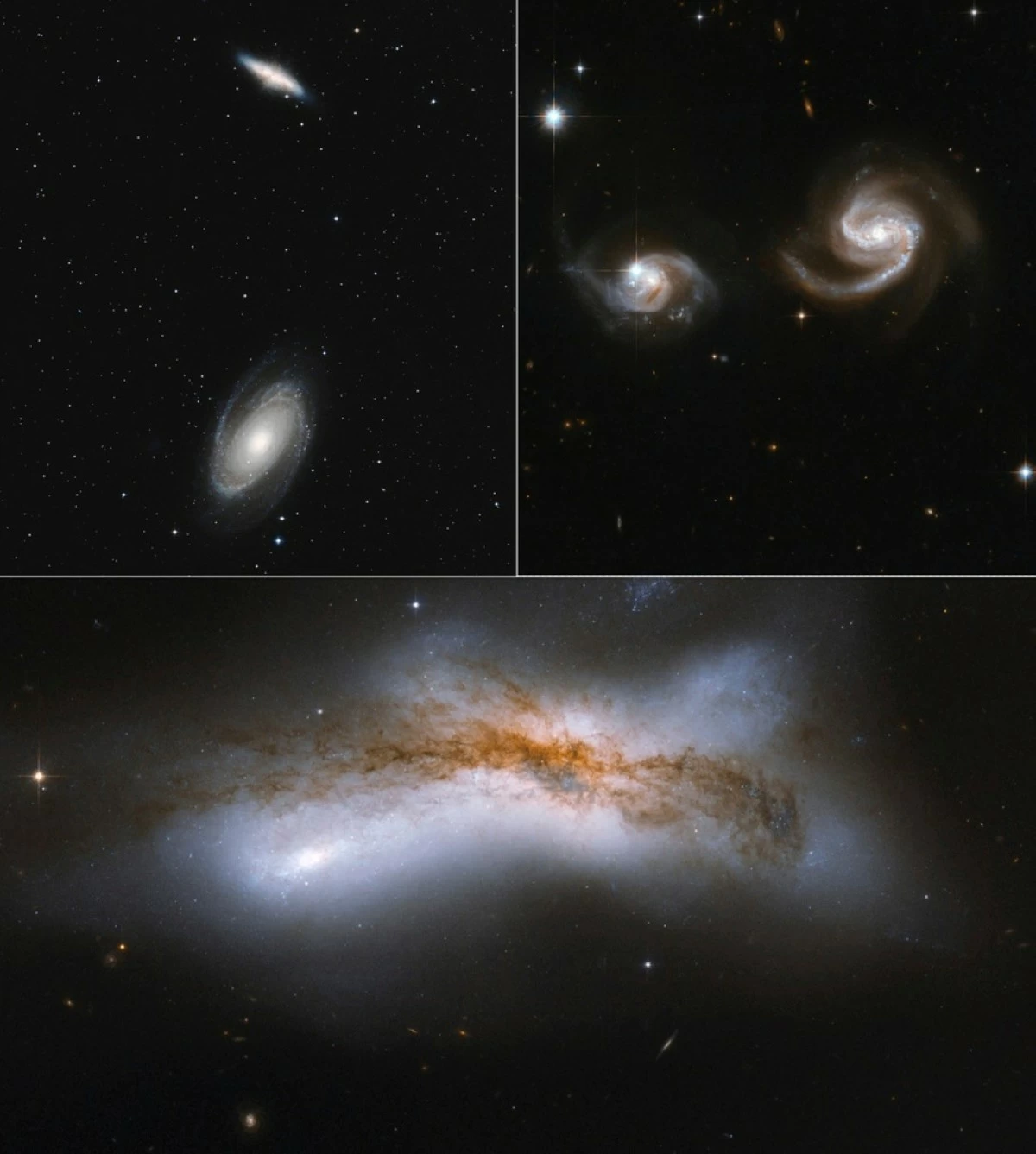
In this combination of images from NASA/ESA shows three future scenarios for Milky Way & Andromeda encounter. Top left: Galaxies bypass at 1 million light-year separation. Top right: At 500,000 light-years, dark matter provides friction that brings galaxies to a close encounter. Bottom: A 100,000 light-year separation leads to a collision. (NASA/ESA via AP)

CAPE CANAVERAL, Fla. (AP) — It turns out that looming collision between our Milky Way and Andromeda galaxies might not happen after all.

Astronomers reported Monday that the probability of the two spiral galaxies colliding is less than previously thought, with a 50-50 chance within the next 10 billion years. That’s essentially a coin flip, but still better odds than previous estimates and farther out in time.

“As it stands, proclamations of the impending demise of our galaxy seem greatly exaggerated,” the Finnish-led team wrote in a study appearing in Nature Astronomy.

While good news for the Milky Way galaxy, the latest forecast may be moot for humanity.

“We likely won’t live to see the benefit," lead author Till Sawala of the University of Helsinki said in an email.

Already more than 4.5 billion years old, the sun is on course to run out of energy and die in another 5 billion years or so, but not before becoming so big it will engulf Mercury, Venus and possibly Earth. Even if it doesn’t swallow Earth, the home planet will be left a burnt ball, its oceans long since boiled away.

Sawala’s international team relied on the latest observations by NASA’s Hubble Space Telescope and the European Space Agency’s Gaia star-surveying spacecraft to simulate the possible scenarios facing the Milky Way and next-door neighbor Andromeda. Both already collided with other galaxies in their ancient past and, according to many, seemed destined for a head-on crash.

Past theories put a collision between the two — resulting in a new elliptical galaxy dubbed Milkomeda — as probable if not inevitable. Some predictions had that happening within 5 billion years, if not sooner.

For this new study, the scientists relied on updated galaxy measurements to factor in the gravitational pull on the Milky Way's movement through the universe. They found that the effects of the neighboring Triangulum galaxy increased the likelihood of a merger between the Milky Way and Andromeda, while the Large Magellanic Cloud decreased those chances.

Despite lingering uncertainty over the position, motion and mass of all these galaxies, the scientists ended up with 50-50 odds of a collision within the next 10 billion years.

“The fate of our Milky Way galaxy is a subject of broad interest — not just to astronomers,” said Raja GuhaThakurta of the University of California, Santa Cruz, who was not involved in the study,

A full-on collision, he noted, would transform our home galaxy from a disk of stars seen as a milky band of diffuse light across the sky into a milky blob. A harmless flyby of the two galaxies could leave this stellar disk largely undisturbed, thus preserving our galaxy's name.

More work is needed before the Milky Way’s fate can be predicted with accuracy, according to the researchers. Further insight should help scientists better understand what's happening among galaxies even deeper in the cosmos.

While our galaxy’s fate remains highly uncertain, the sun’s future is “pretty much sealed," according to Sawala. “Of course, there is also a very significant chance that humanity will bring an end to itself still much before that, without any need for astrophysical help."

Related Tags

World news
ADVERTISEMENT
.most-popular .layout-ratio{ padding-bottom: 79.13%; } @media (min-width: 768px) and (max-width: 1024px) { .widget-title { font-size: 15px !important; } }

{{ articles_filter_1561_widget.title }}

.most-popular .layout-ratio{ padding-bottom: 79.13%; } @media (min-width: 768px) and (max-width: 1024px) { .widget-title { font-size: 15px !important; } }

{{ articles_filter_1562_widget.title }}

.most-popular .layout-ratio{ padding-bottom: 79.13%; } @media (min-width: 768px) and (max-width: 1024px) { .widget-title { font-size: 15px !important; } }

{{ articles_filter_1563_widget.title }}

{{ articles_filter_1564_widget.title }}

.mb-article-details { position: relative; } .mb-article-details .article-body-preview, .mb-article-details .article-body-summary{ font-size: 17px; line-height: 30px; font-family: "Libre Caslon Text", serif; color: #000; } .mb-article-details .article-body-preview iframe , .mb-article-details .article-body-summary iframe{ width: 100%; margin: auto; } .read-more-background { background: linear-gradient(180deg, color(display-p3 1.000 1.000 1.000 / 0) 13.75%, color(display-p3 1.000 1.000 1.000 / 0.8) 30.79%, color(display-p3 1.000 1.000 1.000) 72.5%); position: absolute; height: 200px; width: 100%; bottom: 0; display: flex; justify-content: center; align-items: center; padding: 0; } .read-more-background a{ color: #000; } .read-more-btn { padding: 17px 45px; font-family: Inter; font-weight: 700; font-size: 18px; line-height: 16px; text-align: center; vertical-align: middle; border: 1px solid black; background-color: white; } .hidden { display: none; }
function initializeAllSwipers() { // Get all hidden inputs with cms_article_id document.querySelectorAll('[id^="cms_article_id_"]').forEach(function (input) { const cmsArticleId = input.value; const articleSelector = '#article-' + cmsArticleId + ' .body_images'; const swiperElement = document.querySelector(articleSelector); if (swiperElement && !swiperElement.classList.contains('swiper-initialized')) { new Swiper(articleSelector, { loop: true, pagination: false, navigation: { nextEl: '#article-' + cmsArticleId + ' .swiper-button-next', prevEl: '#article-' + cmsArticleId + ' .swiper-button-prev', }, }); } }); } setTimeout(initializeAllSwipers, 3000); const intersectionObserver = new IntersectionObserver( (entries) => { entries.forEach((entry) => { if (entry.isIntersecting) { const newUrl = entry.target.getAttribute("data-url"); if (newUrl) { history.pushState(null, null, newUrl); let article = entry.target; // Extract metadata const author = article.querySelector('.author-section').textContent.replace('By', '').trim(); const section = article.querySelector('.section-info ').textContent.replace(' ', ' '); const title = article.querySelector('.article-title h1').textContent; // Parse URL for Chartbeat path format const parsedUrl = new URL(newUrl, window.location.origin); const cleanUrl = parsedUrl.host + parsedUrl.pathname; // Update Chartbeat configuration if (typeof window._sf_async_config !== 'undefined') { window._sf_async_config.path = cleanUrl; window._sf_async_config.sections = section; window._sf_async_config.authors = author; } // Track virtual page view with Chartbeat if (typeof pSUPERFLY !== 'undefined' && typeof pSUPERFLY.virtualPage === 'function') { try { pSUPERFLY.virtualPage({ path: cleanUrl, title: title, sections: section, authors: author }); } catch (error) { console.error('ping error', error); } } // Optional: Update document title if (title && title !== document.title) { document.title = title; } } } }); }, { threshold: 0.1 } ); function showArticleBody(button) { const article = button.closest("article"); const summary = article.querySelector(".article-body-summary"); const body = article.querySelector(".article-body-preview"); const readMoreSection = article.querySelector(".read-more-background"); // Hide summary and read-more section summary.style.display = "none"; readMoreSection.style.display = "none"; // Show the full article body body.classList.remove("hidden"); } document.addEventListener("DOMContentLoaded", () => { let loadCount = 0; // Track how many times articles are loaded const offset = [1, 2, 3, 4, 5, 6, 7, 8, 9, 10]; // Offset values const currentUrl = window.location.pathname.substring(1); let isLoading = false; // Prevent multiple calls if (!currentUrl) { console.log("Current URL is invalid."); return; } const sentinel = document.getElementById("load-more-sentinel"); if (!sentinel) { console.log("Sentinel element not found."); return; } function isSentinelVisible() { const rect = sentinel.getBoundingClientRect(); return ( rect.top < window.innerHeight && rect.bottom >= 0 ); } function onScroll() { if (isLoading) return; if (isSentinelVisible()) { if (loadCount >= offset.length) { console.log("Maximum load attempts reached."); window.removeEventListener("scroll", onScroll); return; } isLoading = true; const currentOffset = offset[loadCount]; window.loadMoreItems().then(() => { let article = document.querySelector('#widget_1690 > div:nth-last-of-type(2) article'); intersectionObserver.observe(article) loadCount++; }).catch(error => { console.error("Error loading more items:", error); }).finally(() => { isLoading = false; }); } } window.addEventListener("scroll", onScroll); });

Sign up by email to receive news.