ADVERTISEMENT

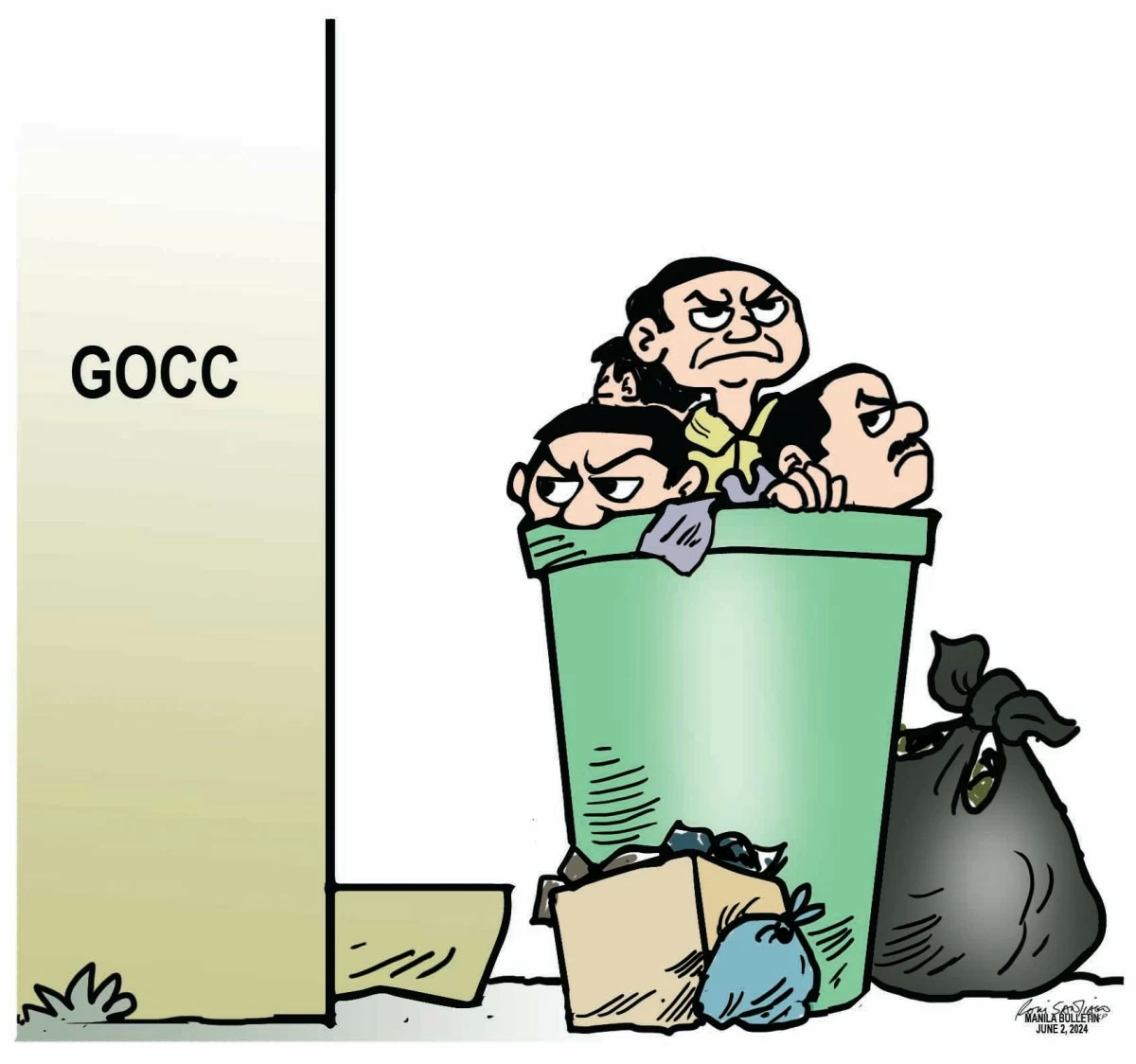
Resetting governance: PBBM's call for courtesy resignations in GOCCs

Published Jun 2, 2025 12:05 am  |  Updated Jun 1, 2025 03:42 pm
President Ferdinand R. Marcos Jr.’s recent directive for 158 heads of government-owned and -controlled corporations (GOCCs) to submit courtesy resignations is a bold move that signals a potential recalibration of public sector governance. Far from being a mere administrative reshuffle, this sweeping order invites national reflection on the purpose, performance, and public accountability of state-run enterprises.
GOCCs play a critical role in Philippine governance and economic life. They manage vital public assets and services—from utilities and infrastructure to finance, healthcare, and agriculture. Given their broad mandate and significant financial resources, they are meant to serve as extensions of the state’s development agenda. This is precisely why their governance must be beyond reproach.
The significance of this sector was firmly established with the passage of Republic Act No. 10149 in 2011, which created the Governance Commission for GOCCs (GCG). The GCG was envisioned to instill coherence, efficiency, and professionalism across more than 100 government corporations. It introduced a performance evaluation system, rationalized board compensation, and required transparency in corporate operations. For the first time in decades, there was a central body empowered to oversee, assess, and if necessary, recommend the abolition or merger of underperforming or redundant entities.
Before this reform, the GOCC ecosystem had been tainted by its role in propping up crony capitalism during the martial law era. Numerous corporations were created or co-opted to serve the interests of a few, rather than the public good. After the 1986 People Power Revolution, the Presidential Commission on Good Government (PCGG) investigated and sequestered dozens of such entities, uncovering patterns of misuse and personal enrichment at the expense of the Filipino people.
Since the GCG’s inception, significant strides have been made. Annual dividend remittances to the national treasury have grown, with GOCCs contributing over ₱500 billion since 2011. Greater scrutiny and professional standards have improved operational transparency. Some GOCCs have earned ISO certifications, while others have aligned themselves with national goals such as universal healthcare, food security, and infrastructure development.
Yet challenges remain. Political appointments still dominate key GOCC positions, sometimes at the expense of merit and expertise. Performance metrics, though improved, are not uniformly applied or enforced. And while some GOCCs are models of good governance, others struggle with inefficiency, redundancy, or corruption allegations.
The President’s call for courtesy resignations must be seen in this light—not as a purge, but as an opportunity to reassert the principle that public office is a public trust. It opens the door to recalibrating leadership with individuals who embody competence, integrity, and a clear grasp of strategic public service.
Looking ahead, beyond possible new appointments, several pathways deserve focus. First, the GCG must be further strengthened—not only in oversight capacity, but also in institutional independence. Second, recruitment and retention policies for GOCC leadership must prioritize technical expertise and insulate appointments from undue political interference. Finally, public reporting mechanisms must be enhanced to ensure that the Filipino people—on whose behalf these corporations exist—remain informed and empowered to hold them accountable.
This moment presents a rare chance to reaffirm the principles of accountability and effectiveness in state enterprise. If seized with transparency and foresight, it could set a lasting example for reforming public institutions in the service of the common good.
ADVERTISEMENT
.most-popular .layout-ratio{ padding-bottom: 79.13%; } @media (min-width: 768px) and (max-width: 1024px) { .widget-title { font-size: 15px !important; } }

{{ articles_filter_1561_widget.title }}

.most-popular .layout-ratio{ padding-bottom: 79.13%; } @media (min-width: 768px) and (max-width: 1024px) { .widget-title { font-size: 15px !important; } }

{{ articles_filter_1562_widget.title }}

.most-popular .layout-ratio{ padding-bottom: 79.13%; } @media (min-width: 768px) and (max-width: 1024px) { .widget-title { font-size: 15px !important; } }

{{ articles_filter_1563_widget.title }}

{{ articles_filter_1564_widget.title }}

.mb-article-details { position: relative; } .mb-article-details .article-body-preview, .mb-article-details .article-body-summary{ font-size: 17px; line-height: 30px; font-family: "Libre Caslon Text", serif; color: #000; } .mb-article-details .article-body-preview iframe , .mb-article-details .article-body-summary iframe{ width: 100%; margin: auto; } .read-more-background { background: linear-gradient(180deg, color(display-p3 1.000 1.000 1.000 / 0) 13.75%, color(display-p3 1.000 1.000 1.000 / 0.8) 30.79%, color(display-p3 1.000 1.000 1.000) 72.5%); position: absolute; height: 200px; width: 100%; bottom: 0; display: flex; justify-content: center; align-items: center; padding: 0; } .read-more-background a{ color: #000; } .read-more-btn { padding: 17px 45px; font-family: Inter; font-weight: 700; font-size: 18px; line-height: 16px; text-align: center; vertical-align: middle; border: 1px solid black; background-color: white; } .hidden { display: none; }
function initializeAllSwipers() { // Get all hidden inputs with cms_article_id document.querySelectorAll('[id^="cms_article_id_"]').forEach(function (input) { const cmsArticleId = input.value; const articleSelector = '#article-' + cmsArticleId + ' .body_images'; const swiperElement = document.querySelector(articleSelector); if (swiperElement && !swiperElement.classList.contains('swiper-initialized')) { new Swiper(articleSelector, { loop: true, pagination: false, navigation: { nextEl: '#article-' + cmsArticleId + ' .swiper-button-next', prevEl: '#article-' + cmsArticleId + ' .swiper-button-prev', }, }); } }); } setTimeout(initializeAllSwipers, 3000); const intersectionObserver = new IntersectionObserver( (entries) => { entries.forEach((entry) => { if (entry.isIntersecting) { const newUrl = entry.target.getAttribute("data-url"); if (newUrl) { history.pushState(null, null, newUrl); let article = entry.target; // Extract metadata const author = article.querySelector('.author-section').textContent.replace('By', '').trim(); const section = article.querySelector('.section-info ').textContent.replace(' ', ' '); const title = article.querySelector('.article-title h1').textContent; // Parse URL for Chartbeat path format const parsedUrl = new URL(newUrl, window.location.origin); const cleanUrl = parsedUrl.host + parsedUrl.pathname; // Update Chartbeat configuration if (typeof window._sf_async_config !== 'undefined') { window._sf_async_config.path = cleanUrl; window._sf_async_config.sections = section; window._sf_async_config.authors = author; } // Track virtual page view with Chartbeat if (typeof pSUPERFLY !== 'undefined' && typeof pSUPERFLY.virtualPage === 'function') { try { pSUPERFLY.virtualPage({ path: cleanUrl, title: title, sections: section, authors: author }); } catch (error) { console.error('ping error', error); } } // Optional: Update document title if (title && title !== document.title) { document.title = title; } } } }); }, { threshold: 0.1 } ); function showArticleBody(button) { const article = button.closest("article"); const summary = article.querySelector(".article-body-summary"); const body = article.querySelector(".article-body-preview"); const readMoreSection = article.querySelector(".read-more-background"); // Hide summary and read-more section summary.style.display = "none"; readMoreSection.style.display = "none"; // Show the full article body body.classList.remove("hidden"); } document.addEventListener("DOMContentLoaded", () => { let loadCount = 0; // Track how many times articles are loaded const offset = [1, 2, 3, 4, 5, 6, 7, 8, 9, 10]; // Offset values const currentUrl = window.location.pathname.substring(1); let isLoading = false; // Prevent multiple calls if (!currentUrl) { console.log("Current URL is invalid."); return; } const sentinel = document.getElementById("load-more-sentinel"); if (!sentinel) { console.log("Sentinel element not found."); return; } function isSentinelVisible() { const rect = sentinel.getBoundingClientRect(); return ( rect.top < window.innerHeight && rect.bottom >= 0 ); } function onScroll() { if (isLoading) return; if (isSentinelVisible()) { if (loadCount >= offset.length) { console.log("Maximum load attempts reached."); window.removeEventListener("scroll", onScroll); return; } isLoading = true; const currentOffset = offset[loadCount]; window.loadMoreItems().then(() => { let article = document.querySelector('#widget_1690 > div:nth-last-of-type(2) article'); intersectionObserver.observe(article) loadCount++; }).catch(error => { console.error("Error loading more items:", error); }).finally(() => { isLoading = false; }); } } window.addEventListener("scroll", onScroll); });

Sign up by email to receive news.