







The Philippines and the European Union (EU) announced on Monday, June 2, the creation of the new EU-Philippine Security and Defense Dialogue, which will deepen cooperation on security matters both in the regional and global spheres.
PH, EU agree to establish security, defense dialogue
Published Jun 2, 2025 03:03 pm


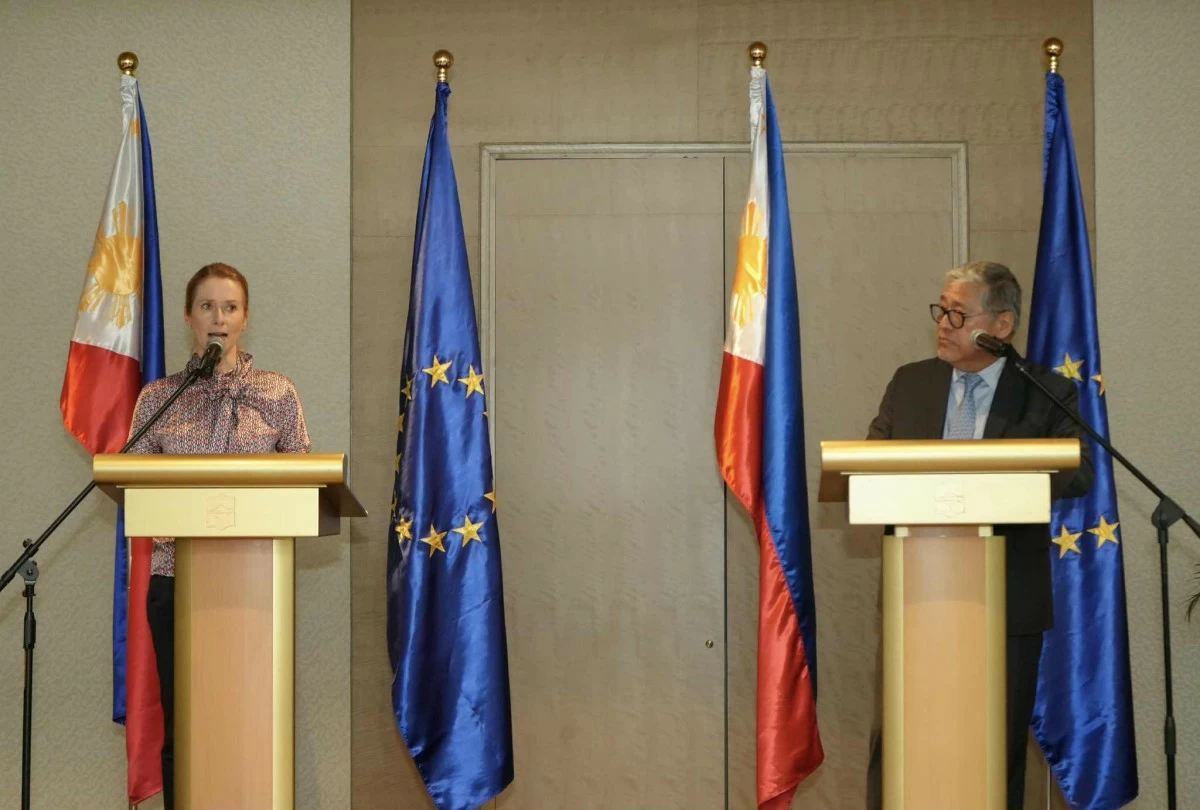
DFA Secretary Enrique Manalo and High Representative for Foreign Affairs and Security Policy and Vice President of the European Commission Kaja Kallas speak to the media during a joint press conference on Monday, June 2, 2025. (Royce Vann Paul Pantua/DFA-OPD)
The announcement was made during a joint press conference after a bilateral meeting between Department of Foreign Affairs (DFA) Secretary Enrique Manalo and High Representative for Foreign Affairs and Security Policy and Vice President of the European Commission (HRVP) Kaja Kallas, who was in the country from June 1 to 2 to discuss ways to strengthen the relationship between the two parties.
“Today, our relationship reaches another significant milestone with our decision to create a Security and Defense Dialogue. This Dialogue will provide a mechanism for the PH and the EU to discuss security- and defense-related issues with both depth and regularity,” Manalo said.
He added that Kallas’ visit to the country “is another testament” of EU’s and the Philippines “enduring friendship” that was strengthened “by our shared commitment to democracy, good governance, the rule of law, human rights, and sustainable development.”
The new security and defense collaboration will be grounded on existing partnerships and agreements, such as the Subcommittee on Maritime Cooperation under the Philippines-EU Partnership and Cooperation Agreement.
For her part, Kallas described the dialogue as “a dedicated platform through which we can deepen our cooperation, exchange expertise on security and defense, and explore joint initiatives that contribute to the regional, as well as global, security.”
“Our work will be comprehensive and will include maritime security, cybersecurity, foreign information manipulation and interference, counterterrorism, crisis response, and more,” she added.
FTA negotiations
Aside from the introduction of the new security and defense dialogue, Manalo also underlined the need to conclude the negotiations for the Philippine-EU Free Trade Agreement (FTA) to further deepen the economic ties and collaboration through trade and investment.
“Noting the firm commitment of both sides in advancing negotiations, I expressed the Philippines’ hope for the continued support of the EU and its Member States toward the early conclusion of negotiations of a comprehensive, balanced, and modern FTA,” he added.
Since the relationship between the Philippines and EU goes beyond security and defense, Kallas said that both sides “will move forward with the next rounds of negotiations” of the FTA.
Further economic cooperation with the Philippines is also being built based on digital connectivity, people-to-people contacts, and a green economy, the EU official stressed, highlighting the importance of multilateralism and the role of the Association of Southeast Asian Nations (ASEAN).
“We look forward to working closely with the Philippines as you are the chair of ASEAN in 2026,” she said.
Rules-based int’l order
While the two officials made no mention of China’s current aggressive actions in the contested waters of the South China Sea, both recognized the primacy of a rules-based international order in maintaining peace and stability.
“First of all, we share a commitment to upholding the rules-based international order, to promoting peace and stability, and to addressing common challenges together. These include the developments in the South China Sea and Russia's illegal war of aggression in Ukraine,” Kallas said.
Manalo shared that both sides “reaffirmed our steadfast commitment” to the United Nations Charter, as well as the 2016 Arbitral Award, for “non-aggression, sovereign equality, and the territorial integrity of all nations.”
These principles, he added, shape the Philippines’ “consistent positions” on key global and regional issues, including the South China Sea dispute and Russia’s invasion of Ukraine.
“We thank the EU and its Member States for their clear and principled statements of support regarding recent incidents in the South China Sea,” he said.
“Though today’s geopolitical uncertainties may be challenging, the enduring strength of Philippines–EU relations provides a solid foundation for us to pursue shared goals and develop forward-looking solutions,” the DFA chief added.