








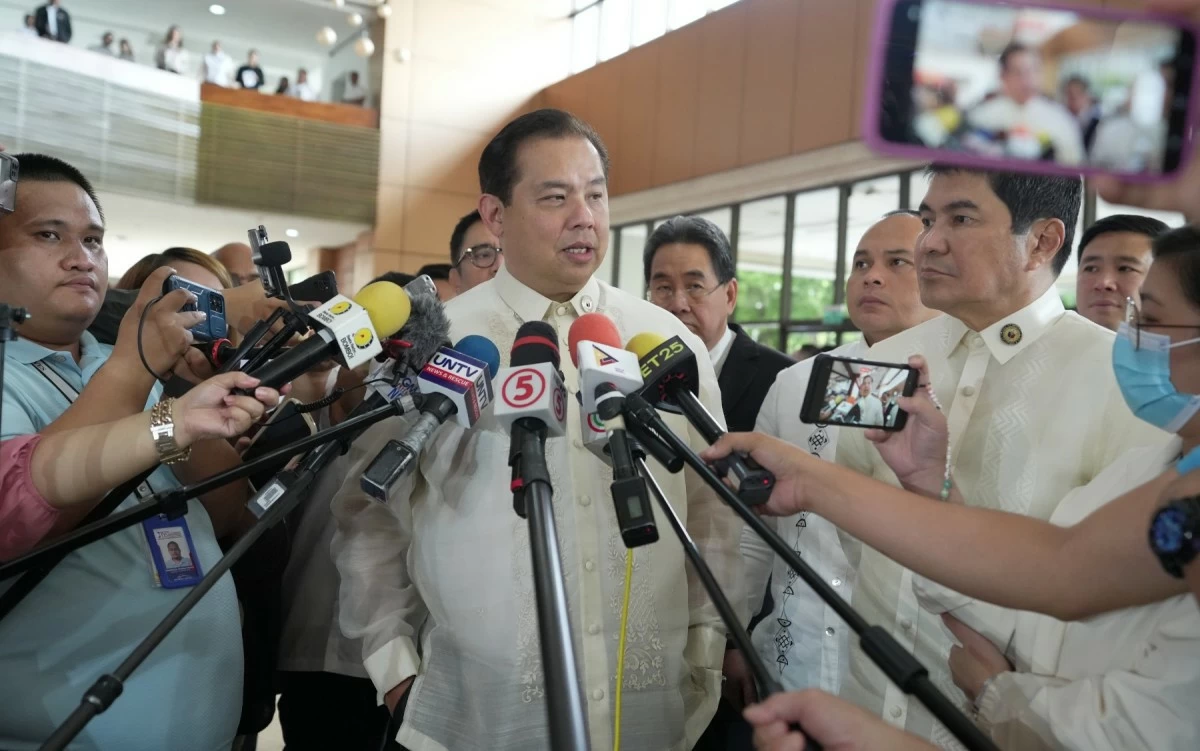
House Speaker Martin Romualdez has expressed optimism with the potential institutionalization of the Marcos administration’s P20-per-kilo rice program.
“Kung kaya sa ilang lugar, dapat kayanin sa buong bansa (If its doable is select areas, then it should be done in the entire country)," Romualdez, Leyte's 1st district representative, said in a statement Sunday, June 1.
"President Marcos has set an aspiration that resonates with every Filipino family. It’s now our job in Congress to back that up with data, strategy, and decisive legislation,” Romualdez said.
In this regard, the Speaker directed the House of Representatives’ policy and budget experts to immediately conduct a comprehensive study on the feasibility of making the P20-per-kilo rice program a national policy.
It can be recalled that Marcos made it his campaign promise back in 2022 to reduce prices of rice--the Filipino staple food--to P20. The promise came to fruition this year in certain locations.
“The House of Representatives is fully committed to working with Malacañang, the DA (Department of Agriculture), DSWD (Department of Social Welfare and Development), DBM (Department of Budget and Management), and local government units to make P20 rice not only possible—but permanent,” Romualdez said.
He said the study by the Congressional Policy and Budget Research Department (CPBRD) led by House Deputy Secretary General Dr. Romulo Emmanuel M. Miral Jr. would examine the policy, fiscal, and legislative pathways needed to make the President’s campaign promise a sustainable reality for Filipino households.
The leader of the 306-member legislative chamber emphasized that the CPBRD report, due within 60 days, will guide the House during budget hearings and committee deliberations.
The Speaker says that Congress shares the President’s aspiration. “Ang pangarap ni Pangulong Marcos ay pangarap rin ng Kongreso—isang hapag-kainan na may sapat, abot-kaya, at de-kalidad na bigas para sa bawat Pilipino."
(President Marcos' dream is also the dream of Congress—a dining table with sufficient, affordable, and high-quality rice for every Filipino.)
Initial estimates show that subsidizing rice at P20 per kilo for the country’s poor and near-poor population—about 44 million Filipinos consuming 20 million kilos daily—would require a subsidy of P7 per kilo.
That translates to P140 million per day or roughly P51.1 billion annually. To ensure fiscal sustainability, Speaker Romualdez proposed a four-year phase-in plan.
In 2025, the program would cover only the bottom 20 percent of the population, requiring about P17 billion. In 2026, it would expand to the bottom 35 percent, costing P30 billion.
By 2027, it would reach the bottom 50 percent, with the full P51-billion requirement. The 2028 phase would focus on optimizing the system and integrating the program with food stamp and buffer stocking initiatives.
Romualdez emphasized that while current initiatives like the Kadiwa stores offer some relief, the effort must go beyond subsidies to address deeper structural issues in the rice supply chain.
He cited systemic challenges identified by President Marcos, including widespread smuggling and hoarding, dependence on rice imports, and inadequate support for local farmers.
“This study will not be limited to subsidy calculations. We need to overhaul the entire system—from seed to store shelf,” he said.
Bridging the gap
The House chief pointed to data from the Philippine Statistics Authority (PSA) showing that from January to March 2025, the average farmgate price for palay was P19.54 per kilo, while retail rice sold for P53.85 per kilo—a disparity of more than P32.
Bridging this gap, he said, would require increased government procurement directly from farmer cooperatives, improved post-harvest infrastructure, stronger price stabilization mechanisms under the National Food Authority (NFA), and strict enforcement of the Anti-Agricultural Economic Sabotage Act.
Romualdez also confirmed that the House will prioritize legislative measures to institutionalize affordable rice.
These include the creation of a Rice Assistance Fund to consolidate rice-related subsidies across agencies such as the DA and DSWD, the passage of a National Rice Buffer Stocking Act with clear procurement and importation protocols, the expansion of the Rice Competitiveness Enhancement Fund to support mechanization and drying facilities, and the establishment of a Logistics and Market Stabilization Fund to address transport, warehousing, and emergency supply disruptions.
“Food security is not just the job of the farmer. It is a responsibility that involves every part of government and society,” said the Lakas-Christian Muslim Democrats (Lakas-CMD) president.