






President Marcos said Chinese Premier Li Qiang shared the same concern over the economic risks posed by the United States’ unilateral tariff regimes, saying they do not want it to carry on.
Manila Bulletin
 Philippines
National
Marcos, China's Li share sentiments over US tariff hikes: It must not continue
Philippines
National
Marcos, China's Li share sentiments over US tariff hikes: It must not continue
Philippines
National
Marcos, China's Li share sentiments over US tariff hikes: It must not continue
Marcos, China's Li share sentiments over US tariff hikes: It must not continue
Published May 28, 2025 12:39 pm
|
Updated May 28, 2025 01:59 pm


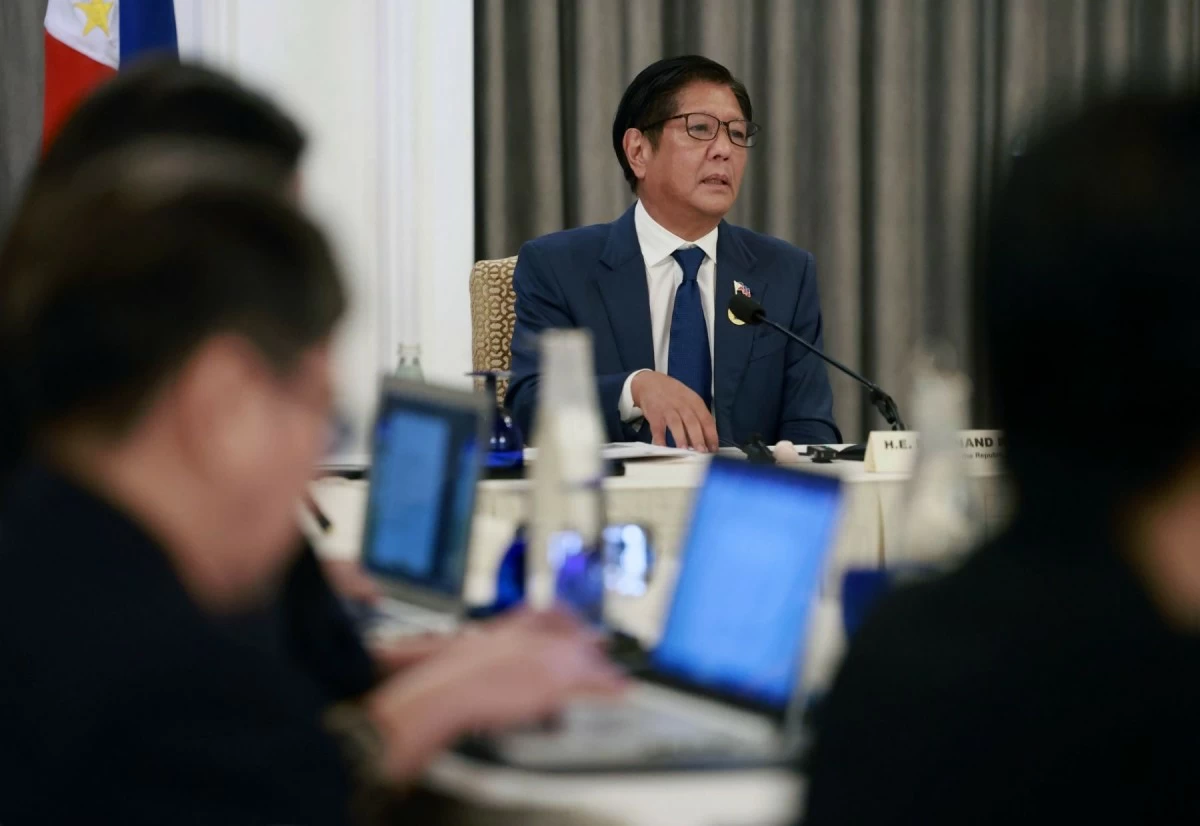
President Ferdinand R. Marcos Jr. speaks during a press conference at the Ritz-Carlton Kuala Lumpur following the 46th ASEAN Summit in Malaysia, May 27, 2025. (Mark Balmores)
Marcos shared in an interview with reporters in Kuala Lumpur, Malaysia that he was able to have a brief conversation with the Chinese Premier during a lunch at the Association of Southeast Asian Nations (ASEAN) Summit.
"He was sitting next to me at lunch. I was sitting next to the Chinese Premier and the Foreign Minister of UAE (United Arab Emirates)," Marcos said.
"Tinanong ko lang sa kanya, sabi ko (I asked him): What is the Chinese perspective of this new – new unilateral tariff schedule?"
"And he says, 'Well, you know, Mr. Trump has his own – seems to have his own idea. But we certainly do not want this to continue. It's not good for everyone. We don’t want this'," Marcos shared.
The President further said that he was hoping to be able to get the chance to talk to the Premier as he was curious about China's take on the tariffs beyond the statements they have been making publicly.
"But I was very, very curious to get a little bit beyond the party lang. Because we’ve heard what China says on TV. But to be able to get the chance to talk to the Premier, I thought I was hoping to get in," he said.
"I think, yes, it— you can see that it – it is sincere on their part that they do not want this. They do not want this to carry on. They want everything to be normalized," the President added.
The President emphasized the critical role of China in the region’s economic stability and how fluctuations in its economy directly affect ASEAN nations, including the Philippines.
“We trade with China. We have many investments in China, and we have many Chinese investments in the Philippines,” Marcos said.
The Chief Executive further cautioned that the continued implementation of unilateral tariff measures, if left unaddressed, could pose risks to broader regional and global economic stability.
Earlier this year, US President Donald Trump imposed a 10 percent minimum tariff on all imports under the “Reciprocal Trade and Tariffs” policy, heavily impacting Southeast Asia.
Cambodia now faces up to 49 percent in duties, Vietnam with 46 percent, and the Philippines with 17 percent. China, central to the trade dispute, was hit with total duties reaching 125 percent.
With the 90-day tariff pause set to expire in July, Marcos acknowledged the concerns and uncertainties being carefully considered by ASEAN leaders.
“Basically, we're just guessing. We don't know what will happen between now and July when the 90 days run out,” the President said.
He noted that even if tariff measures are eventually reversed, the impact on global business confidence has already been felt.
“Kahit ano pang mangyari, kahit ibalik, bura lahat, rewind lahat (Whatever happens, even if we go back, erase everything, and rewind) back to what it was in January—tomorrow—we're back to square one tungkol sa (in) tariff. May permanent effect na hindi na mawawala (There is a permanent effect that will not be undone),” he said.
'ASEAN must rely more on each other'
As a way forward, Marcos called for stronger regional coordination and deeper economic integration within ASEAN, acknowledging the performance of ASEAN’s economy and the complementarities of their markets within the region.
“We have to depend more on each other, on ASEAN. Malakas naman ang loob namin sa ASEAN member countries. Masigla ang kanilang mga ekonomiya. Masigla ang ating ekonomiya (We have a strong confidence with the ASEAN member countries. We have vibrant economies),” President Marcos noted.
“If we cannot sell to these markets anymore, then let's sell to each other's markets. The best, most solid way forward is to be a reliable partner for each other in ASEAN,” he added.
Marcos also welcomed the introduction of a new trilateral framework involving ASEAN, the Gulf Cooperation Council (GCC), and China, recognizing its potential to become a significant global economic bloc.
“If you put these groups together... just start with the GCC and ASEAN... that is a very important economic bloc. If we come to a good arrangement, then that will be a rival to any kind of economic bloc anywhere in the world,” he said.
The President also encouraged fellow ASEAN leaders to assess global trade shifts, emphasizing the need to identify potential risks, advantages, or opportunities that can be maximized.
“I was telling all the others that what we have to do is to identify what those changes are going to be. Is it damaging? Or is it to our advantage? Or is it something that we can maximize?,” Marcos said.
“And that's how we need to adjust. Because whatever else happens, this will change, this is changing, this will change, this has changed,” the President noted.