

ADVERTISEMENT

Student-made tool could improve early breast cancer detection

UP scientists develop mathematical model for detecting early signs of metastasis

Published May 27, 2025 11:28 am

At A Glance

  • LVI is when cancer cells begin invading lymphatic and blood vessels, allowing it to spread throughout the body in a process known as metastasis.
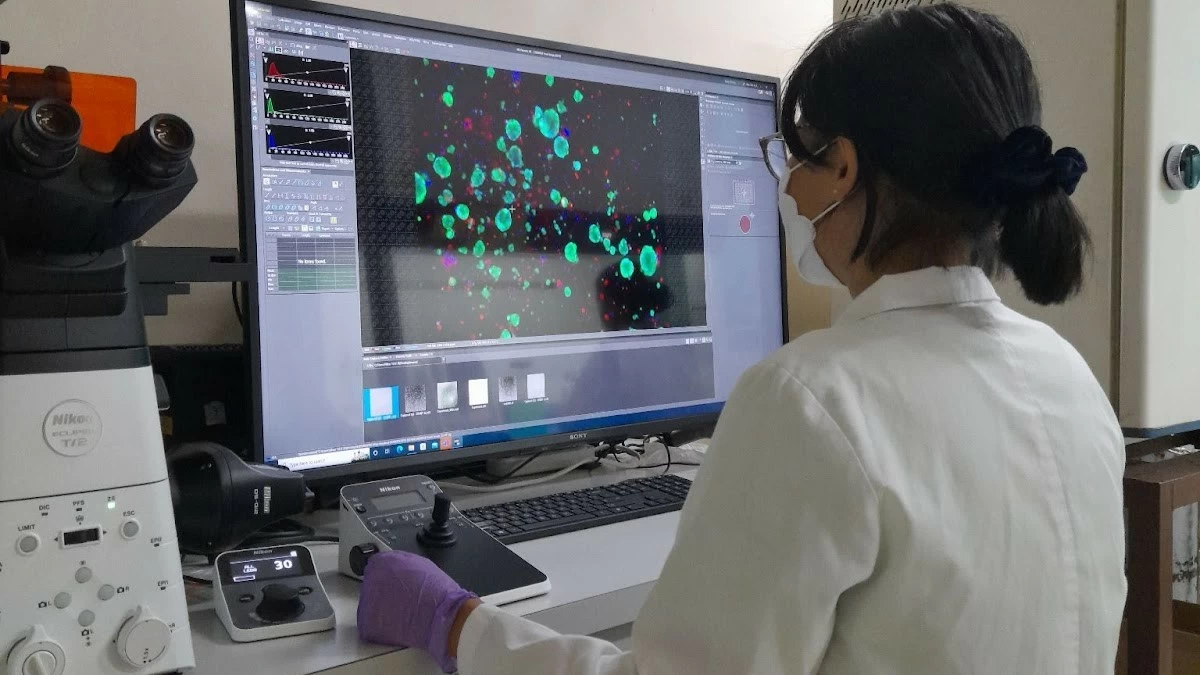
A CLOSER LOOK Biologist Regina Joyce Ferrer analyzing breast cancer organoids. (Photo: Dr. Michael Velarde)
Breast cancer claimed over 670,000 lives worldwide in 2022, 11,000 of those were Filipinos.
Second only to lung cancer, breast cancer is one of the leading cause of cancer-related mortality in the country. A new tool developed by biologists from the University of the Philippines (UP) hopes to help in detecting early symptoms.
“If we can detect lymphovascular invasion (LVI) earlier, doctors could personalize patient treatment and improve their outcomes,” shares Dr. Michael Velarde from UP Diliman College of Science Institute of Biology (UPD-CS IB). “This could help avoid ineffective treatments and focus on strategies that work better for aggressive breast cancer.”
LVI is when cancer cells begin invading lymphatic and blood vessels, allowing it to spread throughout the body in a process known as metastasis. In order to detect LVI, tissue surrounding a tumor needs to be surgically removed. This new tool under development hopes to remove the need for that.
Using the clinical data of over 625 breast cancer patients at the Philippine General Hospital and publicly available data, Dr. Velarde and his team (Allen Joy Corachea, Regina Joyce Ferrer, Lance Patrick Ty, and Madeleine Morta of UPD-CS IB, and researchers from the Philippine Genome Center and UP Manila) managed to find certain genes that survive chemotherapy and eventually metastasize. From this, the team was able to develop a regression model that analyzed the expression patterns of the two genes. Their model managed to correctly predict LVI status at the time of biopsy and before surgery 92 percent of the time.
Though the tool is still in its early stages of development, there are hopes it can make detecting early signs of breast cancer and providing the necessary treatment much easier. “More validation studies are needed before this can be used in clinics,” mentions Dr. Velarde. “Our goal is to develop a practical test that can be used in Philippine hospitals to guide doctors in choosing the best treatment for each patient.”

Related Tags

Health and Wellbeing breast cancer Breast Cancer Awareness Month UP University of the Philippines
ADVERTISEMENT
.most-popular .layout-ratio{ padding-bottom: 79.13%; } @media (min-width: 768px) and (max-width: 1024px) { .widget-title { font-size: 15px !important; } }

{{ articles_filter_1561_widget.title }}

.most-popular .layout-ratio{ padding-bottom: 79.13%; } @media (min-width: 768px) and (max-width: 1024px) { .widget-title { font-size: 15px !important; } }

{{ articles_filter_1562_widget.title }}

.most-popular .layout-ratio{ padding-bottom: 79.13%; } @media (min-width: 768px) and (max-width: 1024px) { .widget-title { font-size: 15px !important; } }

{{ articles_filter_1563_widget.title }}

{{ articles_filter_1564_widget.title }}

.mb-article-details { position: relative; } .mb-article-details .article-body-preview, .mb-article-details .article-body-summary{ font-size: 17px; line-height: 30px; font-family: "Libre Caslon Text", serif; color: #000; } .mb-article-details .article-body-preview iframe , .mb-article-details .article-body-summary iframe{ width: 100%; margin: auto; } .read-more-background { background: linear-gradient(180deg, color(display-p3 1.000 1.000 1.000 / 0) 13.75%, color(display-p3 1.000 1.000 1.000 / 0.8) 30.79%, color(display-p3 1.000 1.000 1.000) 72.5%); position: absolute; height: 200px; width: 100%; bottom: 0; display: flex; justify-content: center; align-items: center; padding: 0; } .read-more-background a{ color: #000; } .read-more-btn { padding: 17px 45px; font-family: Inter; font-weight: 700; font-size: 18px; line-height: 16px; text-align: center; vertical-align: middle; border: 1px solid black; background-color: white; } .hidden { display: none; }
function initializeAllSwipers() { // Get all hidden inputs with cms_article_id document.querySelectorAll('[id^="cms_article_id_"]').forEach(function (input) { const cmsArticleId = input.value; const articleSelector = '#article-' + cmsArticleId + ' .body_images'; const swiperElement = document.querySelector(articleSelector); if (swiperElement && !swiperElement.classList.contains('swiper-initialized')) { new Swiper(articleSelector, { loop: true, pagination: false, navigation: { nextEl: '#article-' + cmsArticleId + ' .swiper-button-next', prevEl: '#article-' + cmsArticleId + ' .swiper-button-prev', }, }); } }); } setTimeout(initializeAllSwipers, 3000); const intersectionObserver = new IntersectionObserver( (entries) => { entries.forEach((entry) => { if (entry.isIntersecting) { const newUrl = entry.target.getAttribute("data-url"); if (newUrl) { history.pushState(null, null, newUrl); let article = entry.target; // Extract metadata const author = article.querySelector('.author-section').textContent.replace('By', '').trim(); const section = article.querySelector('.section-info ').textContent.replace(' ', ' '); const title = article.querySelector('.article-title h1').textContent; // Parse URL for Chartbeat path format const parsedUrl = new URL(newUrl, window.location.origin); const cleanUrl = parsedUrl.host + parsedUrl.pathname; // Update Chartbeat configuration if (typeof window._sf_async_config !== 'undefined') { window._sf_async_config.path = cleanUrl; window._sf_async_config.sections = section; window._sf_async_config.authors = author; } // Track virtual page view with Chartbeat if (typeof pSUPERFLY !== 'undefined' && typeof pSUPERFLY.virtualPage === 'function') { try { pSUPERFLY.virtualPage({ path: cleanUrl, title: title, sections: section, authors: author }); } catch (error) { console.error('ping error', error); } } // Optional: Update document title if (title && title !== document.title) { document.title = title; } } } }); }, { threshold: 0.1 } ); function showArticleBody(button) { const article = button.closest("article"); const summary = article.querySelector(".article-body-summary"); const body = article.querySelector(".article-body-preview"); const readMoreSection = article.querySelector(".read-more-background"); // Hide summary and read-more section summary.style.display = "none"; readMoreSection.style.display = "none"; // Show the full article body body.classList.remove("hidden"); } document.addEventListener("DOMContentLoaded", () => { let loadCount = 0; // Track how many times articles are loaded const offset = [1, 2, 3, 4, 5, 6, 7, 8, 9, 10]; // Offset values const currentUrl = window.location.pathname.substring(1); let isLoading = false; // Prevent multiple calls if (!currentUrl) { console.log("Current URL is invalid."); return; } const sentinel = document.getElementById("load-more-sentinel"); if (!sentinel) { console.log("Sentinel element not found."); return; } function isSentinelVisible() { const rect = sentinel.getBoundingClientRect(); return ( rect.top < window.innerHeight && rect.bottom >= 0 ); } function onScroll() { if (isLoading) return; if (isSentinelVisible()) { if (loadCount >= offset.length) { console.log("Maximum load attempts reached."); window.removeEventListener("scroll", onScroll); return; } isLoading = true; const currentOffset = offset[loadCount]; window.loadMoreItems().then(() => { let article = document.querySelector('#widget_1690 > div:nth-last-of-type(2) article'); intersectionObserver.observe(article) loadCount++; }).catch(error => { console.error("Error loading more items:", error); }).finally(() => { isLoading = false; }); } } window.addEventListener("scroll", onScroll); });

Sign up by email to receive news.