







President Marcos has urged partners of the Association of Southeast Asian Nations (ASEAN) to increase climate finance to enable the region to achieve its goals to combat the effects of climate change.
Marcos urges ASEAN partners to scale up climate finance
Published May 26, 2025 03:56 pm


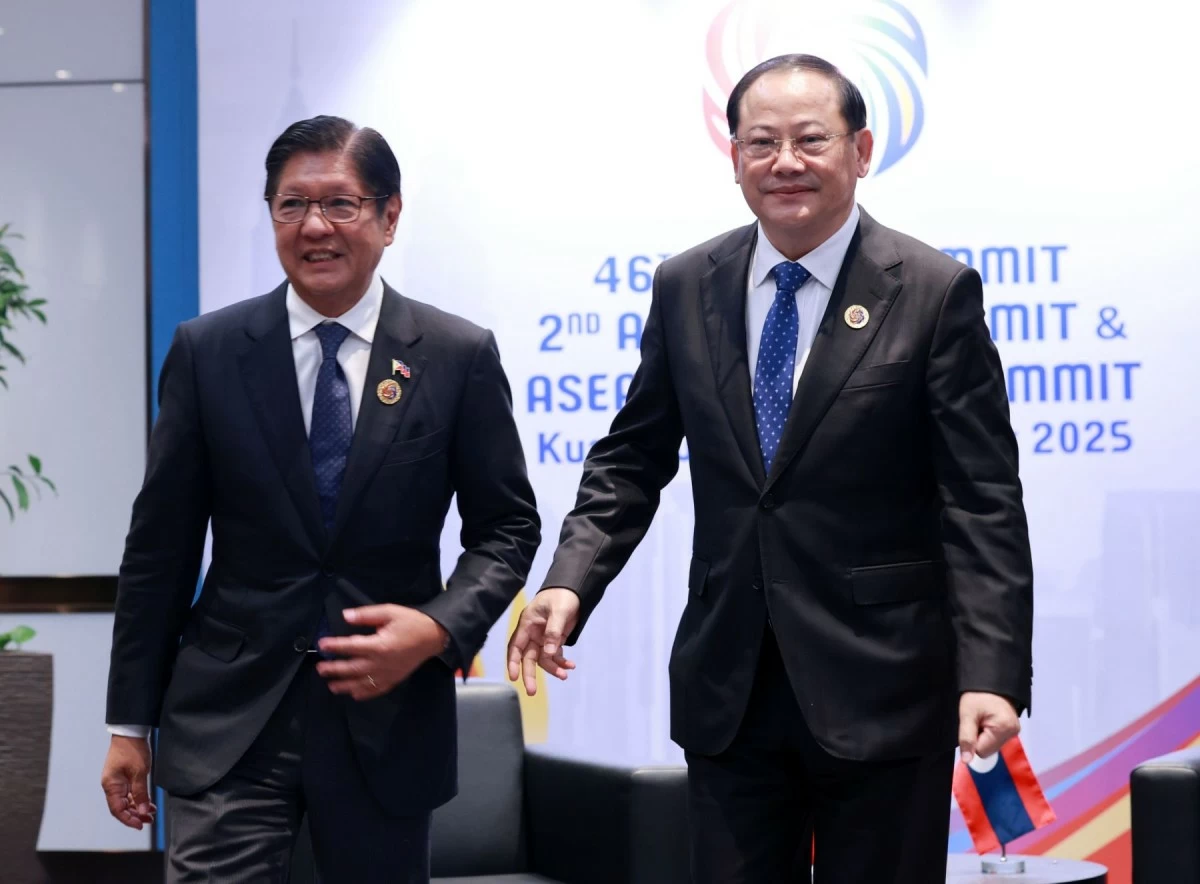
President Ferdinand R. Marcos Jr. meets with Prime Minister Sonexay Siphandone of the Lao People’s Democratic Republic during a bilateral meeting held as part of the 46th ASEAN Summit and Related Meetings at the Kuala Lumpur Convention Centre (KLCC) in Kuala Lumpur, Malaysia, on May 26, 2025. (Mark Balmores/Canon R6 Mark II)
In his intervention during the 46th ASEAN Summit plenary in Malaysia on Monday, May 26, Marcos reaffirmed the Philippines' commitment to advocate for scientific and evidence-based solutions to the climate crisis.
He stressed that climate change "is now the most defining and cross-cutting challenge of our time."
"As one of the most climate-vulnerable regions globally, nearly half of the entire ASEAN population faces significant climate-related risks," Marcos said in his intervention.
"As the host of the Board of the Fund for responding to Loss and Damage, the Philippines will continue to advocate for scientific and evidence-based, investment-led, and transformative solutions to the climate crisis," he added.
Emphasizing that the region is frequently and heavily-hit by effects of climate change, he called for "deeper regional cooperation."
"In this regard, we urge ASEAN’s partners to scale up predictable, accessible, and adequate climate finance to enable ASEAN to realize its climate ambitions and safeguard the future of our communities," Marcos said.
"We also call for deeper regional cooperation to address these emerging and transboundary challenges," he added.
The President also urged all Member States of the ASEAN to engage regional partners not merely to expand but to uphold the region's values such as love for peace and concern for the welfare of its peoples.
"Let me thus urge all Member States to remember that to meaningfully engage our partners, we must advance these values and interests sensitive, of course, to our external partners’ respective strengths and challenges," he said.
"Let us, therefore, continue engaging our partners not merely to expand networks, but to uphold and project the values that define ASEAN— peace, inclusivity, and shared progress.
During his intervention, Marcos also reaffirmed the country's commitment to the full implementation of the ASEAN Declaration to Prevent and Combat Trafficking in Persons Caused by the Abuse of Technology.
He stressed that "effective responses to transnational crime require robust cooperation, timely intelligence-sharing, and strengthened law enforcement."
Like what he said prior to departing for Malaysia, Marcos underscored the urgent need to accelerate the adoption of a legally binding Code of Conduct in the South China Sea to safeguard maritime rights, promote stability, and prevent miscalculations at sea.
He also commended Malaysia’s leadership in convening the Special ASEAN Economic Ministers’ Meeting and welcomed the consensus to avoid retaliatory measures.
"This measured and unified approach upholds ASEAN’s commitment to dialogue, diplomacy, and a rules-based multilateral trading system," he said.
"Effective responses to transnational crime require robust cooperation, timely intelligence-sharing, and strengthened law enforcement," he further stressed.
Marcos is in Kuala Lumpur, Malaysia for the 46th Association of Southeast Asian Nations (ASEAN) Summit, where he will join regional leaders to discuss key developments and shared goals for the region.
Joining the President were Trade Secretary Ma. Cristina Aldeguer-Roque, Communications Secretary Jay Ruiz, and Mindanao Development Authority chief Secretary Leo Tereso Magno.
The Chief Executive will also attend the 16th Brunei, Darussalam-Indonesia-Malaysia-Philippines East ASEAN Growth Area (BIMP-EAGA) Summit, which the President will chair; the 2nd ASEAN-Gulf Cooperation Council (GCC) Summit; and the ASEAN-GCC-China Summit.