

ADVERTISEMENT

192,000 affected by flooding in Maguindanao del Sur

Published May 20, 2025 02:25 pm
DAVAO CITY – The number of affected residents in the massive flooding in Maguindanao del Sur rose to 192,005 as of 5 p.m., Monday, May 19, the National Disaster Risk Reduction and Management Council (NDRRMC) reported.
The number of affected barangays also went up to 47 from 98 barangays in the towns of Ampatuan, Datu Abdullah Sangki, Datu Piang, Datu Salibu, Datu Saudi Ampatuan, Datu Hoffer Ampatuan, Mamasapano, Guindulungan, Shariff Aguak Shariff Saydona Mustapha, and Sultan sa Barongis, the NDRMMC added.
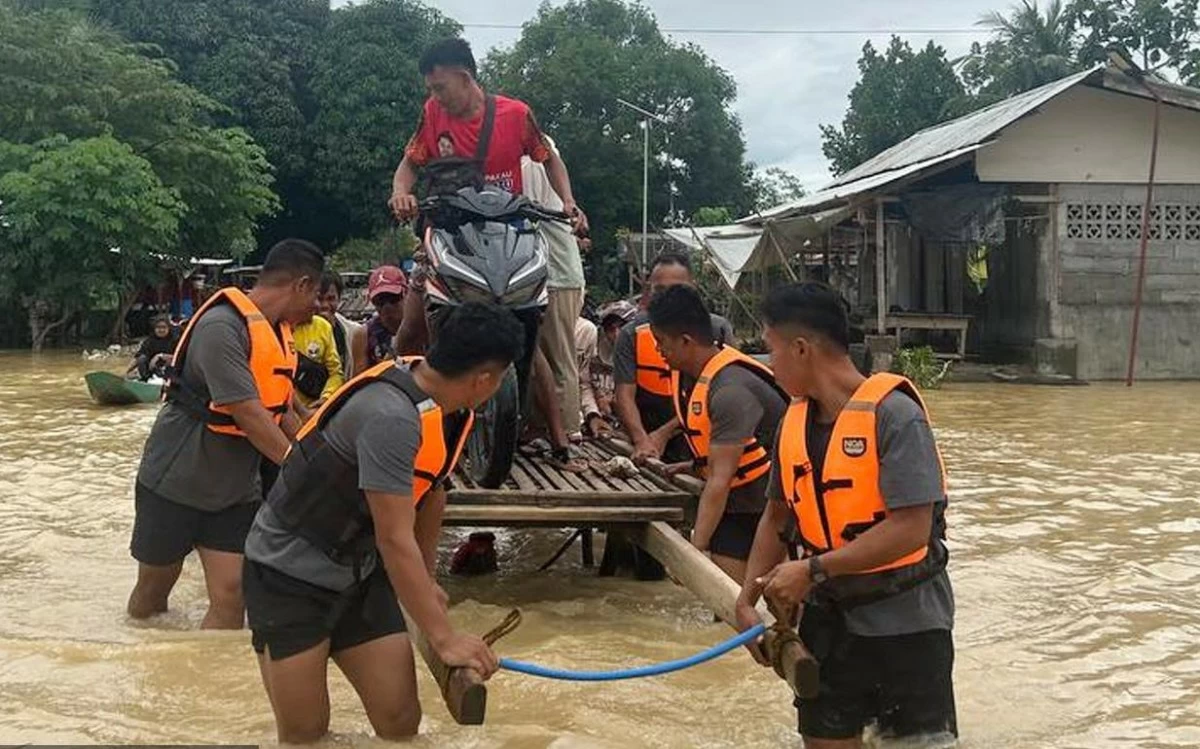
THE 33rd Infantry Battalion rescues residents in Barangay Tuka, Mamasapano, Maguindanao del Sur from flooding over the weekend. (33rd IB)
The NDRRMC added that the marshy town of Mamasapano has the highest number of affected residents with 34,700.
The massive flooding was caused by torrential rains due to the Intertropical Convergence Zone (ITCZ) since May 14.
The Mamasapano Disaster Risk Reduction and Management Council said that eight of 14 affected barangays have been submerged in floodwater for five days.
These affected towns sit on the periphery of the 200,000-hectare Ligawasan Marsh that straddles across the provinces of Cotabato, Maguindanao del Norte, Maguindanao del Sur, and Sultan Kudarat.
Ligawasan Marsh serves as the catch basin of waterways that flow from the mountains of Bukidnon and Sultan Kudarat.
Local government officials and concerned agencies have acknowledged that the recurring flood is due to heavy deposit of silt in the Ligawasan Marsh area as well as all the river systems connected into the catch basin.
On Tuesday, May 20, the Philippine Atmospheric, Geophysical, and Astronomical Services Administration released a flood advisory for the BARMM, particularly in the provinces of Basilan, Lanao del Sur, and Maguindanao provinces, as heavy rains due to the low-pressure area may affect the area.
The State weather bureau noted that heavy rains could likely affect waterways, particularly in Barangay Nituan in Parang, Maguindanao del Norte; the river systems in Datu Odin Sinsuat and Buluan and Matuber in Datu Blah Sinsuat, and rivers and tributaries in Dapao in Pualas and Matling in Malabang, all in Lanao del Sur; and the rivers in Gubuan and Kumalarang in Basilan.
“People living near the mountains slopes and in the low-lying areas of the above-mentioned river systems and the local disaster risk reduction and management councils concerned are advised to be alert for possible flashfloods,” PAG-ASA warned in its advisory.

Related Tags

NDRRMC Flooding Maguindanao del Sur Flood
ADVERTISEMENT
.most-popular .layout-ratio{ padding-bottom: 79.13%; } @media (min-width: 768px) and (max-width: 1024px) { .widget-title { font-size: 15px !important; } }

{{ articles_filter_1561_widget.title }}

.most-popular .layout-ratio{ padding-bottom: 79.13%; } @media (min-width: 768px) and (max-width: 1024px) { .widget-title { font-size: 15px !important; } }

{{ articles_filter_1562_widget.title }}

.most-popular .layout-ratio{ padding-bottom: 79.13%; } @media (min-width: 768px) and (max-width: 1024px) { .widget-title { font-size: 15px !important; } }

{{ articles_filter_1563_widget.title }}

{{ articles_filter_1564_widget.title }}

.mb-article-details { position: relative; } .mb-article-details .article-body-preview, .mb-article-details .article-body-summary{ font-size: 17px; line-height: 30px; font-family: "Libre Caslon Text", serif; color: #000; } .mb-article-details .article-body-preview iframe , .mb-article-details .article-body-summary iframe{ width: 100%; margin: auto; } .read-more-background { background: linear-gradient(180deg, color(display-p3 1.000 1.000 1.000 / 0) 13.75%, color(display-p3 1.000 1.000 1.000 / 0.8) 30.79%, color(display-p3 1.000 1.000 1.000) 72.5%); position: absolute; height: 200px; width: 100%; bottom: 0; display: flex; justify-content: center; align-items: center; padding: 0; } .read-more-background a{ color: #000; } .read-more-btn { padding: 17px 45px; font-family: Inter; font-weight: 700; font-size: 18px; line-height: 16px; text-align: center; vertical-align: middle; border: 1px solid black; background-color: white; } .hidden { display: none; }
function initializeAllSwipers() { // Get all hidden inputs with cms_article_id document.querySelectorAll('[id^="cms_article_id_"]').forEach(function (input) { const cmsArticleId = input.value; const articleSelector = '#article-' + cmsArticleId + ' .body_images'; const swiperElement = document.querySelector(articleSelector); if (swiperElement && !swiperElement.classList.contains('swiper-initialized')) { new Swiper(articleSelector, { loop: true, pagination: false, navigation: { nextEl: '#article-' + cmsArticleId + ' .swiper-button-next', prevEl: '#article-' + cmsArticleId + ' .swiper-button-prev', }, }); } }); } setTimeout(initializeAllSwipers, 3000); const intersectionObserver = new IntersectionObserver( (entries) => { entries.forEach((entry) => { if (entry.isIntersecting) { const newUrl = entry.target.getAttribute("data-url"); if (newUrl) { history.pushState(null, null, newUrl); let article = entry.target; // Extract metadata const author = article.querySelector('.author-section').textContent.replace('By', '').trim(); const section = article.querySelector('.section-info ').textContent.replace(' ', ' '); const title = article.querySelector('.article-title h1').textContent; // Parse URL for Chartbeat path format const parsedUrl = new URL(newUrl, window.location.origin); const cleanUrl = parsedUrl.host + parsedUrl.pathname; // Update Chartbeat configuration if (typeof window._sf_async_config !== 'undefined') { window._sf_async_config.path = cleanUrl; window._sf_async_config.sections = section; window._sf_async_config.authors = author; } // Track virtual page view with Chartbeat if (typeof pSUPERFLY !== 'undefined' && typeof pSUPERFLY.virtualPage === 'function') { try { pSUPERFLY.virtualPage({ path: cleanUrl, title: title, sections: section, authors: author }); } catch (error) { console.error('ping error', error); } } // Optional: Update document title if (title && title !== document.title) { document.title = title; } } } }); }, { threshold: 0.1 } ); function showArticleBody(button) { const article = button.closest("article"); const summary = article.querySelector(".article-body-summary"); const body = article.querySelector(".article-body-preview"); const readMoreSection = article.querySelector(".read-more-background"); // Hide summary and read-more section summary.style.display = "none"; readMoreSection.style.display = "none"; // Show the full article body body.classList.remove("hidden"); } document.addEventListener("DOMContentLoaded", () => { let loadCount = 0; // Track how many times articles are loaded const offset = [1, 2, 3, 4, 5, 6, 7, 8, 9, 10]; // Offset values const currentUrl = window.location.pathname.substring(1); let isLoading = false; // Prevent multiple calls if (!currentUrl) { console.log("Current URL is invalid."); return; } const sentinel = document.getElementById("load-more-sentinel"); if (!sentinel) { console.log("Sentinel element not found."); return; } function isSentinelVisible() { const rect = sentinel.getBoundingClientRect(); return ( rect.top < window.innerHeight && rect.bottom >= 0 ); } function onScroll() { if (isLoading) return; if (isSentinelVisible()) { if (loadCount >= offset.length) { console.log("Maximum load attempts reached."); window.removeEventListener("scroll", onScroll); return; } isLoading = true; const currentOffset = offset[loadCount]; window.loadMoreItems().then(() => { let article = document.querySelector('#widget_1690 > div:nth-last-of-type(2) article'); intersectionObserver.observe(article) loadCount++; }).catch(error => { console.error("Error loading more items:", error); }).finally(() => { isLoading = false; }); } } window.addEventListener("scroll", onScroll); });

Sign up by email to receive news.