







Vote-buying in the Philippine election setting is “endemic” and “well-entrenched”, the deputy chief observer of the European Union Election Observation Mission (EU EOM) said on Wednesday, May 14, as the group’s preliminary findings took note of “credible indications” of vote-buying either via cash or goods.
Vote-buying in PH is 'endemic, well-entrenched'—EU observer
Published May 14, 2025 02:54 pm


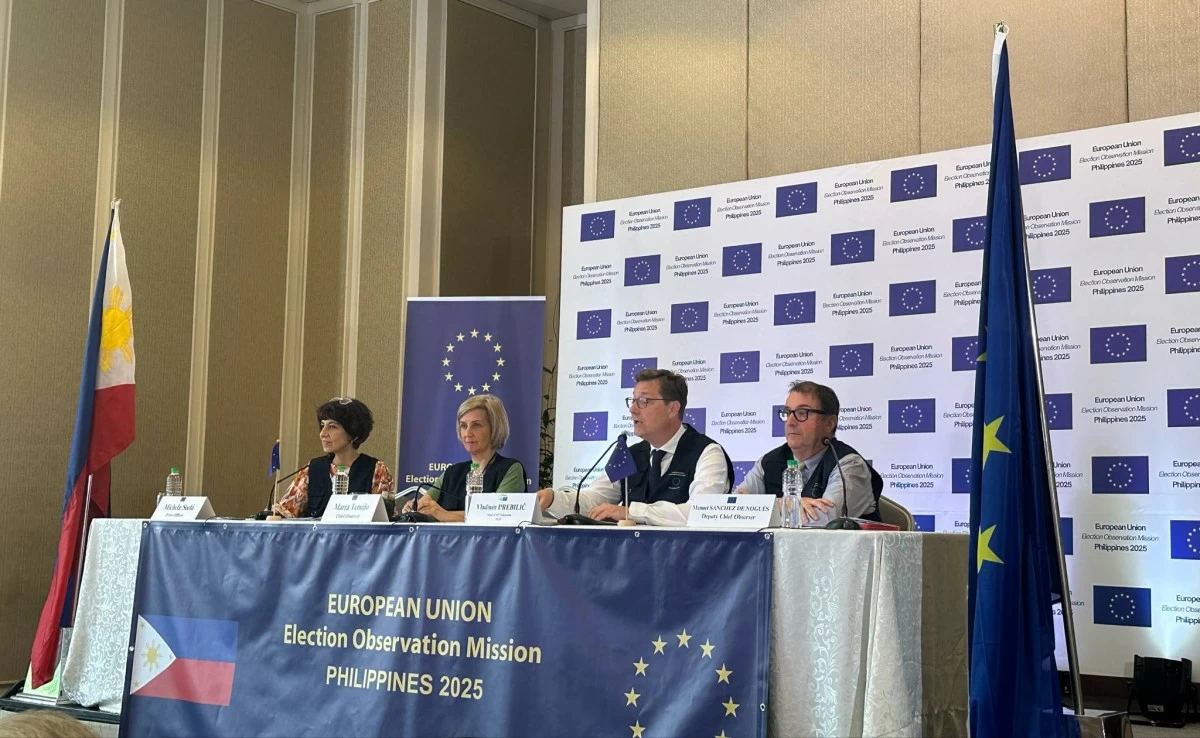
The European Union Election Observation Mission (EU EOM) presents its initial findings and conclusions on the conduct of the May 12 elections during a press conference held in Makati City. (Raymund Antonio/MANILA BULLETIN)
Manuel Sanchez de Nogues, EOM’s deputy chief observer, told the media in a press conference that the practice of vote-buying was observed in Davao Oriental, Bohol, La Union, Palawan, Quezon, Siquijor, Zamboanga City, and Zamboanga del Sur provinces.
“Our observers in the field have received criminal reports on the practice of vote-buying… So it's a practice that is highly entrenched,” he said, noting the social economic concerns that came with it.
“We have received reports, we have also, in some cases, witnesses, which is even difficult because we are highly identified as election observers, but we still have some evidence of those practices,” he added.
Marta Temido, EU EOM chief observer, also said that their observers have “witnessed several credible indications and received reports of vote-buying through cash and goods, as well as partisan distribution of welfare payouts (ayuda).”
This even as the observers noted the Commission on Elections’ (Comelec) efforts to address vote- buying through regulations and initiatives, including forming a dedicated task force named “Kontra Bigay.”
Out of the 98 observed campaign events, the EU EOM said that they witnessed at least five instances of vote-buying.
The mission also raised concern about the so-called “bidding wars” among candidates, as well as the “countrywide partisan distribution of welfare payouts” or most commonly known as “ayuda (aid).”
Political dynasties
Aside from rampant vote-buying, the EU EOM also reported on “political families” dominating the local elections.
“The elections took place against the backdrop of a continued dominance of few political families in the lists of candidates, detracting from overall competitiveness,” Temido said in a statement.
The report furthered that in 20 percent of district races, the candidates, mostly incumbents, ran unopposed, which limited the “genuine pluralistic competition and voter choice in those districts.”
“Voter engagement was strong nationwide but belied the fact that one in five district races were non-competitive, typically featuring only the incumbent. Some stakeholders opined that political programme of some parties were not distinguishable and often overshadowed by personality stagecraft, which could negatively impact the availability of genuine political alternatives to voters,” the preliminary findings read.
Violence
The EU EOM said that electoral violence continues to be a “recurrent feature” in Philippines elections, with it being manifested “through intimidation, harassment and violent incidents targeting candidates, their supporters and election administrators.”
“Violent incidents marred the election process in some parts of the country, including through at least 30 killings of candidates and election officials” Temido said, adding that it influenced the overall atmosphere of the elections because of “widespread intimidation in several provinces.”
Vladimir Prebilič, head of the Delegation of the European Parliament that joined the EU EOM and fully endorsed its statement, stressed that election violence was “unacceptable.”
“Violence during an election is utterly unacceptable, particularly when it results in the loss of dozens of lives. A democratic electoral process should never be associated with such tragic incidents,” he added.
Quoting reports from the Philippine National Police (PNP), the EU EOM said there were about 111 election-related incidents across the country during the election period.
During Election Day, violence was prevalent in the Bangsamoro Autonomous Region in Southern Mindanao (BARMM) and other hotspots, with 10 fatalities reported.
The EU EOM noted, however, that government agencies were “responsive” and have been “actively updating” the list of “areas of concern.”
Media
Citing the Philippines’ “vibrant media environment,” the EU EOM said there are “long-standing” challenges to election coverage in the country, but the atmosphere has improved.
“Long-standing challenges to journalists’ work, such as incidents of intimidation, including red-tagging, impunity for violence and economic fragility persist. Positively, as reported also by EOM interlocutors, the atmosphere has improved overall, and the intensity of hostilities has decreased,” the report added.
It took note of how “access to diverse information, in particular at regional level, continues to be adversely affected” following the lost of franchise of ABS-CBN, once the country’s biggest network, during the Duterte administration.
The preliminary findings aims to “outline initial findings and conclusions, and the extent to which the mission considers the election to have been conducted in line with Philippine laws, as well as with the international commitments to democratic elections the country has subscribed to.”
A comprehensive final report, which will be published two months after the elections, will include “recommendations for the improvement of future elections.”