







Pulse Asia explains gaps between surveys, election results
Published May 13, 2025 02:15 pm


(PULSE ASIA)
As partial results continue to come in following the elections on May 12, Pulse Asia President Ronald Holmes offered insights into the factors that may have contributed to the differences between the firm’s pre-election surveys and the actual vote count.
According to Holmes, late shifts in campaign strategies, voter turnout, and undecided voters making final decisions closer to election day likely played a role in the outcome.
Aquino’s surge
He pointed specifically to the case of former senator Bam Aquino, whose performance exceeded expectations.
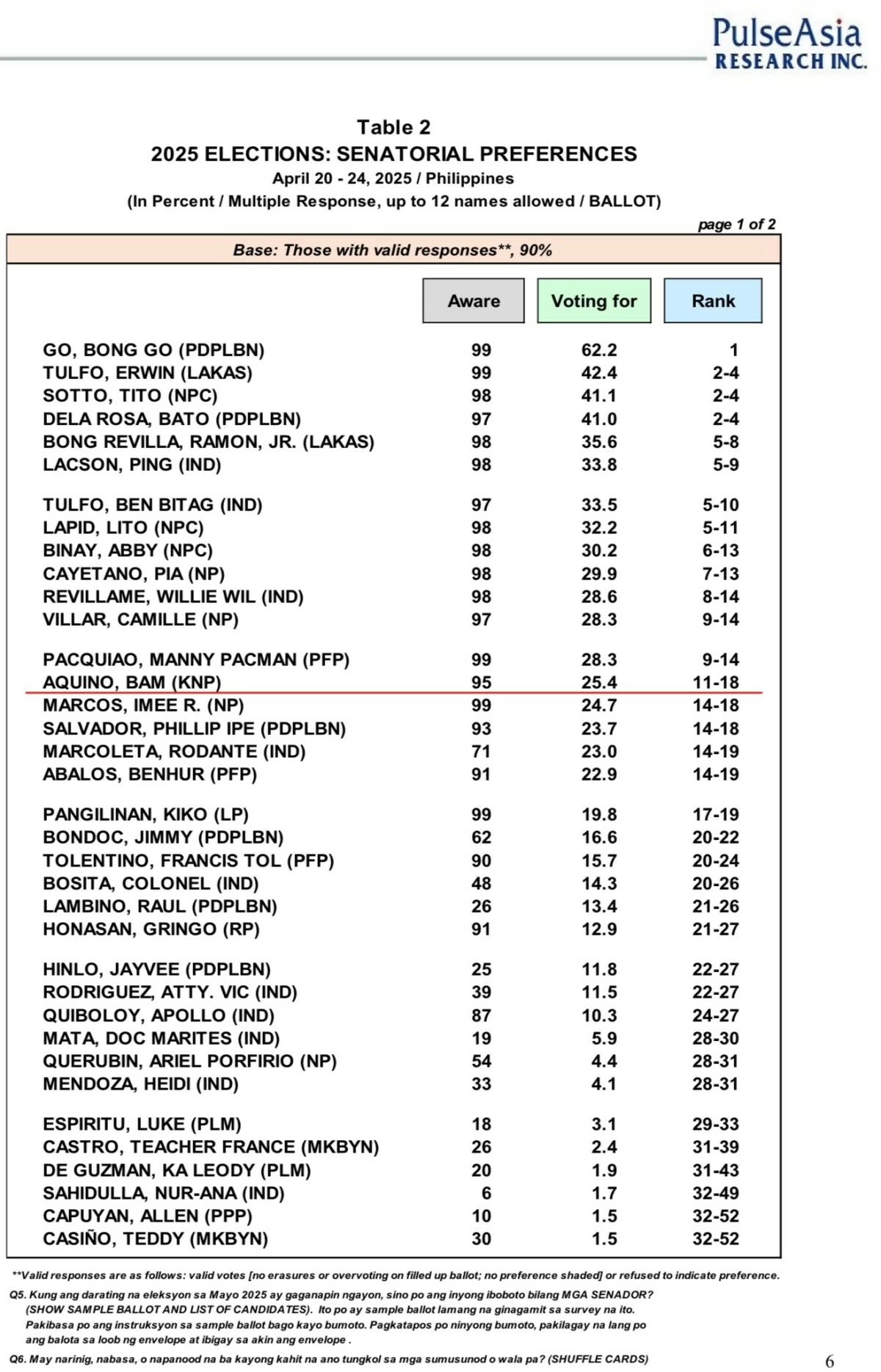
Pulse Asia’s final pre-election survey, conducted from April 20 to 24, placed Aquino within the 11th to 18th ranking range. However, partial voting results show him in the second spot.
“One explanation is what they did, what former senator Bam Aquino did in the last three weeks,” Holmes said in an interview with ABS-CBN on Tuesday, May 13. “What did Bam do to bring him up to that level?”
“The number that we are seeing right now, [about 19 million], is lower than what you normally expect the number to be, but I think that is quite safe on his part,” he said.
Holmes added that based on Pulse Asia’s internal projections, the candidate who lands in the 12th spot should receive about 15 million votes.
Deciding late
“Lower voter turnout may have actually helped Bam Aquino to the extent that those supporting him may have higher turnouts than the other voters who were supporting other candidates,” he explained.
He noted that survey data showed a significant number of respondents remained open to changing their choices, and low fill-out rates in earlier surveys suggested many voters were still deciding as late as April.
“Karamihan nagsabi na babaguhin pa nila ‘yung desisyon (Many said they would still change their decision),” he said. “Since you have low fill-out rates, [ibig sabihin] meron silang idadagdag (that means they were still planning to add more names to their list).”
Holmes also acknowledged the surprisingly strong showing of former senator Kiko Pangilinan, who, like Aquino, outperformed his pre-election ranking.
In Pulse Asia’s April survey, Pangilinan ranked in the 17th to 19th range. However, partial results now place him in the fifth spot.
“Honestly, I was surprised with Bam and Kiko—happily at that,” Holmes said.
Holmes also noted that several other candidates saw steady declines in preference ratings across the February to April surveys, even if their rankings remained unchanged.
These included ACT-CIS Party-list Rep. Erwin Tulfo, media personality Ben Tulfo, former senator Manny Pacquiao, Makati Mayor Abby Binay, and TV personality Willie Revillame.
“Maraming bumaba doon sa aming April survey kung ikukumpara sa March (Many candidates dropped in our April survey compared to March),” Holmes said. “From February, March to April, the slide was quite significant.”
He said these trends were already becoming visible, particularly in the case of Ben Tulfo, and were not entirely surprising given the lack of traditional campaign machinery among some candidates.
Strategic candidate placement by political parties also played a role, Holmes added, citing how PDP-Laban’s slate positioned Las Piñas Rep. Camille Villar and Senator Imee Marcos.
Trust in surveys
He also pointed out the importance of introspection within the polling community, as he acknowledged that Pulse Asia will be reviewing its sampling and methodology in light of the results.
“We will be reviewing our sampling methodology and that’s very important,” he said. “Internally, as academics, the social science research organization, we have to look at our own methodology.”
Responding to criticisms questioning the credibility of surveys, Holmes defended the integrity of polling, reiterating its role as a “snapshot” of public sentiment at a specific time.
“Eto napapakamot ako ng ulo kasi dati ang sinasabi sa survey ay mind-conditioning, ngayon na iba ang resulta ang sinasabi ay hindi na dapat pagkatiwalaan (Now I’m scratching my head. Before, people said surveys were for mind-conditioning. Now that the results differ, they say surveys are no longer trustworthy),” he said.
He reaffirmed Pulse Asia’s commitment to transparency and continuous improvement.
“We are open to admit when we commit a mistake. But of course, we have to review our methodology before we even say, okay, these are the improvements,” Holmes said.