







It’s that time of year again when Filipino internists (internal medicine specialists) and internists-in-training gather over several days to learn about the latest medical information and network for research and clinical practice. Last May 4 to 7, 2025, the Philippine College of Physicians (PCP) held its 55th annual congress at the SMX Convention Center. Typically, 8,000 to 10,000 doctors come to this conference, but this year over 13,000 doctors attended. The delegates came from all over the archipelago, and even from other countries. Featured speakers were among the best in the field of internal medicine and its subspecialties and included distinguished foreign speakers who are world-renowned experts.
A lifetime commitment to learning
Continuing education for your doctors
Published May 13, 2025 03:27 pm


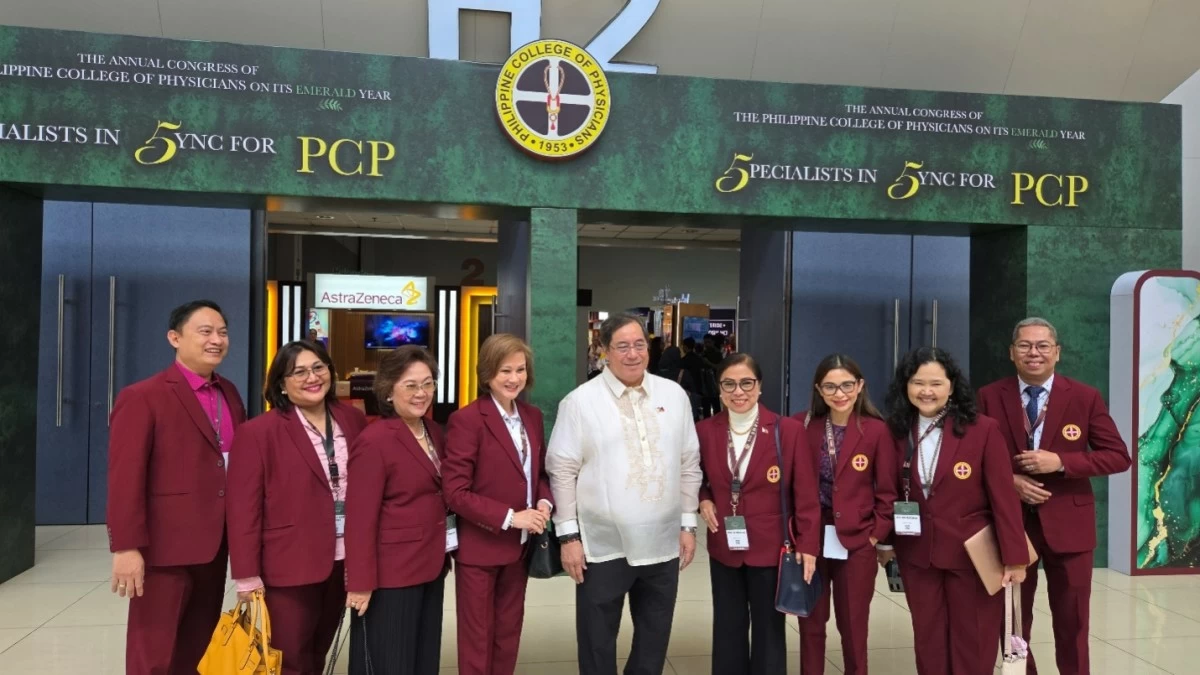
The Philippine College of Physicians board including PCP president Dr. Imelda Mateo (fourth from right) with DOH Secretary Teodoro Herbosa.
Medical conventions are great sources of continuing medical education for busy clinical practitioners. The well-curated scientific program of this year’s PCP convention featured high-yield topics with cutting-edge information applicable to our clinical practice. This information will help us internists take better care of our patients. Aside from the formal scientific program, there were also practical skills lectures, like the one I was asked to deliver, where I explained how to make good presentations and how to better engage your audience.
This year’s first plenary lecture was provocatively entitled “Addressing Generation Gaps in Internal Medicine Training for an Age-inclusive Medical Practice.” The speaker was Dr. Melfor Atienza, the dean of the National Teachers Training Center for Health Professions at the University of the Philippines Manila and a practicing gastroenterologist. Dr. Melfor, or Ma’am Melfie as her students (including me) call her, is one of the best teachers you will ever meet. Her lectures are meticulously crafted, and her exams are scientifically constructed to the point of having item analysis to make sure each question is fair.
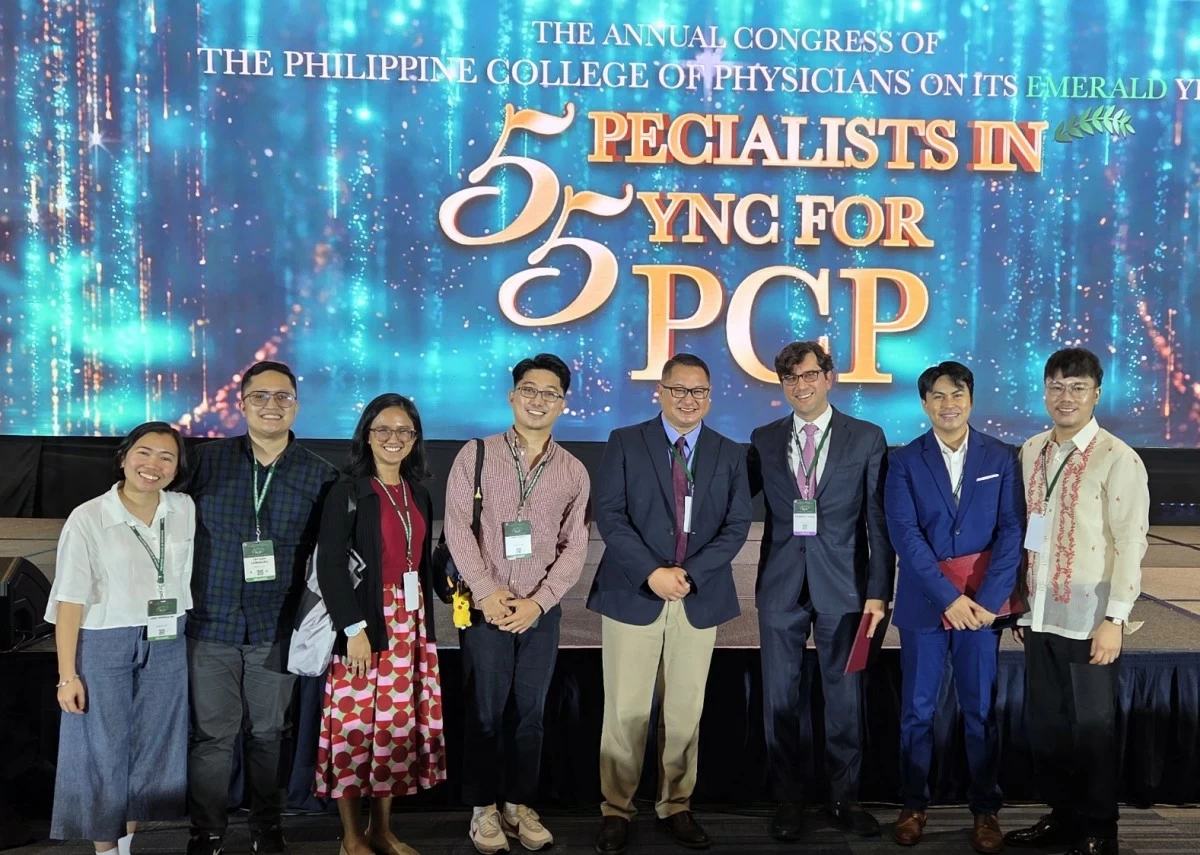
With UP-PGH faculty and infectious diseases fellows at the 55th annual Congress of the Philippine College of Physicians, including Scientific Committee chair Dr. Arthur Dessi Roman (rightmost) and guest plenary speaker Dr. Federico Perez (third from right).
Her talk discussed whether there were truly differences among the attitudes of different generations in medicine, or whether this was just a perception without a scientific basis. She interspersed Menti (a polling app) questions in between slides, which kept the audience engaged. Since the topic was generation gaps, she first asked the audience what generation they belonged to. The greatest number of audience members belonged to Generation Y, also known as Millennials (1981 to 1996), followed by Generation X (1965 to 1980). As a GenXer, I’ve always felt that our generation had the best balance between the strict Builders (1925 to 1945) and Boomers (1945 to 1964) who demanded obedience due to seniority and mostly ruled by fear, and the more sensitive and work-life balance focused Millennials and Gen Z (1997 to 2012). This has led some doctors in my generation to believe that today’s young doctors don’t work as hard as we did back then, and that they take for granted a lot of the knowledge at their fingertips. My generation had to work hard at researching information in the library and memorizing facts for quick retrieval at the bedside. The truth is more complicated, and the presence of AI tools and rapidly changing evidence means that younger doctors have so much more information to learn, and they have to get adept at curating information quickly and efficiently. In the end, it is important to respect differences between ages in order to be inclusive, and each generation finds its own way. The important thing is that each doctor, whatever his generation, should do his best to take good care of his patients.
There were also plenaries on precision medicine, the current role of genetics in internal medicine practice, climate change, and ethical and legal implications of physician engagement in social media, and these were all very well received by the audience. There were excellent breakout sessions on HIV primary care, diagnostics stewardship, liver and gastrointestinal diseases, and many other subspecialties that served to update the audience on the latest developments that could be applied to their patients.
One plenary lecture was particularly relevant to my practice of infectious diseases. This session was entitled Multi-drug Resistant Organisms and Healthcare-associated Infections: Impact, Opportunities and Challenges for Internists. It was given by Dr. Federico Perez, who is an infectious diseases specialist from Case Western Reserve University and the University Hospitals of Cleveland Medical Center. I trained with Federico in Cleveland, where we were both infectious diseases fellows, and since then, Federico has risen to become a world leader in antimicrobial resistance. He is responsible for some of the most important studies for treating multidrug-resistant infections, and we use his findings in those studies to treat our patients in the Philippines and globally. Federico spoke about the state-of-the-art treatment for some of the most resistant infections, but more importantly, highlighted how internists and non-specialists could help interrupt the cycle of increasing antibiotic resistance. Overuse and inappropriate use of antibiotics, not just in medicine but also in agriculture, drives antimicrobial resistance, and so even lay people need to pitch in by taking their antibiotics properly, limiting antibiotic use in livestock, and spreading awareness of the problem. He also presented the results of studies he did that can track resistance in hospitals and best practices, including telling doctors if they are using antibiotics properly to combat resistance.
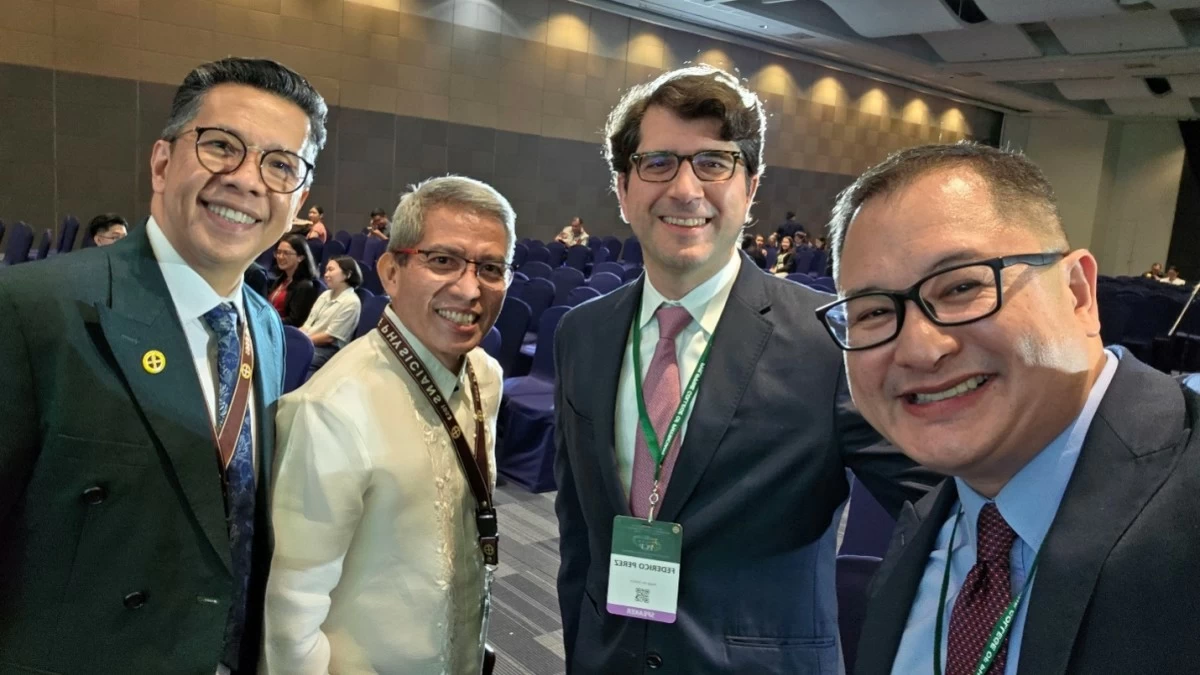
From left: Dr. Nemencio Nicodemus, PCP Vice-President and Over-all Chair of the 55th annual PCP congress, Dr. Rontgene Solante, PCP past president, Dr. Federico Perez, and the author.
The final day started with a plenary session from the Secretary of Health, Dr. Teodoro Herbosa. Sec. Herbosa spoke about his vision for the Department of Health, including addressing the health needs of Filipinos through “BUCAS (Bagong Urgent Care and Ambulatory Service) Centers,” which are a great alternative to emergency rooms in delivering urgent care without clogging up hospital ERs. He also spoke about improved PhilHealth benefits and the critical role of internists in delivering equitable healthcare to the Filipino population.
High-quality local scientific meetings like the PCP Annual Convention are extremely useful for local physicians to stay up to date with the latest evidence-based medical practices without having to go abroad and spend a lot of money on similar conventions. I am astounded by how the caliber of these local meetings keeps getting better and better every year, to the point that physicians from other countries regularly attend our local conferences. In the end, it is about making sure doctors take the best possible care of their patients, which is why we are here in the first place.