

ADVERTISEMENT

Pair of Philippine Eagles released in Leyte

Published May 9, 2025 01:19 pm
DAVAO CITY – A pair of Philippine Eagles was released to the forests in Burauen, Leyte on Thursday, May 8, as part of the Philippine Eagle Foundation’s reintroduction program in the island-province.
The PEF said they are three-year old Kalatungan 1, male, and Sinabadan, an 11-year-old female.
Two of three eagles translocated to Leyte on March 21, they underwent acclimatization for at least a month in the forests of Barangay Kagbana, the same barangay where raptors Carlito and Uswag were also reintroduced on June 28 last year.
Acclimatization will enable them to gradually adjust to the forest environment with minimal human contact, the PEF said. Food response, flight strength, alertness, and avoidance behavior were closely monitored to determine release readiness.
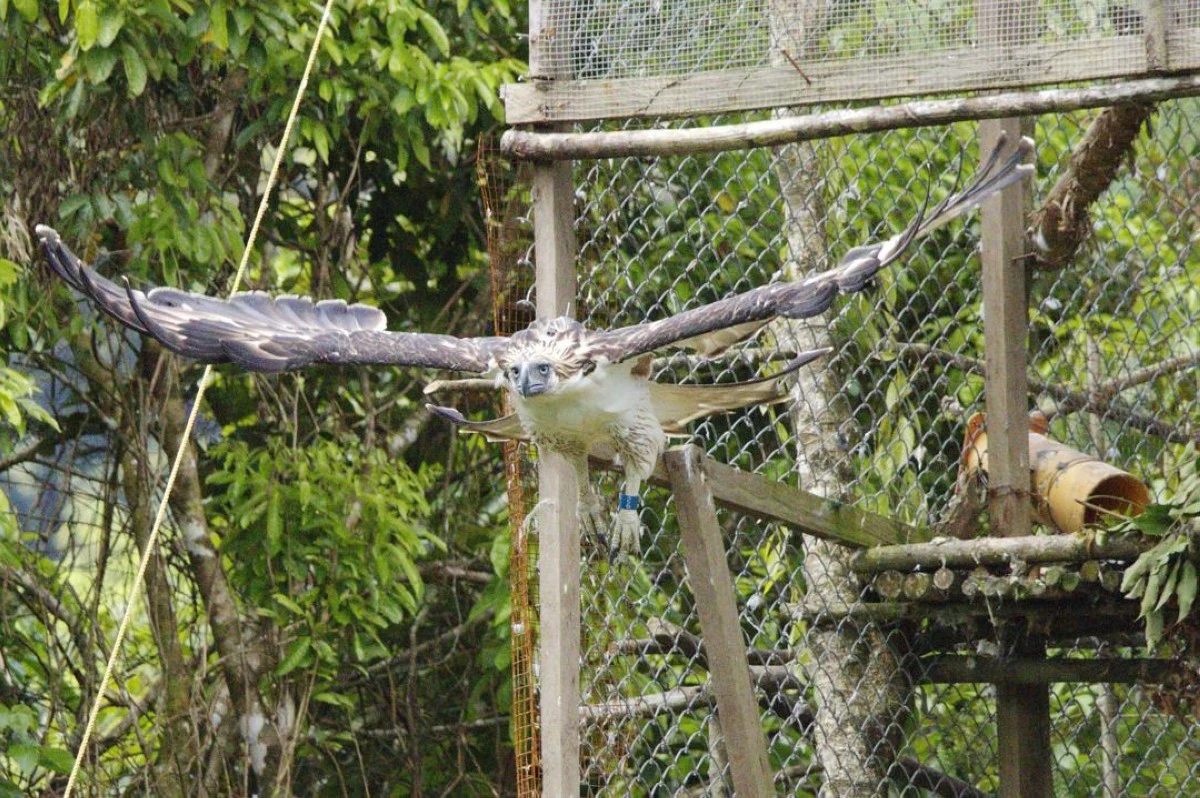
PHILIPPINE Eagle Sinabadan takes off from the temporary cage  in Leyte. (PEF)
PHILIPPINE Eagle Sinabadan takes off from the temporary cage in Leyte. (PEF)
PHILIPPINE Eagle Sinabadan takes off from the temporary cage in Leyte. (PEF)  
The PEF said Kalatungan 1 was the first to take off from their temporary holding cage while Sinabadan flew about an hour later.
They were outfitted with Global Positioning System (GPS) transmitters and VHF (radio) transmitters to enable the PEF to follow their movements.
Like the previous pair, PEF Director for Operations Dr. Jayson Ibañez said Kalatungan 1 and Sinabadan underwent acclimatization in the area since they came from different regions with different environment settings.
Ibañez said PEF employed a different protocol in this latest release compared to last year where they followed the usual release procedure of setting the eagles free after acclimatization and relied on their instinct in their search of their territory.
“This year, we employed a cohort bonding and site bonding procedure to achieve two things: First, pair-bond the birds before release so that they will hopefully stay together and help each other out with hunting, to increase their chances of survival, and second, that they stay at the release site and regard it as their territory, avoiding what has happened to eagle Uswag,” he explained.
The seasoned conservationist admitted that this year’s protocol was based on lessons learned during the release last year.
Uswag died about a month later after it crashlanded in the sea of Leyte. The raptor’s carcass was found floating, together with debris of seagrass and algae, in the sea in the municipality of Pilar in Cebu on the third day of the search and rescue operation on Aug. 3.
Carlito was recently monitored in the forests of Mahagnao Volcano Natural Park, some seven kilometers northeast of Barangay Kagbana.
The reintroduction of the eagles in Leyte is a bold step for the conservation efforts of this critically endangered avian, whose population was believed to have been wiped out during the onslaught of super typhoon “Yolanda” (international name “Haiyan”) in 2013.
According to locals, the last time a pair of eagles was seen in Leyte was around 2007. An eagle was also seen in the area before Yolanda struck.
The Philippine Eagle Species Reintroduction Program, in partnership with the Department of Environment and Natural Resources (DENR), aims to establish a viable eagle population in Leyte and rebuild the ecological presence of the country’s national bird in key forest habitats where it has long been absent, the PEF said.
Like the previous pair, Kalatungan 1 and Sinabadan were rescued from the wild after they sustained bullet wounds.
Kalatungan 1 was rescued in Bukidnon in 2024 after surviving a bullet wound that left him weak and grounded, the PEF said. For months, the raptor underwent intensive veterinary care and flight rehabilitation at the Philippine Eagle Center in Barangay Malagos here.
Sinabadan was rescued in 2023 from Mount Tangkulan in Bukidnon and was named by the Bagobo Tagabawa Indigenous community of Sibulan in Mount Apo as such where she hatched in 2013.
Ibañez said that while Kalatungan 1 is not yet sexually mature, the social cohort bonding protocol could allow them to be comfortable with each other. The bonding also trained them to do things together, like siblings in a nest, he added.
The PEF acknowledged the vital contribution of the Abu Dhabi, United Arab Emirates-based Mohamed bin Zayed Raptor Conservation Fund, which has been instrumental in advancing raptor conservation in the Philippines.
The foundation commended the participation of residents of Barangay Kagbana for their key role in preparing and protecting the release site.
Barangay Kagbana was chosen as the host community because it is the only gateway to the whole Marabong Watershed, Ibañes said.
He added that the 58,000-hectare key biodiversity area can accommodate between six to eight pairs of Philippine Eagles.
A pair of eagles need at least 4,000 to 11, 000 hectares of forests to survive, PEF said.
The third eagle named Lakpue will also be released at a later date, according to the PEF.
“All of these release procedure modifications based on outcomes of annual releases is the main intention of the experimental release/reintroduction program, learn as much as we can about how best to increase survival chances of released eagles,” Ibañez said.

Related Tags

Philippine Eagle PEF Davao City Burauen Leyte
ADVERTISEMENT
.most-popular .layout-ratio{ padding-bottom: 79.13%; } @media (min-width: 768px) and (max-width: 1024px) { .widget-title { font-size: 15px !important; } }

{{ articles_filter_1561_widget.title }}

.most-popular .layout-ratio{ padding-bottom: 79.13%; } @media (min-width: 768px) and (max-width: 1024px) { .widget-title { font-size: 15px !important; } }

{{ articles_filter_1562_widget.title }}

.most-popular .layout-ratio{ padding-bottom: 79.13%; } @media (min-width: 768px) and (max-width: 1024px) { .widget-title { font-size: 15px !important; } }

{{ articles_filter_1563_widget.title }}

{{ articles_filter_1564_widget.title }}

.mb-article-details { position: relative; } .mb-article-details .article-body-preview, .mb-article-details .article-body-summary{ font-size: 17px; line-height: 30px; font-family: "Libre Caslon Text", serif; color: #000; } .mb-article-details .article-body-preview iframe , .mb-article-details .article-body-summary iframe{ width: 100%; margin: auto; } .read-more-background { background: linear-gradient(180deg, color(display-p3 1.000 1.000 1.000 / 0) 13.75%, color(display-p3 1.000 1.000 1.000 / 0.8) 30.79%, color(display-p3 1.000 1.000 1.000) 72.5%); position: absolute; height: 200px; width: 100%; bottom: 0; display: flex; justify-content: center; align-items: center; padding: 0; } .read-more-background a{ color: #000; } .read-more-btn { padding: 17px 45px; font-family: Inter; font-weight: 700; font-size: 18px; line-height: 16px; text-align: center; vertical-align: middle; border: 1px solid black; background-color: white; } .hidden { display: none; }
function initializeAllSwipers() { // Get all hidden inputs with cms_article_id document.querySelectorAll('[id^="cms_article_id_"]').forEach(function (input) { const cmsArticleId = input.value; const articleSelector = '#article-' + cmsArticleId + ' .body_images'; const swiperElement = document.querySelector(articleSelector); if (swiperElement && !swiperElement.classList.contains('swiper-initialized')) { new Swiper(articleSelector, { loop: true, pagination: false, navigation: { nextEl: '#article-' + cmsArticleId + ' .swiper-button-next', prevEl: '#article-' + cmsArticleId + ' .swiper-button-prev', }, }); } }); } setTimeout(initializeAllSwipers, 3000); const intersectionObserver = new IntersectionObserver( (entries) => { entries.forEach((entry) => { if (entry.isIntersecting) { const newUrl = entry.target.getAttribute("data-url"); if (newUrl) { history.pushState(null, null, newUrl); let article = entry.target; // Extract metadata const author = article.querySelector('.author-section').textContent.replace('By', '').trim(); const section = article.querySelector('.section-info ').textContent.replace(' ', ' '); const title = article.querySelector('.article-title h1').textContent; // Parse URL for Chartbeat path format const parsedUrl = new URL(newUrl, window.location.origin); const cleanUrl = parsedUrl.host + parsedUrl.pathname; // Update Chartbeat configuration if (typeof window._sf_async_config !== 'undefined') { window._sf_async_config.path = cleanUrl; window._sf_async_config.sections = section; window._sf_async_config.authors = author; } // Track virtual page view with Chartbeat if (typeof pSUPERFLY !== 'undefined' && typeof pSUPERFLY.virtualPage === 'function') { try { pSUPERFLY.virtualPage({ path: cleanUrl, title: title, sections: section, authors: author }); } catch (error) { console.error('ping error', error); } } // Optional: Update document title if (title && title !== document.title) { document.title = title; } } } }); }, { threshold: 0.1 } ); function showArticleBody(button) { const article = button.closest("article"); const summary = article.querySelector(".article-body-summary"); const body = article.querySelector(".article-body-preview"); const readMoreSection = article.querySelector(".read-more-background"); // Hide summary and read-more section summary.style.display = "none"; readMoreSection.style.display = "none"; // Show the full article body body.classList.remove("hidden"); } document.addEventListener("DOMContentLoaded", () => { let loadCount = 0; // Track how many times articles are loaded const offset = [1, 2, 3, 4, 5, 6, 7, 8, 9, 10]; // Offset values const currentUrl = window.location.pathname.substring(1); let isLoading = false; // Prevent multiple calls if (!currentUrl) { console.log("Current URL is invalid."); return; } const sentinel = document.getElementById("load-more-sentinel"); if (!sentinel) { console.log("Sentinel element not found."); return; } function isSentinelVisible() { const rect = sentinel.getBoundingClientRect(); return ( rect.top < window.innerHeight && rect.bottom >= 0 ); } function onScroll() { if (isLoading) return; if (isSentinelVisible()) { if (loadCount >= offset.length) { console.log("Maximum load attempts reached."); window.removeEventListener("scroll", onScroll); return; } isLoading = true; const currentOffset = offset[loadCount]; window.loadMoreItems().then(() => { let article = document.querySelector('#widget_1690 > div:nth-last-of-type(2) article'); intersectionObserver.observe(article) loadCount++; }).catch(error => { console.error("Error loading more items:", error); }).finally(() => { isLoading = false; }); } } window.addEventListener("scroll", onScroll); });

Sign up by email to receive news.