






 Philippines
National
PH, US end 'Balikatan' with strong message to 'threats': 'Don't mess with us'
Philippines
National
PH, US end 'Balikatan' with strong message to 'threats': 'Don't mess with us'
PH, US end 'Balikatan' with strong message to 'threats': 'Don't mess with us'


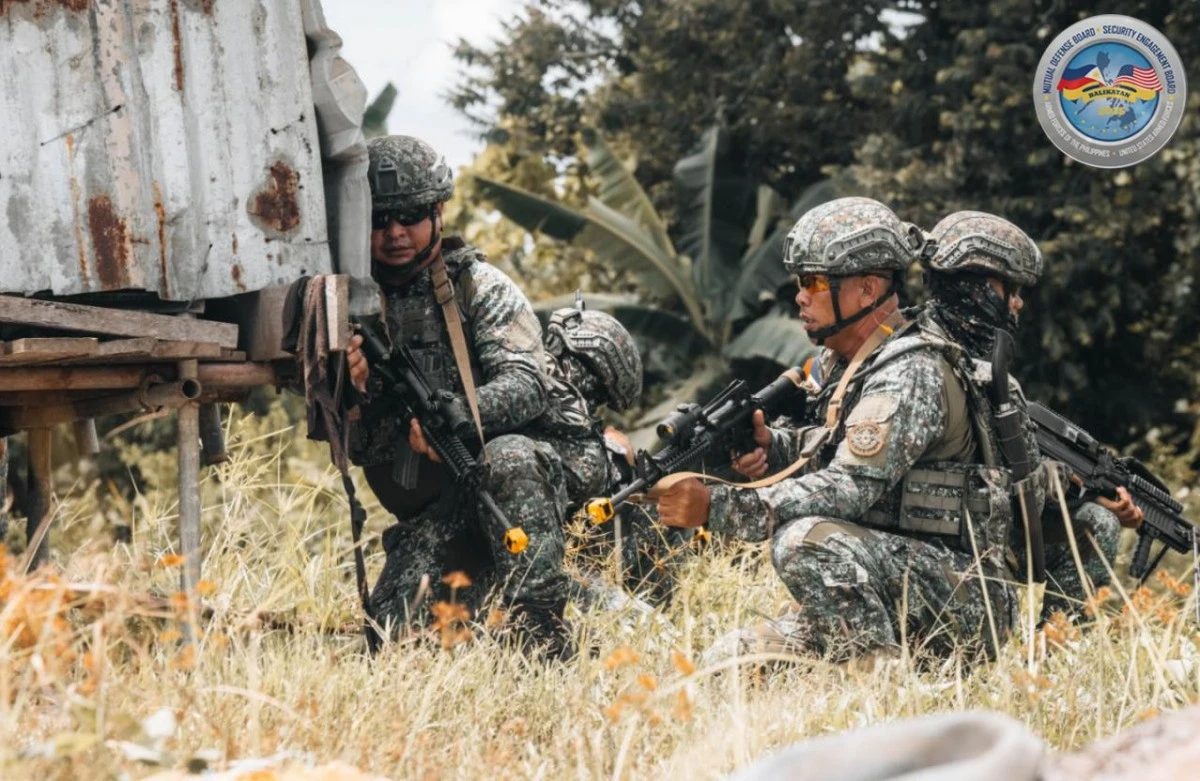
“Don’t mess with us.”
This was the stern warning given by the Armed Forces of the Philippines (AFP) and the United States Armed Forces to provocateurs in the Indo-Pacific region as they officially wrapped up the 40th edition of the Balikatan Exercises—their largest annual joint military drill—on Friday, May 9, at Camp Aguinaldo in Quezon City following three weeks of intensive training nationwide.
The closing ceremony was graced by Department of National Defense (DND) Sec. Gilberto Teodoro Jr., AFP Chief of Staff Gen. Romeo Brawner Jr., and US Marine Lt. Gen. Michael Cederholm, commander of US Joint Task Force Balikatan.
In his speech, Cederholm noted that Balikatan has stood as a testament to the strength of the US and Philippines alliance, which is “rooted in shared values and beliefs, shaped by history, and vital to the future of a prosperous and secure Indo-Pacific” region.
“This year, we reaffirmed a critical truth. Our alliances and partnerships are a strategic advantage in any scenario, be it conflict, crisis, or humanitarian response,” he said. “Together with the AFP, we put the ‘D’ in deterrence, defense, and don't mess with us.”
Teodoro said it was “obvious” which country does not adhere to the rule of law. “It is only China,” he said.
China continued to tighten its grip on the South China Sea as it made unilateral claims on certain features that overlap with the Philippines’ claims in the West Philippine Sea (WPS), and harass Philippine vessels during patrol operations.
This year’s Balikatan involved around 14,000 to 16,000 Filipino and American servicemen who trained shoulder-to-shoulder across all domains and alongside Australia, Japan, and 18 other observer nations, rehearsing a full-battle exercise.
But Brawner said Balikatan was more than just a series of military drills.
“It is a demonstration of enduring partnerships and collaborative resolve. It embodies our collective readiness to act in unison, underscoring that our greatest strength lies in unity,” the military chief noted.
Among the activities included were the maritime security operations in Palawan and Northern Luzon; sea denial drills in the Luzon Straits with the deployment of the Navy-Marine Expeditionary Ship Interdiction System (NMESIS) anti-ship missile system in Batanes; live-fire drills using various cutting-edge air and missile defense systems such as the Marine Air Defense Integrated System (MADIS), Avenger Air Defense System, and Surface-to-air Python and Derby (Spyder) medium-range missile system; and cyber defense exercises.
The two forces also conducted over 1,600 medical and dental examinations, as well as other humanitarian missions where the US government invested $2.5 million into schools, clinics, and health facilities, directly impacting 75,000 Filipinos.
“Balikatan 2025 reflects what makes our alliance so enduring: shared commitment, deep trust, and constant evolution. Every year, we become more interoperable, more capable, and more united in our pursuit of a free and open Indo-Pacific,” Cederholm said.
What’s next? What’s new?
Brawner said the success of this year’s Balikatan will serve as a foundation for enhanced collaboration, sustained engagement, and greater inclusivity in future exercises.
He said that exercise planners have already started mapping out the next iteration of Balikatan next year.
Meanwhile, Teodoro said the whole point of conducting large-scale exercises such as Balikatan was to “make ourselves more resilient” by building “strong fences”.
“These exercises with and amongst our partners and future partners are part of those fenceposts that we need to build in order to deter any malign actor from interfering with what international law provides each and every one of us,” the defense chief stressed.
He said next year, he would want to see new exercises that will be included in the Balikatan, new strategic areas where they would be held, and new terrains where the participants are going to operate.
He said the management of the Balikatan Exercises next year will also be transferred from the AFP’s deputy chief of staff for education, training, and doctrine to AFP’s deputy chief of staff for operations.
"So, next year will not merely be an exercise in execution and choice of exercises, but we will go deep down into the assumptions on why you are training shoulder to shoulder to do a particular activity. And I think that will enhance our interoperability, not only on the tactical level but more importantly on the operational and of course on the strategic levels too,” Teodoro said.