

ADVERTISEMENT

'Bigger than DepEd': Parents, stakeholders urged to unite in national fight against illiteracy

Published May 8, 2025 11:10 am

At A Glance

  • DepEd Secretary Sonny Angara stressed that combating illiteracy requires a unified effort beyond the classroom, involving parents, local government units (LGUs), and the private sector to address challenges like hunger and lack of home support that hinder learning.
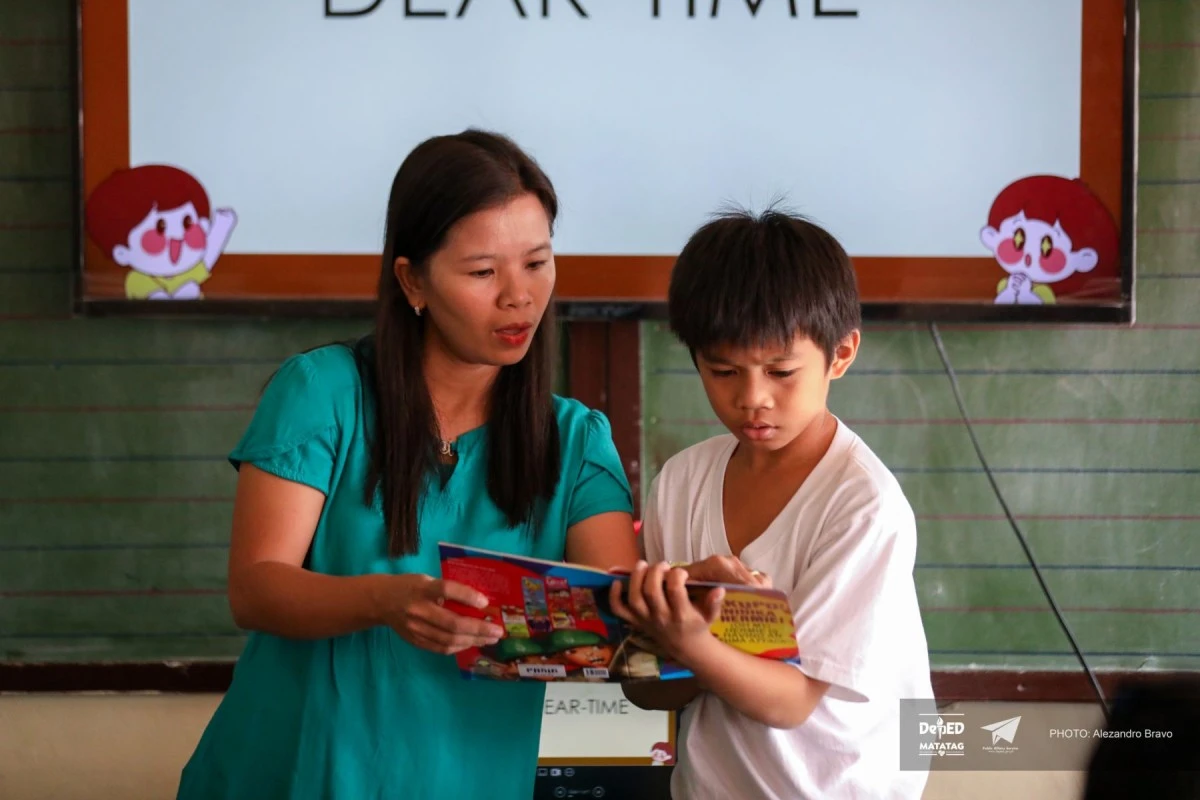
Emphasizing the critical role of collective action in ensuring every Filipino child gains essential reading and writing skills for a brighter future, the Department of Education (DepEd) has called on parents, educators, and community stakeholders to unite in a nationwide campaign to combat illiteracy.
Through a holistic approach that integrates education with health and nutrition programs, DepEd strives to foster a supportive learning environment that extends beyond textbooks and traditional classrooms. (Photo from DepEd)
“While DepEd is keen on bridging gaps on the curriculum side, the illiteracy problem is not a classroom problem alone,” DepEd Secretary Sonny Angara said in a statement.
“This is bigger than DepEd,” Angara stressed, noting that children cannot learn on an empty stomach and teachers cannot teach reading if students come to school hungry, sick, or unsupported at home.
Angara said that solving illiteracy requires mobilizing parents, local government units (LGUs), and the private sector.
Addressing the literacy crisis
Citing the 2024 Functional Literacy, Education, and Mass Media Survey (FLEMMS), DepEd emphasized that the literacy crisis cannot be solved by schools alone and must involve families, local governments, and private partners.
To address basic literacy and numeracy gaps, DepEd is rolling out several intervention programs this summer, including the Literacy Remediation Program (LRP), Bawat Bata Makakabasa Program (BBMP), 2025 Learning Camp, and the Summer Academic Remediation Program.
These initiatives, DepEd noted, target struggling learners to ensure they can read, write, and do basic math before advancing to the next grade level.
Parents as frontline literacy champions
President Marcos earlier highlighted the critical role of parents in fostering early literacy, encouraging them to actively engage in their children’s learning through storytelling and home reading.
Citing UNESCO, DepEd noted that daily reading habits and a positive home environment significantly influence a child’s learning—sometimes even more than formal classroom instruction.
Reading starts at home
To promote family-based literacy, DepEd said it continues to partner with civic organizations. In Cebu, the Zonta Club of Cebu II launched Alimbukad: Basa Pamilya, a program that provides reading kits and monthly guided sessions to empower parents as educators at home.
Implemented in schools like Poo Elementary School in Lapu-Lapu City, the initiative helps build a reading culture within households—a key to long-term literacy development.
Tackling malnutrition to boost learning
Recognizing the direct link between nutrition and academic performance, DepEd said it is expanding its School-Based Feeding Program (SBFP) to reach over 3.3 million learners in SY 2025–2026, including all public Kindergarten students.
This move is backed by research on the “first 1,000 days,” a critical period for a child’s cognitive and physical development.
“We are doing our part,” Angara said. “Now we need the rest of the village to act,” he added.
To enhance reach and efficiency, DepEd said it is partnering with organizations like the Jollibee Group Foundation. Through its Busog, Lusog, Talino (BLT) program, the foundation operates 41 Central Kitchens that prepare and distribute nutritious meals to over 30,000 students in more than 200 schools.
“Napakalaking tulong ng programang ito sa development ng mga bata, para ang mga bata araw-araw sa school ay busog, para lahat ng itinuturo ng mga teacher ay naa-absorb nila” (“This program is a tremendous help in children's development, ensuring that they are well-fed every day in school so they can fully absorb everything their teachers teach”), said Cayabon Elementary School Principal Leah M. Gualvez. The school is located in Masbate.
DepEd’s whole-of-nation approach to literacy
By combining educational interventions with health and nutrition programs, DepEd aims to create a learning-conducive environment that goes beyond textbooks and classrooms.
Through collaboration with families, LGUs, and the private sector, DepEd said it is pushing forward a unified strategy to improve functional literacy rates nationwide.
RELATED STORY: 
https://mb.com.ph/2023/5/29/ph-education-in-crisis-1

Related Tags

DepEd. literacy DepEd Secretary Sonny Angara Philippines education system reading learning crisis
ADVERTISEMENT
.most-popular .layout-ratio{ padding-bottom: 79.13%; } @media (min-width: 768px) and (max-width: 1024px) { .widget-title { font-size: 15px !important; } }

{{ articles_filter_1561_widget.title }}

.most-popular .layout-ratio{ padding-bottom: 79.13%; } @media (min-width: 768px) and (max-width: 1024px) { .widget-title { font-size: 15px !important; } }

{{ articles_filter_1562_widget.title }}

.most-popular .layout-ratio{ padding-bottom: 79.13%; } @media (min-width: 768px) and (max-width: 1024px) { .widget-title { font-size: 15px !important; } }

{{ articles_filter_1563_widget.title }}

{{ articles_filter_1564_widget.title }}

.mb-article-details { position: relative; } .mb-article-details .article-body-preview, .mb-article-details .article-body-summary{ font-size: 17px; line-height: 30px; font-family: "Libre Caslon Text", serif; color: #000; } .mb-article-details .article-body-preview iframe , .mb-article-details .article-body-summary iframe{ width: 100%; margin: auto; } .read-more-background { background: linear-gradient(180deg, color(display-p3 1.000 1.000 1.000 / 0) 13.75%, color(display-p3 1.000 1.000 1.000 / 0.8) 30.79%, color(display-p3 1.000 1.000 1.000) 72.5%); position: absolute; height: 200px; width: 100%; bottom: 0; display: flex; justify-content: center; align-items: center; padding: 0; } .read-more-background a{ color: #000; } .read-more-btn { padding: 17px 45px; font-family: Inter; font-weight: 700; font-size: 18px; line-height: 16px; text-align: center; vertical-align: middle; border: 1px solid black; background-color: white; } .hidden { display: none; }
function initializeAllSwipers() { // Get all hidden inputs with cms_article_id document.querySelectorAll('[id^="cms_article_id_"]').forEach(function (input) { const cmsArticleId = input.value; const articleSelector = '#article-' + cmsArticleId + ' .body_images'; const swiperElement = document.querySelector(articleSelector); if (swiperElement && !swiperElement.classList.contains('swiper-initialized')) { new Swiper(articleSelector, { loop: true, pagination: false, navigation: { nextEl: '#article-' + cmsArticleId + ' .swiper-button-next', prevEl: '#article-' + cmsArticleId + ' .swiper-button-prev', }, }); } }); } setTimeout(initializeAllSwipers, 3000); const intersectionObserver = new IntersectionObserver( (entries) => { entries.forEach((entry) => { if (entry.isIntersecting) { const newUrl = entry.target.getAttribute("data-url"); if (newUrl) { history.pushState(null, null, newUrl); let article = entry.target; // Extract metadata const author = article.querySelector('.author-section').textContent.replace('By', '').trim(); const section = article.querySelector('.section-info ').textContent.replace(' ', ' '); const title = article.querySelector('.article-title h1').textContent; // Parse URL for Chartbeat path format const parsedUrl = new URL(newUrl, window.location.origin); const cleanUrl = parsedUrl.host + parsedUrl.pathname; // Update Chartbeat configuration if (typeof window._sf_async_config !== 'undefined') { window._sf_async_config.path = cleanUrl; window._sf_async_config.sections = section; window._sf_async_config.authors = author; } // Track virtual page view with Chartbeat if (typeof pSUPERFLY !== 'undefined' && typeof pSUPERFLY.virtualPage === 'function') { try { pSUPERFLY.virtualPage({ path: cleanUrl, title: title, sections: section, authors: author }); } catch (error) { console.error('ping error', error); } } // Optional: Update document title if (title && title !== document.title) { document.title = title; } } } }); }, { threshold: 0.1 } ); function showArticleBody(button) { const article = button.closest("article"); const summary = article.querySelector(".article-body-summary"); const body = article.querySelector(".article-body-preview"); const readMoreSection = article.querySelector(".read-more-background"); // Hide summary and read-more section summary.style.display = "none"; readMoreSection.style.display = "none"; // Show the full article body body.classList.remove("hidden"); } document.addEventListener("DOMContentLoaded", () => { let loadCount = 0; // Track how many times articles are loaded const offset = [1, 2, 3, 4, 5, 6, 7, 8, 9, 10]; // Offset values const currentUrl = window.location.pathname.substring(1); let isLoading = false; // Prevent multiple calls if (!currentUrl) { console.log("Current URL is invalid."); return; } const sentinel = document.getElementById("load-more-sentinel"); if (!sentinel) { console.log("Sentinel element not found."); return; } function isSentinelVisible() { const rect = sentinel.getBoundingClientRect(); return ( rect.top < window.innerHeight && rect.bottom >= 0 ); } function onScroll() { if (isLoading) return; if (isSentinelVisible()) { if (loadCount >= offset.length) { console.log("Maximum load attempts reached."); window.removeEventListener("scroll", onScroll); return; } isLoading = true; const currentOffset = offset[loadCount]; window.loadMoreItems().then(() => { let article = document.querySelector('#widget_1690 > div:nth-last-of-type(2) article'); intersectionObserver.observe(article) loadCount++; }).catch(error => { console.error("Error loading more items:", error); }).finally(() => { isLoading = false; }); } } window.addEventListener("scroll", onScroll); });

Sign up by email to receive news.