

ADVERTISEMENT

Nuns leading the world's Catholic orders gather in Rome

Published May 6, 2025 10:27 am

At A Glance

  • The International Union of Superiors General is holding its plenary assembly this week – coincidentally at the same time as the conclave, which opens Wednesday.
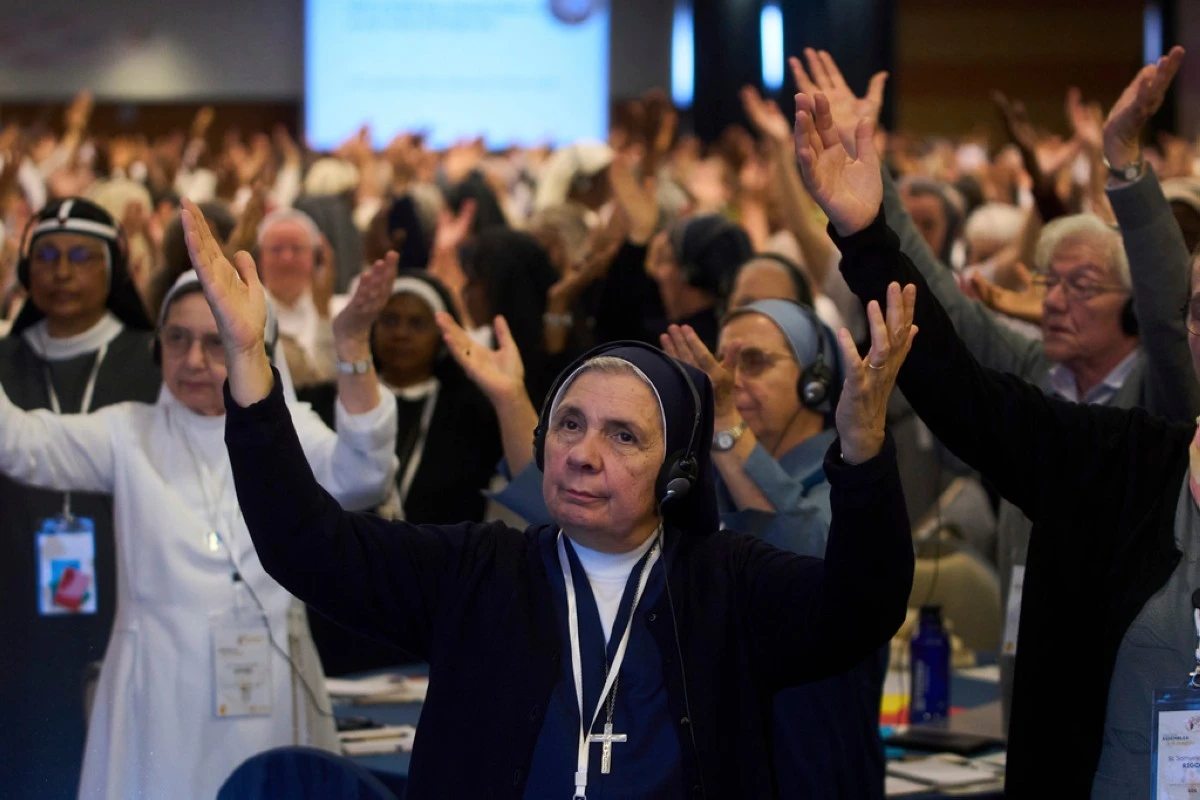
Nuns pray during a congress of nearly 900 superiors of the world's female religious orders in Rome, Monday, May 5, 2025. (AP Photo/Alessandra Tarantino)

By GIOVANNA DELL'ORTO 
ROME (AP) — They don't have a vote in the pope's election, but nearly 900 superiors of the world's female Catholic orders met in Rome on Monday to chart a course forward, a few miles from where cardinals will gather in a conclave to choose a successor to Pope Francis.
Sister Mary Barron, president of the umbrella group of leaders of women's religious orders, urged the superiors and the over 650,000 nuns worldwide to pray that the cardinals make the right choice and reflect on how to carry forward Francis' vision.
"We must be vigilant in doing our part to keep that flame of church renewal alive," she told the assembly of sisters — some in regular clothes, others in traditional habits.
The International Union of Superiors General is holding its plenary assembly this week – coincidentally at the same time as the conclave, which opens Wednesday.
The Catholic Church reserves the priesthood for men, so only men will choose the leader of the world's 1.4-billion Catholics. Of the 133 cardinals expected to vote at the conclave, 108 were appointed by Francis.
Among those present at the assembly was Sister Nathalie Becquart — elevated by Pope Francis as the first female undersecretary in the Vatican's Synod of Bishops office in 2021.
Many saw her appointment, as well as that of Sister Raffaella Petrini as president of the Vatican City State, as a sign that the rigidly male Catholic hierarchy might finally allow women to assume high-level decision-making responsibilities.
Delphine Kalisha of the Sisters of Mercy in Zambia said she hopes the new pope will continue to promote sisters in positions of leadership.
"That has given us hope for women in the church," Kalisha said.
Becquart told The Associated Press that sisters want "to be better listened to, like others, to be valued."
"Maybe you are a cardinal or a young sister, we are all together called to be protagonists to carry on the mission of the church," she said.
The orders at the assembly are involved in public ministries such as education and health. Superior generals from Argentina to Zambia said that's an essential role at the frontlines of the church's social work, which Francis emphasized.
Barron exhorted her fellow sisters, who last gathered in a general assembly in 2022, to continue to embrace Francis' vision of a church that listens to all by "daring to dream a future that reflects the boundless love of God."
Quoting from poets Emily Dickinson and Maya Angelou, she called religious sisters to meet the needs of the world's most marginalized.
"Our path forward might not be clear or conventional, but it's illuminated by the language of hope," Barron said.
Topics discussed in the first working session included wars, migration and human trafficking, climate change and economic inequality.
Several sister said they hope the next pope carries on Francis' legacy of outreach to the marginalized, whether at the Vatican or in impoverished borderlands.
Sister Graciela Trivilino of Argentina – who as head of the Franciscan Sisters of Bonlanden in Argentina has worked with people with addiction for many years – said the goal is "to take the Gospel to the concrete facts of everyday life."
In Sicily, Sister Maria Agnese Ciarrocco does street ministry with the Sisters of the Poor of Don Morinello.
"We're all in a climate of challenge," she said. "Let's keep hoping that religious life can still be something that attracts people precisely by the way we work, by our presence."
Several sisters said the decline in vocations even in Africa, a continent where Catholicism is strong, is a major worry for the future.
"Even just our presence is a lot of witness that people need," said Sister Theodosia Baki of the Tertiary Sisters of St. Francis in Cameroon. Her order focuses on the education of girls, as well as health and refugee care in five African countries.
Barron said that despite many challenges, including problems with securing visas for missionary work, the sisters' contributions are increasingly needed.
"I think right now in the Church and the world there are so many opportunities for consecrated life to make a difference," she said.

Related Tags

WORLDNEWS
ADVERTISEMENT
.most-popular .layout-ratio{ padding-bottom: 79.13%; } @media (min-width: 768px) and (max-width: 1024px) { .widget-title { font-size: 15px !important; } }

{{ articles_filter_1561_widget.title }}

.most-popular .layout-ratio{ padding-bottom: 79.13%; } @media (min-width: 768px) and (max-width: 1024px) { .widget-title { font-size: 15px !important; } }

{{ articles_filter_1562_widget.title }}

.most-popular .layout-ratio{ padding-bottom: 79.13%; } @media (min-width: 768px) and (max-width: 1024px) { .widget-title { font-size: 15px !important; } }

{{ articles_filter_1563_widget.title }}

{{ articles_filter_1564_widget.title }}

.mb-article-details { position: relative; } .mb-article-details .article-body-preview, .mb-article-details .article-body-summary{ font-size: 17px; line-height: 30px; font-family: "Libre Caslon Text", serif; color: #000; } .mb-article-details .article-body-preview iframe , .mb-article-details .article-body-summary iframe{ width: 100%; margin: auto; } .read-more-background { background: linear-gradient(180deg, color(display-p3 1.000 1.000 1.000 / 0) 13.75%, color(display-p3 1.000 1.000 1.000 / 0.8) 30.79%, color(display-p3 1.000 1.000 1.000) 72.5%); position: absolute; height: 200px; width: 100%; bottom: 0; display: flex; justify-content: center; align-items: center; padding: 0; } .read-more-background a{ color: #000; } .read-more-btn { padding: 17px 45px; font-family: Inter; font-weight: 700; font-size: 18px; line-height: 16px; text-align: center; vertical-align: middle; border: 1px solid black; background-color: white; } .hidden { display: none; }
function initializeAllSwipers() { // Get all hidden inputs with cms_article_id document.querySelectorAll('[id^="cms_article_id_"]').forEach(function (input) { const cmsArticleId = input.value; const articleSelector = '#article-' + cmsArticleId + ' .body_images'; const swiperElement = document.querySelector(articleSelector); if (swiperElement && !swiperElement.classList.contains('swiper-initialized')) { new Swiper(articleSelector, { loop: true, pagination: false, navigation: { nextEl: '#article-' + cmsArticleId + ' .swiper-button-next', prevEl: '#article-' + cmsArticleId + ' .swiper-button-prev', }, }); } }); } setTimeout(initializeAllSwipers, 3000); const intersectionObserver = new IntersectionObserver( (entries) => { entries.forEach((entry) => { if (entry.isIntersecting) { const newUrl = entry.target.getAttribute("data-url"); if (newUrl) { history.pushState(null, null, newUrl); let article = entry.target; // Extract metadata const author = article.querySelector('.author-section').textContent.replace('By', '').trim(); const section = article.querySelector('.section-info ').textContent.replace(' ', ' '); const title = article.querySelector('.article-title h1').textContent; // Parse URL for Chartbeat path format const parsedUrl = new URL(newUrl, window.location.origin); const cleanUrl = parsedUrl.host + parsedUrl.pathname; // Update Chartbeat configuration if (typeof window._sf_async_config !== 'undefined') { window._sf_async_config.path = cleanUrl; window._sf_async_config.sections = section; window._sf_async_config.authors = author; } // Track virtual page view with Chartbeat if (typeof pSUPERFLY !== 'undefined' && typeof pSUPERFLY.virtualPage === 'function') { try { pSUPERFLY.virtualPage({ path: cleanUrl, title: title, sections: section, authors: author }); } catch (error) { console.error('ping error', error); } } // Optional: Update document title if (title && title !== document.title) { document.title = title; } } } }); }, { threshold: 0.1 } ); function showArticleBody(button) { const article = button.closest("article"); const summary = article.querySelector(".article-body-summary"); const body = article.querySelector(".article-body-preview"); const readMoreSection = article.querySelector(".read-more-background"); // Hide summary and read-more section summary.style.display = "none"; readMoreSection.style.display = "none"; // Show the full article body body.classList.remove("hidden"); } document.addEventListener("DOMContentLoaded", () => { let loadCount = 0; // Track how many times articles are loaded const offset = [1, 2, 3, 4, 5, 6, 7, 8, 9, 10]; // Offset values const currentUrl = window.location.pathname.substring(1); let isLoading = false; // Prevent multiple calls if (!currentUrl) { console.log("Current URL is invalid."); return; } const sentinel = document.getElementById("load-more-sentinel"); if (!sentinel) { console.log("Sentinel element not found."); return; } function isSentinelVisible() { const rect = sentinel.getBoundingClientRect(); return ( rect.top < window.innerHeight && rect.bottom >= 0 ); } function onScroll() { if (isLoading) return; if (isSentinelVisible()) { if (loadCount >= offset.length) { console.log("Maximum load attempts reached."); window.removeEventListener("scroll", onScroll); return; } isLoading = true; const currentOffset = offset[loadCount]; window.loadMoreItems().then(() => { let article = document.querySelector('#widget_1690 > div:nth-last-of-type(2) article'); intersectionObserver.observe(article) loadCount++; }).catch(error => { console.error("Error loading more items:", error); }).finally(() => { isLoading = false; }); } } window.addEventListener("scroll", onScroll); });

Sign up by email to receive news.