ADVERTISEMENT

October's 'ring of fire' eclipse to dazzle South America and Pacific

Published Sep 30, 2024 10:33 am
ring of fire.jpg
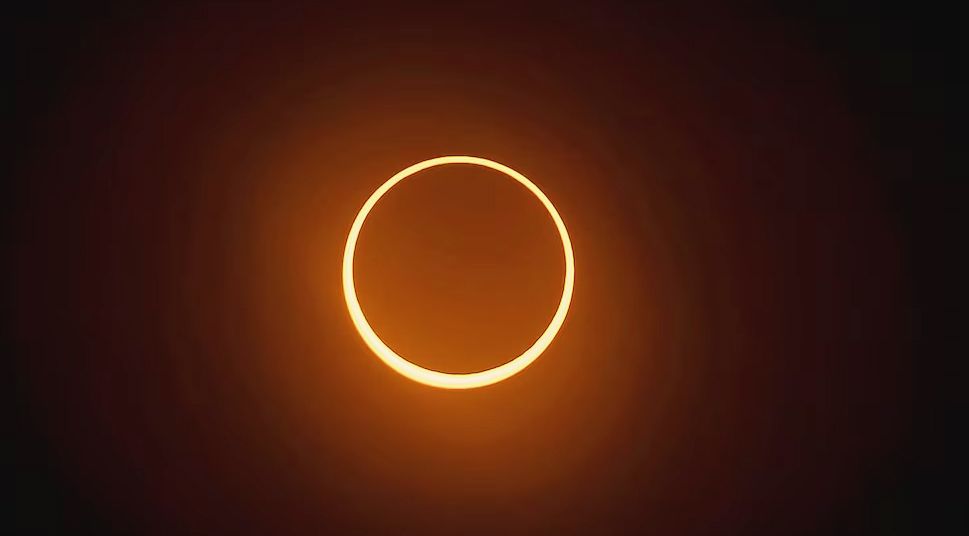
FILE PHOTO shows the ‘ring of fire’ annular eclipse during the Albuquerque International Balloon Fiesta in Albuquerque, N.M., on Saturday, Oct. 14, 2023. (Chancey Bush/The Albu-querque Journal via AP)


NEW YORK (AP) — A “ring of fire” eclipse of the sun is coming. But only a lucky few will be in the path.


The annular solar eclipse will be visible Wednesday over Easter Island and the tips of Argentina and Chile.


Here’s how to safely watch the final solar spectacle of the year.


What is an annular solar eclipse?


Solar eclipses happen when the sun, moon, and Earth line up just so. The moon casts a shadow that can partially or totally block the sun’s light.
During an annular eclipse, the moon obscures all but a ring-shaped sliver of the sun. That’s because the moon is at a point in its orbit that’s farther from Earth.


“The moon is just not quite big enough to cover the sun,” said Carolyn Sumners at the Houston Museum of Natural Science.


This eclipse will occur mostly over water in the Pacific. Rapa Nui, known as Easter Island, is in the path along with parts of Argentina and Chile.
A partial solar eclipse, when the sun appears as a crescent, can be seen from several locations including Brazil, Paraguay, Uruguay, and Hawaii.
Solar eclipses happen about two to five times a year. April's total eclipse of the sun dazzled skywatchers in parts of Mexico, Canada, and the US.


How do I safely look at a solar eclipse?
 

Looking directly at the sun can cause eye damage, even when most of it is covered.


The annular eclipse is safe to spot wearing solar eclipse glasses, which block out ultraviolet light from the sun and nearly all visible light. Sunglasses or binoculars won’t cut it.


Glasses should say they comply with ISO 12312-2 standards, though fake suppliers can also list this on their products.


If you don't have eclipse glasses, you can still enjoy the spectacle indirectly. Make a pinhole projector using household materials or hold up a colander and look down to see an image of the eclipse projected below.


Peering at the ground under a shady tree can also reveal crescent shadows as the sunlight filters through branches and leaves.


What’s coming next?
 

Two partial solar eclipses will grace the skies next year in March and September.


The next total solar eclipse won’t arrive until 2026 and will pass over the northern fringes of Greenland, Iceland, and Spain.

ADVERTISEMENT
.most-popular .layout-ratio{ padding-bottom: 79.13%; } @media (min-width: 768px) and (max-width: 1024px) { .widget-title { font-size: 15px !important; } }

{{ articles_filter_1561_widget.title }}

.most-popular .layout-ratio{ padding-bottom: 79.13%; } @media (min-width: 768px) and (max-width: 1024px) { .widget-title { font-size: 15px !important; } }

{{ articles_filter_1562_widget.title }}

.most-popular .layout-ratio{ padding-bottom: 79.13%; } @media (min-width: 768px) and (max-width: 1024px) { .widget-title { font-size: 15px !important; } }

{{ articles_filter_1563_widget.title }}

{{ articles_filter_1564_widget.title }}

.mb-article-details { position: relative; } .mb-article-details .article-body-preview, .mb-article-details .article-body-summary{ font-size: 17px; line-height: 30px; font-family: "Libre Caslon Text", serif; color: #000; } .mb-article-details .article-body-preview iframe , .mb-article-details .article-body-summary iframe{ width: 100%; margin: auto; } .read-more-background { background: linear-gradient(180deg, color(display-p3 1.000 1.000 1.000 / 0) 13.75%, color(display-p3 1.000 1.000 1.000 / 0.8) 30.79%, color(display-p3 1.000 1.000 1.000) 72.5%); position: absolute; height: 200px; width: 100%; bottom: 0; display: flex; justify-content: center; align-items: center; padding: 0; } .read-more-background a{ color: #000; } .read-more-btn { padding: 17px 45px; font-family: Inter; font-weight: 700; font-size: 18px; line-height: 16px; text-align: center; vertical-align: middle; border: 1px solid black; background-color: white; } .hidden { display: none; }
function initializeAllSwipers() { // Get all hidden inputs with cms_article_id document.querySelectorAll('[id^="cms_article_id_"]').forEach(function (input) { const cmsArticleId = input.value; const articleSelector = '#article-' + cmsArticleId + ' .body_images'; const swiperElement = document.querySelector(articleSelector); if (swiperElement && !swiperElement.classList.contains('swiper-initialized')) { new Swiper(articleSelector, { loop: true, pagination: false, navigation: { nextEl: '#article-' + cmsArticleId + ' .swiper-button-next', prevEl: '#article-' + cmsArticleId + ' .swiper-button-prev', }, }); } }); } setTimeout(initializeAllSwipers, 3000); const intersectionObserver = new IntersectionObserver( (entries) => { entries.forEach((entry) => { if (entry.isIntersecting) { const newUrl = entry.target.getAttribute("data-url"); if (newUrl) { history.pushState(null, null, newUrl); let article = entry.target; // Extract metadata const author = article.querySelector('.author-section').textContent.replace('By', '').trim(); const section = article.querySelector('.section-info ').textContent.replace(' ', ' '); const title = article.querySelector('.article-title h1').textContent; // Parse URL for Chartbeat path format const parsedUrl = new URL(newUrl, window.location.origin); const cleanUrl = parsedUrl.host + parsedUrl.pathname; // Update Chartbeat configuration if (typeof window._sf_async_config !== 'undefined') { window._sf_async_config.path = cleanUrl; window._sf_async_config.sections = section; window._sf_async_config.authors = author; } // Track virtual page view with Chartbeat if (typeof pSUPERFLY !== 'undefined' && typeof pSUPERFLY.virtualPage === 'function') { try { pSUPERFLY.virtualPage({ path: cleanUrl, title: title, sections: section, authors: author }); } catch (error) { console.error('ping error', error); } } // Optional: Update document title if (title && title !== document.title) { document.title = title; } } } }); }, { threshold: 0.1 } ); function showArticleBody(button) { const article = button.closest("article"); const summary = article.querySelector(".article-body-summary"); const body = article.querySelector(".article-body-preview"); const readMoreSection = article.querySelector(".read-more-background"); // Hide summary and read-more section summary.style.display = "none"; readMoreSection.style.display = "none"; // Show the full article body body.classList.remove("hidden"); } document.addEventListener("DOMContentLoaded", () => { let loadCount = 0; // Track how many times articles are loaded const offset = [1, 2, 3, 4, 5, 6, 7, 8, 9, 10]; // Offset values const currentUrl = window.location.pathname.substring(1); let isLoading = false; // Prevent multiple calls if (!currentUrl) { console.log("Current URL is invalid."); return; } const sentinel = document.getElementById("load-more-sentinel"); if (!sentinel) { console.log("Sentinel element not found."); return; } function isSentinelVisible() { const rect = sentinel.getBoundingClientRect(); return ( rect.top < window.innerHeight && rect.bottom >= 0 ); } function onScroll() { if (isLoading) return; if (isSentinelVisible()) { if (loadCount >= offset.length) { console.log("Maximum load attempts reached."); window.removeEventListener("scroll", onScroll); return; } isLoading = true; const currentOffset = offset[loadCount]; window.loadMoreItems().then(() => { let article = document.querySelector('#widget_1690 > div:nth-last-of-type(2) article'); intersectionObserver.observe(article) loadCount++; }).catch(error => { console.error("Error loading more items:", error); }).finally(() => { isLoading = false; }); } } window.addEventListener("scroll", onScroll); });

Sign up by email to receive news.