

ADVERTISEMENT

Israel releases video of a Gaza tunnel where it says Hamas militants killed 6 hostages

Published Sep 11, 2024 02:17 am

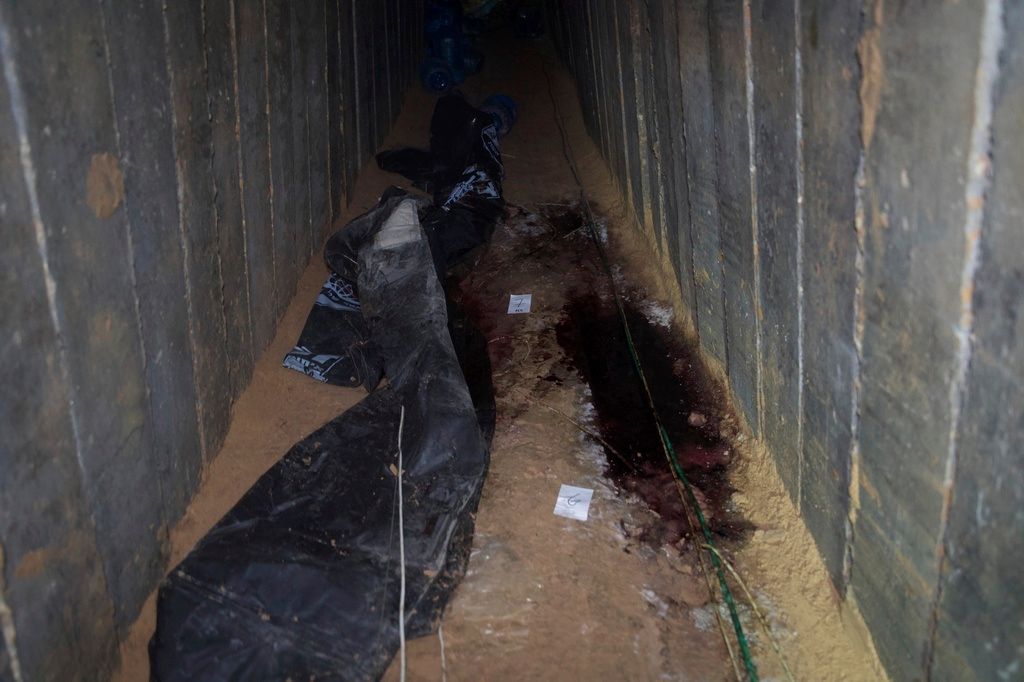
JERUSALEM (AP) — The Israeli military on Tuesday released video footage of a Gaza tunnel where it says six hostages were recently killed by Hamas. The video shows a low, narrow passageway deep underground that had no bathroom and poor ventilation.
IMG_6069.jpeg

This undated photo released by the Israel Defense Forces shows the Gaza tunnel where it says six Israeli hostages were recently killed by Hamas militants. (Israeli Army via AP)

The discovery of the hostages’ bodies last month has sparked a mass outpouring of anger in Israel and the release of the new video could add to the pressure on Prime Minister Benjamin Netanyahu to reach a cease-fire deal with Hamas to bring the remaining hostages held by Hamas home.

Israeli military spokesman Rear Adm. Daniel Hagari said Tuesday the footage of the Gaza tunnel had been shown to the hostages’ families, and that it “was very hard for them to see how their loved ones survived in those conditions.”

Hagari revealed the video in a nationally televised press conference after visiting the tunnel himself. He said the tunnel was reached by a shaft buried under a child's bedroom in a home in the southern Gaza town of Rafah. The tunnel was about 20 meters (70 feet) underground and stretched about 120 meters (yards).

In the video, a hunched-over Hagari, unable to stand upright in the narrow arched passageway, describes the conditions as extremely humid and difficult to breathe. He showed bottles of urine, a bucket that appeared to have served as a makeshift toilet, a chess board and ammunition for an automatic rifle believed to have been used by the captors.

“They were here in this tunnel in horrific conditions, where there's no air to breathe, where you cannot stand," he said.

The six included Israeli-American Hersh Goldberg-Polin, 23, a native of Berkeley, California, whose parents led a high-profile global campaign seeking his release. Goldberg-Polin lost part of his left arm to a grenade in the Oct. 7 attack that sparked the war in Gaza. In April, Hamas issued a video that showed him alive, sparking protests in Israel. The army identified the others as Ori Danino, 25; Eden Yerushalmi, 24; Almog Sarusi, 27; Alexander Lobanov, 33; and Carmel Gat, 40.

Three of the six – including Goldberg-Polin – had reportedly been scheduled to be released in the first phase of a cease-fire proposal discussed in July, further fueling anger when they were found dead.

The Hostages Families Forum, a group representing relatives of hostages, said in a statement that “time is running out” and called for an immediate deal to return those kidnapped.

“Every day that passes is a danger to their lives, hanging by a thread, at the mercy of terrorists capable of the worst crimes against humanity,” the group said.

Pathology tests on the bodies of the six, who were found by the military in the southern Gaza city of Rafah on Saturday, Aug. 31, showed they had been killed sometime on the night of Aug. 29, Hagari told reporters.

Hagari said Israeli soldiers found evidence indicating the hostages and at least two captors had been there for more than a few days. Mattresses, clothes, assault rifle magazines and shells were also found, as was some food, mainly energy bars and tuna. There were blood stains on the floor, he said.

The day before the bodies were found, Hagari said, the army had killed two militants trying to run away from a complex of tunnels near where the hostages were found. There was “a probability” that the two had been those who killed the hostages, he said. DNA tests were being carried out to verify this, he added.

Hamas kidnapped about 250 people during the Oct. 7 attack. More than 100 were released during a brief cease-fire in November in exchange for the release of Palestinians imprisoned by Israel. Eight have been rescued by Israeli forces, while Israeli troops mistakenly killed three Israeli hostages who had escaped captivity in December. Israeli authorities say 101 hostages remain in captivity, including 35 who are believed to be dead.

Shai Dickman, the cousin of Gat, one of the hostages who was found dead in the tunnel, told Israel's Channel 13 TV that the government should move immediately to reach a deal to bring home the remaining hostages.

“There are still people living like this,” she said, holding back tears. “If there had been a deal on time, Carmel would be sitting here.”

Hamas has offered to release the hostages in return for an end to the war, the withdrawal of Israeli forces from Gaza and the release of a large number of Palestinian prisoners, including high-profile militants. But negotiations on a cease-fire have failed to produce any deal.

Related Tags

world news
ADVERTISEMENT
.most-popular .layout-ratio{ padding-bottom: 79.13%; } @media (min-width: 768px) and (max-width: 1024px) { .widget-title { font-size: 15px !important; } }

{{ articles_filter_1561_widget.title }}

.most-popular .layout-ratio{ padding-bottom: 79.13%; } @media (min-width: 768px) and (max-width: 1024px) { .widget-title { font-size: 15px !important; } }

{{ articles_filter_1562_widget.title }}

.most-popular .layout-ratio{ padding-bottom: 79.13%; } @media (min-width: 768px) and (max-width: 1024px) { .widget-title { font-size: 15px !important; } }

{{ articles_filter_1563_widget.title }}

{{ articles_filter_1564_widget.title }}

.mb-article-details { position: relative; } .mb-article-details .article-body-preview, .mb-article-details .article-body-summary{ font-size: 17px; line-height: 30px; font-family: "Libre Caslon Text", serif; color: #000; } .mb-article-details .article-body-preview iframe , .mb-article-details .article-body-summary iframe{ width: 100%; margin: auto; } .read-more-background { background: linear-gradient(180deg, color(display-p3 1.000 1.000 1.000 / 0) 13.75%, color(display-p3 1.000 1.000 1.000 / 0.8) 30.79%, color(display-p3 1.000 1.000 1.000) 72.5%); position: absolute; height: 200px; width: 100%; bottom: 0; display: flex; justify-content: center; align-items: center; padding: 0; } .read-more-background a{ color: #000; } .read-more-btn { padding: 17px 45px; font-family: Inter; font-weight: 700; font-size: 18px; line-height: 16px; text-align: center; vertical-align: middle; border: 1px solid black; background-color: white; } .hidden { display: none; }
function initializeAllSwipers() { // Get all hidden inputs with cms_article_id document.querySelectorAll('[id^="cms_article_id_"]').forEach(function (input) { const cmsArticleId = input.value; const articleSelector = '#article-' + cmsArticleId + ' .body_images'; const swiperElement = document.querySelector(articleSelector); if (swiperElement && !swiperElement.classList.contains('swiper-initialized')) { new Swiper(articleSelector, { loop: true, pagination: false, navigation: { nextEl: '#article-' + cmsArticleId + ' .swiper-button-next', prevEl: '#article-' + cmsArticleId + ' .swiper-button-prev', }, }); } }); } setTimeout(initializeAllSwipers, 3000); const intersectionObserver = new IntersectionObserver( (entries) => { entries.forEach((entry) => { if (entry.isIntersecting) { const newUrl = entry.target.getAttribute("data-url"); if (newUrl) { history.pushState(null, null, newUrl); let article = entry.target; // Extract metadata const author = article.querySelector('.author-section').textContent.replace('By', '').trim(); const section = article.querySelector('.section-info ').textContent.replace(' ', ' '); const title = article.querySelector('.article-title h1').textContent; // Parse URL for Chartbeat path format const parsedUrl = new URL(newUrl, window.location.origin); const cleanUrl = parsedUrl.host + parsedUrl.pathname; // Update Chartbeat configuration if (typeof window._sf_async_config !== 'undefined') { window._sf_async_config.path = cleanUrl; window._sf_async_config.sections = section; window._sf_async_config.authors = author; } // Track virtual page view with Chartbeat if (typeof pSUPERFLY !== 'undefined' && typeof pSUPERFLY.virtualPage === 'function') { try { pSUPERFLY.virtualPage({ path: cleanUrl, title: title, sections: section, authors: author }); } catch (error) { console.error('ping error', error); } } // Optional: Update document title if (title && title !== document.title) { document.title = title; } } } }); }, { threshold: 0.1 } ); function showArticleBody(button) { const article = button.closest("article"); const summary = article.querySelector(".article-body-summary"); const body = article.querySelector(".article-body-preview"); const readMoreSection = article.querySelector(".read-more-background"); // Hide summary and read-more section summary.style.display = "none"; readMoreSection.style.display = "none"; // Show the full article body body.classList.remove("hidden"); } document.addEventListener("DOMContentLoaded", () => { let loadCount = 0; // Track how many times articles are loaded const offset = [1, 2, 3, 4, 5, 6, 7, 8, 9, 10]; // Offset values const currentUrl = window.location.pathname.substring(1); let isLoading = false; // Prevent multiple calls if (!currentUrl) { console.log("Current URL is invalid."); return; } const sentinel = document.getElementById("load-more-sentinel"); if (!sentinel) { console.log("Sentinel element not found."); return; } function isSentinelVisible() { const rect = sentinel.getBoundingClientRect(); return ( rect.top < window.innerHeight && rect.bottom >= 0 ); } function onScroll() { if (isLoading) return; if (isSentinelVisible()) { if (loadCount >= offset.length) { console.log("Maximum load attempts reached."); window.removeEventListener("scroll", onScroll); return; } isLoading = true; const currentOffset = offset[loadCount]; window.loadMoreItems().then(() => { let article = document.querySelector('#widget_1690 > div:nth-last-of-type(2) article'); intersectionObserver.observe(article) loadCount++; }).catch(error => { console.error("Error loading more items:", error); }).finally(() => { isLoading = false; }); } } window.addEventListener("scroll", onScroll); });

Sign up by email to receive news.