

ADVERTISEMENT

Sabalenka wins latest-starting match in US Open history that finally begins after midnight

Published Sep 1, 2024 12:57 am

At A Glance

  • Aryna Sabalenka finally got rolling after a bad beginning to the latest-starting match in U.S. Open history, regrouping to beat No. 29 Ekaterina Alexandrova, 2-6, 6-1, 6-2, early Saturday, Aug. 31, to reach the fourth round.
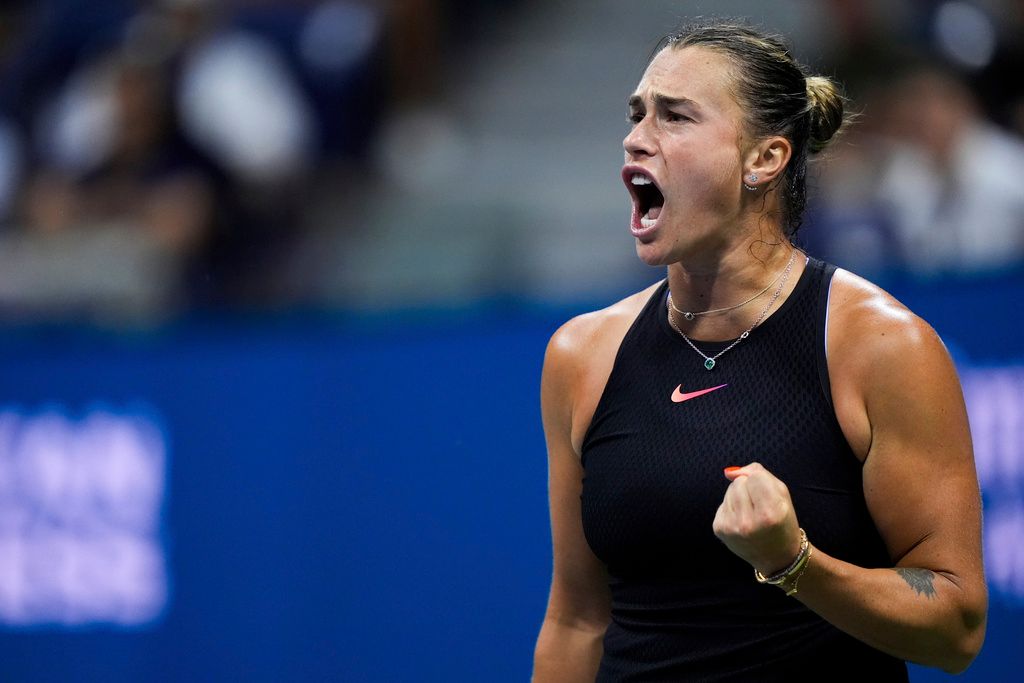
NEW YORK (AP) — Aryna Sabalenka finally got rolling after a bad beginning to the latest-starting match in U.S. Open history, regrouping to beat No. 29 Ekaterina Alexandrova, 2-6, 6-1, 6-2, early Saturday, Aug. 31, to reach the fourth round.

AP24244185671117.jpg
Aryna Sabalenka, of Belarus, reacts during a match against Erika Andreeva, of Russia, in the third round of the U.S. Open tennis championships early Saturday, Aug. 31, in New York. (AP Photo/Julia Nikhinson)

The No. 2 seed didn’t get underway until 12:07 a.m. and had dropped the first set barely a half-hour later. But she seized control early in the second set, winning 10 straight games to open a 5-0 lead in the third.

The runner-up last year in Flushing Meadows eventually finished off the victory at 1:48, tied for the second-latest ending to a women’s match at the U.S. Open, and advanced to face No. 33 seed Elise Mertens on Sunday.

“I was happy that I was able to stay focused, no matter what, and I was able to turn around this match,” Sabalenka said.

The previous latest start to a women’s match at the U.S. Open was exactly at midnight on Sept. 2, 1987, with Gabriela Sabatini going on to beat Beverly Bowes 6-3, 6-3.

The night session at Arthur Ashe Stadium began more than an hour after its usual 7 p.m. starting time following Frances Tiafoe’s victory over Ben Shelton in the afternoon that lasted 4 hours, 3 minutes.

Under a new late-night match policy the tournament debuted this year, the tournament referee can move any match that hasn’t gone on by 11:15 p.m.. Instead, Sabalenka and Alexandrova were kept on Ashe, finally getting on the court after defending champion Novak Djokovic was shocked by No. 28 seed Alexei Popyrin in four sets.

A U.S. Tennis Association spokesman said tournament officials kept the Grandstand available in the event they wanted to move the Sabalenka-Alexandrova match. A decision was going to be made by the end of the fourth set of the Djokovic-Popyrin match.

Sabalenka said her desire was to remain on Ashe, though she would prefer it be in the opener of the night session and put the men second.

The bigger problem was the quick start by Alexandrova, who broke Sabalenka’s serve twice in the first set.

“She just crushed it. She played so well,” Sabalenka said.

But once Sabalenka broke for a 3-1 lead in the second set, she got going quickly from there to wrap it up earlier than the latest end of a women’s match, when Maria Sakkari finished off Bianca Andreescu at 2:13 a.m. on Sept. 6, 2021.

Sabalenka hoped to be in bed by 4 a.m. and sleep as long as she could.

“Technically, I did my practice session today, so I’m good for tomorrow, right?” she joked. “Can I just tell my team that? It’s 2 a.m.; we count it like today.”

The match wasn’t the last to end. No. 4 Alexander Zverev outlasted Tomas Martin Etcheverry 5-7, 7-5, 6-1, 6-3 in a match that ended at 2:35 a.m.

Related Tags

US Open Aryna Sabalenka
ADVERTISEMENT
.most-popular .layout-ratio{ padding-bottom: 79.13%; } @media (min-width: 768px) and (max-width: 1024px) { .widget-title { font-size: 15px !important; } }

{{ articles_filter_1561_widget.title }}

.most-popular .layout-ratio{ padding-bottom: 79.13%; } @media (min-width: 768px) and (max-width: 1024px) { .widget-title { font-size: 15px !important; } }

{{ articles_filter_1562_widget.title }}

.most-popular .layout-ratio{ padding-bottom: 79.13%; } @media (min-width: 768px) and (max-width: 1024px) { .widget-title { font-size: 15px !important; } }

{{ articles_filter_1563_widget.title }}

{{ articles_filter_1564_widget.title }}

.mb-article-details { position: relative; } .mb-article-details .article-body-preview, .mb-article-details .article-body-summary{ font-size: 17px; line-height: 30px; font-family: "Libre Caslon Text", serif; color: #000; } .mb-article-details .article-body-preview iframe , .mb-article-details .article-body-summary iframe{ width: 100%; margin: auto; } .read-more-background { background: linear-gradient(180deg, color(display-p3 1.000 1.000 1.000 / 0) 13.75%, color(display-p3 1.000 1.000 1.000 / 0.8) 30.79%, color(display-p3 1.000 1.000 1.000) 72.5%); position: absolute; height: 200px; width: 100%; bottom: 0; display: flex; justify-content: center; align-items: center; padding: 0; } .read-more-background a{ color: #000; } .read-more-btn { padding: 17px 45px; font-family: Inter; font-weight: 700; font-size: 18px; line-height: 16px; text-align: center; vertical-align: middle; border: 1px solid black; background-color: white; } .hidden { display: none; }
function initializeAllSwipers() { // Get all hidden inputs with cms_article_id document.querySelectorAll('[id^="cms_article_id_"]').forEach(function (input) { const cmsArticleId = input.value; const articleSelector = '#article-' + cmsArticleId + ' .body_images'; const swiperElement = document.querySelector(articleSelector); if (swiperElement && !swiperElement.classList.contains('swiper-initialized')) { new Swiper(articleSelector, { loop: true, pagination: false, navigation: { nextEl: '#article-' + cmsArticleId + ' .swiper-button-next', prevEl: '#article-' + cmsArticleId + ' .swiper-button-prev', }, }); } }); } setTimeout(initializeAllSwipers, 3000); const intersectionObserver = new IntersectionObserver( (entries) => { entries.forEach((entry) => { if (entry.isIntersecting) { const newUrl = entry.target.getAttribute("data-url"); if (newUrl) { history.pushState(null, null, newUrl); let article = entry.target; // Extract metadata const author = article.querySelector('.author-section').textContent.replace('By', '').trim(); const section = article.querySelector('.section-info ').textContent.replace(' ', ' '); const title = article.querySelector('.article-title h1').textContent; // Parse URL for Chartbeat path format const parsedUrl = new URL(newUrl, window.location.origin); const cleanUrl = parsedUrl.host + parsedUrl.pathname; // Update Chartbeat configuration if (typeof window._sf_async_config !== 'undefined') { window._sf_async_config.path = cleanUrl; window._sf_async_config.sections = section; window._sf_async_config.authors = author; } // Track virtual page view with Chartbeat if (typeof pSUPERFLY !== 'undefined' && typeof pSUPERFLY.virtualPage === 'function') { try { pSUPERFLY.virtualPage({ path: cleanUrl, title: title, sections: section, authors: author }); } catch (error) { console.error('ping error', error); } } // Optional: Update document title if (title && title !== document.title) { document.title = title; } } } }); }, { threshold: 0.1 } ); function showArticleBody(button) { const article = button.closest("article"); const summary = article.querySelector(".article-body-summary"); const body = article.querySelector(".article-body-preview"); const readMoreSection = article.querySelector(".read-more-background"); // Hide summary and read-more section summary.style.display = "none"; readMoreSection.style.display = "none"; // Show the full article body body.classList.remove("hidden"); } document.addEventListener("DOMContentLoaded", () => { let loadCount = 0; // Track how many times articles are loaded const offset = [1, 2, 3, 4, 5, 6, 7, 8, 9, 10]; // Offset values const currentUrl = window.location.pathname.substring(1); let isLoading = false; // Prevent multiple calls if (!currentUrl) { console.log("Current URL is invalid."); return; } const sentinel = document.getElementById("load-more-sentinel"); if (!sentinel) { console.log("Sentinel element not found."); return; } function isSentinelVisible() { const rect = sentinel.getBoundingClientRect(); return ( rect.top < window.innerHeight && rect.bottom >= 0 ); } function onScroll() { if (isLoading) return; if (isSentinelVisible()) { if (loadCount >= offset.length) { console.log("Maximum load attempts reached."); window.removeEventListener("scroll", onScroll); return; } isLoading = true; const currentOffset = offset[loadCount]; window.loadMoreItems().then(() => { let article = document.querySelector('#widget_1690 > div:nth-last-of-type(2) article'); intersectionObserver.observe(article) loadCount++; }).catch(error => { console.error("Error loading more items:", error); }).finally(() => { isLoading = false; }); } } window.addEventListener("scroll", onScroll); });

Sign up by email to receive news.