ADVERTISEMENT

Hiroshima governor says nuclear disarmament must be tackled as a pressing issue, not an ideal

Published Aug 6, 2024 01:27 pm
AP24219043202786.jpg
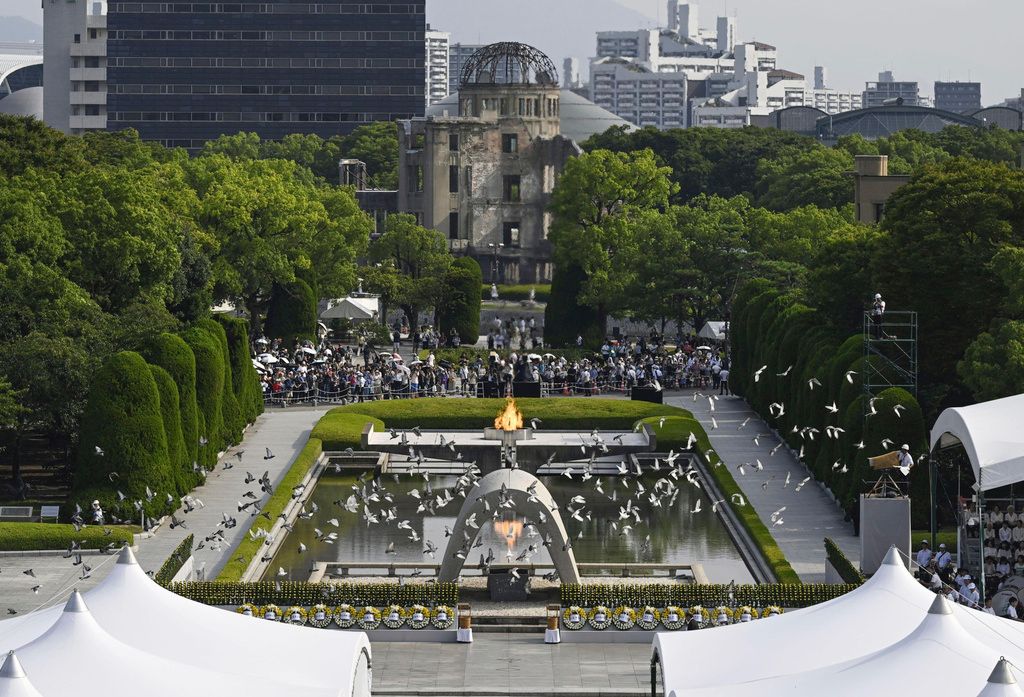
Doves fly over the cenotaph dedicated to the victims of the atomic bombing during an annual ceremony marking the 79th anniversary of the world's first atomic bombing, at the Peace Memorial Park in Hiroshima, western Japan, Tuesday, Aug. 6, 2024. (Yu Nakajima/Kyodo News via AP)

TOKYO (AP) — Hiroshima officials urged world leaders Tuesday to stop relying on nuclear weapons as deterrence and take immediate action toward abolishment — not as an ideal, but to remove the risk of atomic war amid conflicts in Ukraine and the Middle East and rising tensions in East Asia.

They commented as Hiroshima remembered its atomic bombing 79 years ago at the end of World War II.

The memorial comes days after Japan and the U.S. reaffirmed Washington's commitment to “extended deterrence,” which includes atomic weapons, to protect its Asian ally. That is a shift from Japan’s past reluctance to openly discuss the sensitive issue as the world’s only country to have suffered atomic attacks.

Hiroshima Gov. Hidehiko Yuzaki said nuclear-armed nations and supporters of atomic deterrence “deliberately ignore ... the fact that once people invented a weapon, they used it without exception.”

“As long as nuclear weapons exist, they will surely be used again someday,” Yuzaki said in his address at the Hiroshima Peace Memorial Park.

“Nuclear weapons abolition is not an ideal to achieve far in the future. Instead, it is a pressing and real issue that we should desperately engage in at this moment since nuclear problems involve an imminent risk to human survival,” he said.

Hiroshima Mayor Kazumi Matsui said Russia’s war on Ukraine and the worsening conflict between Israel and Palestinians are “deepening distrust and fear among nations” and reinforcing a view that use of force in settling conflict is unavoidable.

The atomic bomb dropped by the United States on Hiroshima on Aug. 6, 1945, destroyed the city, killing 140,000 people. A second bomb dropped three days later on Nagasaki killed 70,000 more. Japan surrendered on Aug. 15, ending World War II and Japan’s nearly half-century aggression in Asia.

About 50,000 people at the ceremony observed a minute of silence with the sound of a peace bell at 8:15 a.m., the time when a U.S. B-29 dropped the bomb on the city. Hundreds of white doves, considered symbols of peace, were released.

Prime Minister Fumio Kishida, who attended the ceremony, said global conflicts and divided views over approaches to nuclear disarmament make achieving that goal “all the more challenging,” but pledged to do his utmost in pursuing “realistic and practical measures” to build momentum within the international community.

His critics say it is a hollow promise because Japan relies on the U.S. nuclear umbrella for protection and has been rapidly expanding its military.

Japan, the United States and other regional allies have been stepping up security cooperation in response to a more assertive China and the growing nuclear and missile threats from North Korea. Japan has sought stronger U.S. protection by its nuclear capability.

Many survivors of the bombings have lasting injuries and illnesses resulting from the explosions and radiation exposure and have faced discrimination in Japan.

As of March, 106,823 survivors — 6,824 fewer than a year ago, and now with an average age of 85.58 — are certified as eligible for government medical support, according to the Health and Welfare Ministry. Many others, including those who say they were victims of the radioactive “black rain” that fell outside the initially designated areas of Hiroshima and Nagasaki, are still without support.

Hiroshima officials called on Kishida’s government to do more to provide support and address their wishes.

The aging survivors, known as “hibakusha,” continue to push for a nuclear arms ban as they desperately campaign to have their effort kept alive by younger generations.

Related Tags

WORLDNEWS
ADVERTISEMENT
.most-popular .layout-ratio{ padding-bottom: 79.13%; } @media (min-width: 768px) and (max-width: 1024px) { .widget-title { font-size: 15px !important; } }

{{ articles_filter_1561_widget.title }}

.most-popular .layout-ratio{ padding-bottom: 79.13%; } @media (min-width: 768px) and (max-width: 1024px) { .widget-title { font-size: 15px !important; } }

{{ articles_filter_1562_widget.title }}

.most-popular .layout-ratio{ padding-bottom: 79.13%; } @media (min-width: 768px) and (max-width: 1024px) { .widget-title { font-size: 15px !important; } }

{{ articles_filter_1563_widget.title }}

{{ articles_filter_1564_widget.title }}

.mb-article-details { position: relative; } .mb-article-details .article-body-preview, .mb-article-details .article-body-summary{ font-size: 17px; line-height: 30px; font-family: "Libre Caslon Text", serif; color: #000; } .mb-article-details .article-body-preview iframe , .mb-article-details .article-body-summary iframe{ width: 100%; margin: auto; } .read-more-background { background: linear-gradient(180deg, color(display-p3 1.000 1.000 1.000 / 0) 13.75%, color(display-p3 1.000 1.000 1.000 / 0.8) 30.79%, color(display-p3 1.000 1.000 1.000) 72.5%); position: absolute; height: 200px; width: 100%; bottom: 0; display: flex; justify-content: center; align-items: center; padding: 0; } .read-more-background a{ color: #000; } .read-more-btn { padding: 17px 45px; font-family: Inter; font-weight: 700; font-size: 18px; line-height: 16px; text-align: center; vertical-align: middle; border: 1px solid black; background-color: white; } .hidden { display: none; }
function initializeAllSwipers() { // Get all hidden inputs with cms_article_id document.querySelectorAll('[id^="cms_article_id_"]').forEach(function (input) { const cmsArticleId = input.value; const articleSelector = '#article-' + cmsArticleId + ' .body_images'; const swiperElement = document.querySelector(articleSelector); if (swiperElement && !swiperElement.classList.contains('swiper-initialized')) { new Swiper(articleSelector, { loop: true, pagination: false, navigation: { nextEl: '#article-' + cmsArticleId + ' .swiper-button-next', prevEl: '#article-' + cmsArticleId + ' .swiper-button-prev', }, }); } }); } setTimeout(initializeAllSwipers, 3000); const intersectionObserver = new IntersectionObserver( (entries) => { entries.forEach((entry) => { if (entry.isIntersecting) { const newUrl = entry.target.getAttribute("data-url"); if (newUrl) { history.pushState(null, null, newUrl); let article = entry.target; // Extract metadata const author = article.querySelector('.author-section').textContent.replace('By', '').trim(); const section = article.querySelector('.section-info ').textContent.replace(' ', ' '); const title = article.querySelector('.article-title h1').textContent; // Parse URL for Chartbeat path format const parsedUrl = new URL(newUrl, window.location.origin); const cleanUrl = parsedUrl.host + parsedUrl.pathname; // Update Chartbeat configuration if (typeof window._sf_async_config !== 'undefined') { window._sf_async_config.path = cleanUrl; window._sf_async_config.sections = section; window._sf_async_config.authors = author; } // Track virtual page view with Chartbeat if (typeof pSUPERFLY !== 'undefined' && typeof pSUPERFLY.virtualPage === 'function') { try { pSUPERFLY.virtualPage({ path: cleanUrl, title: title, sections: section, authors: author }); } catch (error) { console.error('ping error', error); } } // Optional: Update document title if (title && title !== document.title) { document.title = title; } } } }); }, { threshold: 0.1 } ); function showArticleBody(button) { const article = button.closest("article"); const summary = article.querySelector(".article-body-summary"); const body = article.querySelector(".article-body-preview"); const readMoreSection = article.querySelector(".read-more-background"); // Hide summary and read-more section summary.style.display = "none"; readMoreSection.style.display = "none"; // Show the full article body body.classList.remove("hidden"); } document.addEventListener("DOMContentLoaded", () => { let loadCount = 0; // Track how many times articles are loaded const offset = [1, 2, 3, 4, 5, 6, 7, 8, 9, 10]; // Offset values const currentUrl = window.location.pathname.substring(1); let isLoading = false; // Prevent multiple calls if (!currentUrl) { console.log("Current URL is invalid."); return; } const sentinel = document.getElementById("load-more-sentinel"); if (!sentinel) { console.log("Sentinel element not found."); return; } function isSentinelVisible() { const rect = sentinel.getBoundingClientRect(); return ( rect.top < window.innerHeight && rect.bottom >= 0 ); } function onScroll() { if (isLoading) return; if (isSentinelVisible()) { if (loadCount >= offset.length) { console.log("Maximum load attempts reached."); window.removeEventListener("scroll", onScroll); return; } isLoading = true; const currentOffset = offset[loadCount]; window.loadMoreItems().then(() => { let article = document.querySelector('#widget_1690 > div:nth-last-of-type(2) article'); intersectionObserver.observe(article) loadCount++; }).catch(error => { console.error("Error loading more items:", error); }).finally(() => { isLoading = false; }); } } window.addEventListener("scroll", onScroll); });

Sign up by email to receive news.