







PH, Germany eye finalization of 'broader' defense agreement


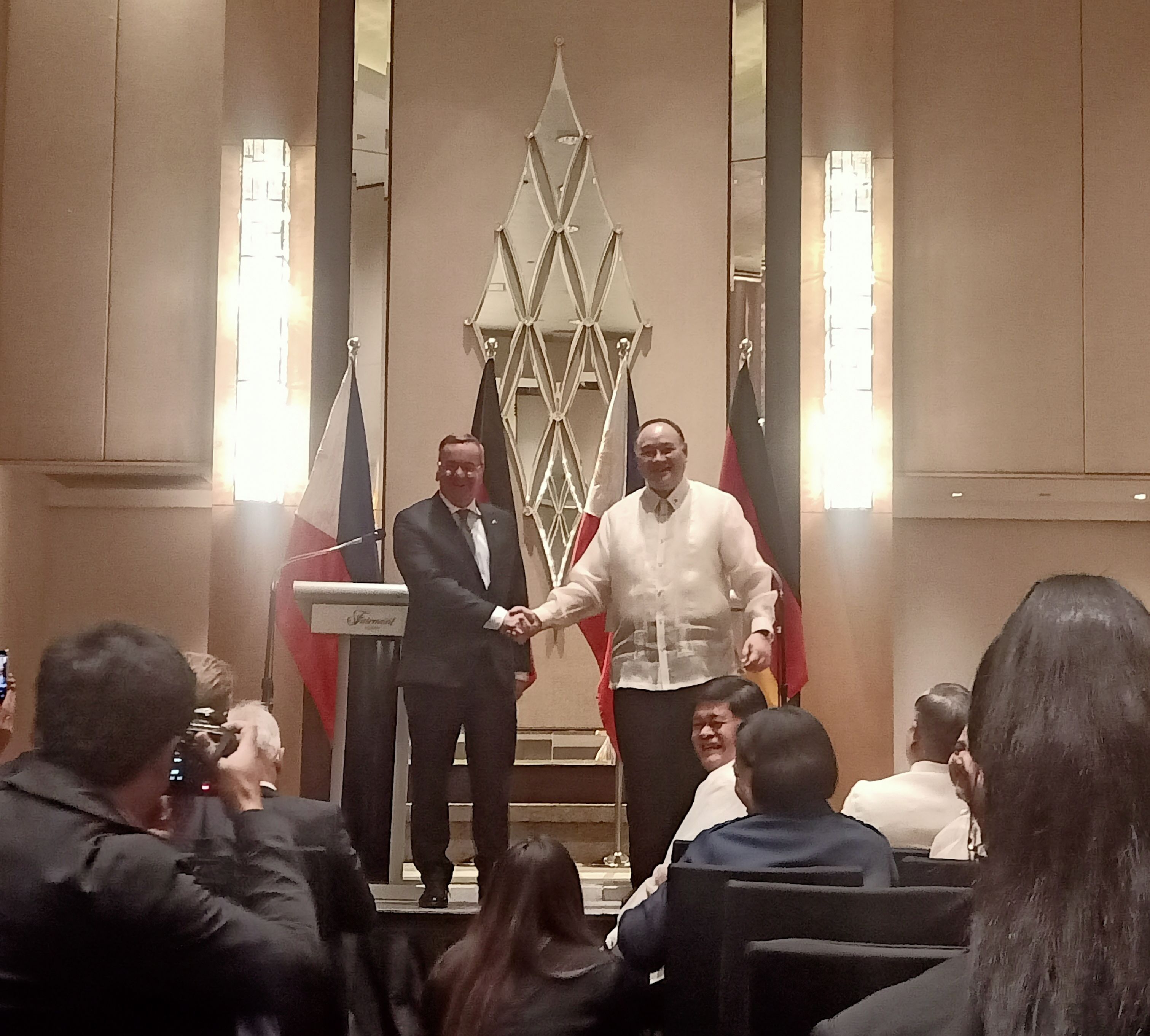
The defense departments of the Philippines and Germany committed to conclude a “broader” defense agreement “within this year” as both countries expressed a united stand to resist “unlawful” actions by China in the South China Sea, top defense officials from the two countries said on Sunday, Aug. 4.
Department of National Defense (DND) Sec. Gilberto Teodoro Jr. met German Federal Minister of Defense Boris Pistorius in Makati City, where they discussed trends in the security environment and exchanged views on regional issues in the Indo-Pacific and Eastern Europe. This marked the first ever visit to the Philippines by a German Federal defense minister.
Teodoro and Pistorius said in a joint statement that they “committed to conclude a broader Arrangement on Defense Cooperation, which will expand the scope of mutually beneficial cooperation between the Philippines and Germany into new areas,” in recognition of the security challenges that both countries face, including China’s aggression in the West Philippine Sea (WPS).
Details of the agreement were not discussed in detail but during their meeting, Teodoro and Pistorius expressed their “unwavering commitment” to the revitalization of the Philippines-Germany defense relations.
“We agreed to enhance further cooperation initiatives entered into various fields, and perhaps conclude as soon as possible the Defense Cooperation Agreement with Germany. We feel that there are synergies in technologies, in defense industries, in capabilities, in mutual exchange of training and education and a host of other areas particularly in technological and cybersecurity,” Teodoro said.
As for the timeline of the conclusion of the agreement, Teodoro said both sides are working to have it completed “hopefully as soon as possible, hopefully within this year" while Pistorius said it will be inked "maybe in October."
However, Teodoro said it is still premature to say that the planned broader defense agreement between the Philippines and Germany would blossom into the establishment of a Visiting Forces Agreement (VFA).
“I believe it would be too premature to say whether or not a Visiting Forces Agreement will result from this. Who knows? But we cannot say at this time,” Teodoro said.
The VFA is a military pact that provides the legal basis and status protections for foreign military personnel in the Philippines on official business, and vice versa.
The Philippines has a VFA with the United States and Australia, while it signed a counterpart agreement dubbed as Reciprocal Access Agreement (RAA) with Japan just last month.
With the renewed ties, Teodoro said that he invited the German Navy to join the Philippine Navy (PN) in a joint sail in the WPS through the conduct of a maritime cooperative activity (MCA).
Within the past week, the PN held bilateral sails in the WPS with the United States Navy (USN) and Japanese Maritime Self-Defense Force (JMSDF).
The Philippines is also looking to establish a defense attache office in Germany.
Alliance
Germany is one of the Philippines’ oldest formal defense partners through the 1974 Administrative Agreement concerning the training of Armed Forces of the Philippines (AFP) personnel in Berlin.
“This year we are resuming relations with our ministries,” Pistorius said. “We want to build long-lasting relations between our armed forces and we want to learn from each other. Second, we want to cooperate more closely in the fields of armaments. This could for example include cooperation in air defense, coastal defense. We want to further expand our training cooperation.”
The German defense chief said the planned broader defense agreement is “crucial” for both Manila and Berlin.
“It also sends a clear message to our partners that countries advocating a rules-based international order stand together, and our stance is clear: all countries must be able to enjoy freedom of navigation regardless of the economic strength or geographic size,” Pistorius noted.
Although the Philippines and China agreed to de-escalate the tension in the WPS through diplomatic talks, Beijing continues to deploy ships within the exclusive economic zone (EEZ) of Manila.
China claims almost the entire South China Sea, overlapping with the territorial claims of several Southeast Asian countries including the Philippines.
“There is only one cause of conflict in the South China Sea, in particular, the West Philippine Sea: it is China’s illegal and unilateral attempt to appropriate most if not all of the South China Sea as their internal waters pursuant to now their 10-dash line,” Teodoro said.
Teodoro and Pistorius reaffirmed their staunch commitment to freedom of navigation, overflight, and other peaceful uses of the seas consistent with the United Nations Convention on the Law of the Sea (UNCLOS), and agreed to continue promoting the comprehensive implementation of UNCLOS as the legal framework within which all activities in the oceans and seas must be carried out.
They also reaffirmed that the 2016 Arbitral Award on the South China Sea, which invalidated China’s claims in the SCS, is final and legally binding.
Pistorius’ visit to Manila serves as a follow-up to his meeting with the then DND OIC Senior Undersecretary Carlito G. Galvez Jr.’s on June 3, 2023 on the sidelines of the 20th International Institute for Strategic Studies (IISS) Shangri-La Dialogue (SLD), where both sides discussed prospects for deepening defense cooperation towards the shared goal of upholding peace and stability.
The meeting also coincides with the 70th anniversary of Philippines-Germany diplomatic relations, which was formally established in 1954.