






 Sports
Djokovic bags first Olympic gold medal, beats Alcaraz in the men's tennis final
Sports
Djokovic bags first Olympic gold medal, beats Alcaraz in the men's tennis final
Djokovic bags first Olympic gold medal, beats Alcaraz in the men's tennis final


At A Glance
- He finally got one at age 37. Doesn't matter a bit how long it took. Djokovic beat Carlos Alcaraz, 7-6 (3), 7-6 (2), in an enthralling and evenly matched men's tennis singles final at the 2024 Games on Sunday, Aug. 4.
PARIS (AP) — For all of his Grand Slam championships and other titles, for all of his time at No. 1, Novak Djokovic really, really wanted an Olympic gold medal for Serbia, the last significant accomplishment missing from his glittering resume.
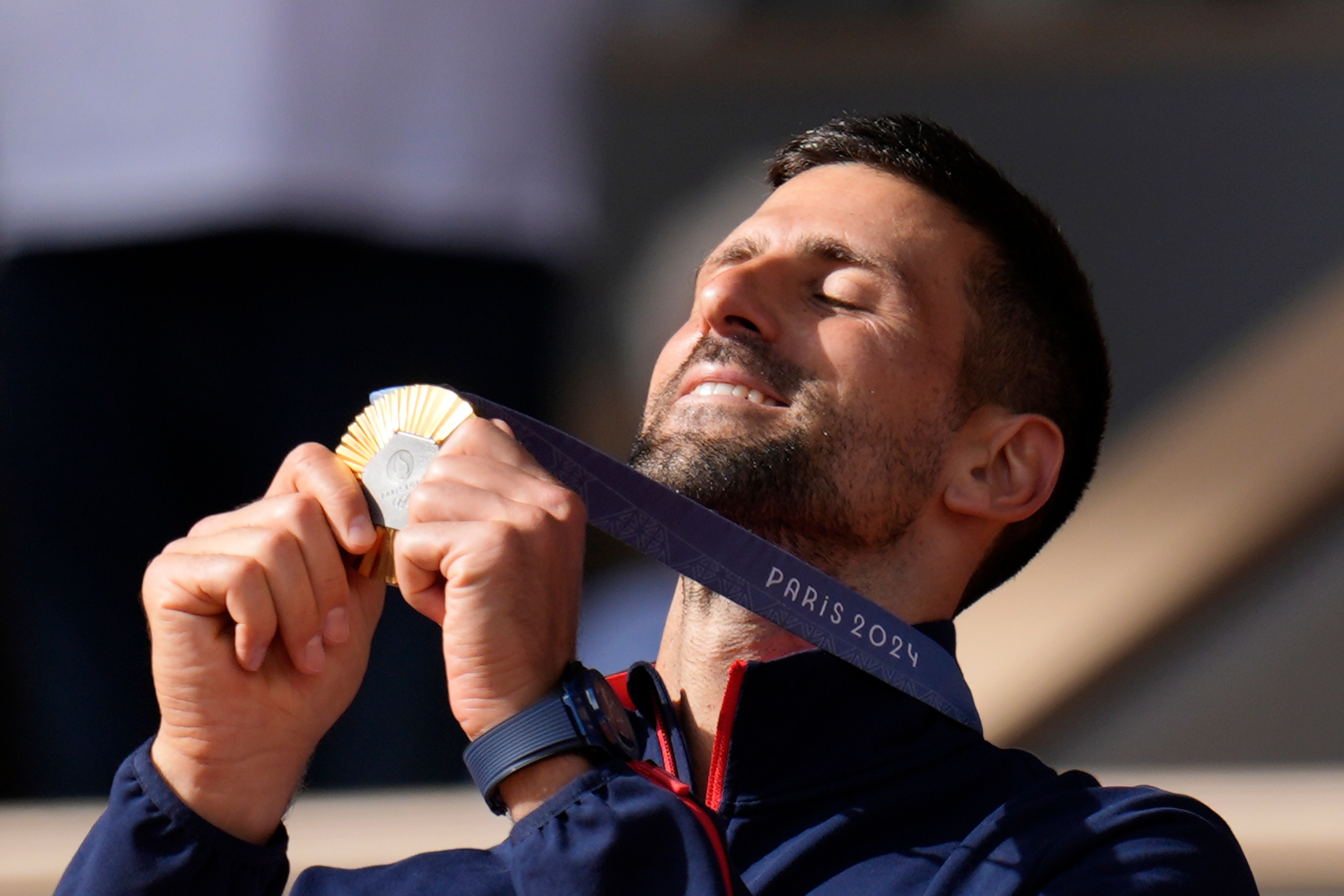
He finally got one at age 37. Doesn’t matter a bit how long it took. Djokovic beat Carlos Alcaraz, 7-6 (3), 7-6 (2), in an enthralling and evenly matched men’s tennis singles final at the 2024 Games on Sunday, Aug. 4.
“I put my heart, my soul, my body, my family — my everything — on the line to win Olympic gold,” Djokovic said. “Incredible battle. Incredible fight.”
His impressive career already featured a men’s-record 24 Grand Slam trophies and the most weeks spent atop in the rankings by any man or woman. It also already contained a Summer Olympics medal, from 2008, but it was a bronze — and he made it clear that simply wasn’t sufficient.
Until he got past bronze medalist Lorenzo Musetti of Italy in the semifinals Friday, Djokovic was 0-3 in that round at the Games. He lost to the eventual gold winner each time: Rafael Nadal at Beijing in 2008, Andy Murray at London in 2012, and Alexander Zverev in Tokyo three years ago.
Before facing Musetti, Djokovic said, “I was like, ‘OK, let’s get through this one.’ That’s why today, before the match, I did not feel as nervous as I would normally feel, because I had secured a medal.”
In Paris, wearing a gray sleeve over the right knee that required surgery for a torn meniscus two months ago, Djokovic faced Nadal in the second round and eliminated his longtime rival in straight sets. Now Djokovic is the oldest man to win the singles gold in his sport since 1908 — and prevented Spain’s Alcaraz, who is 21, from becoming the youngest.
When the victory was his, when the gold was his, thanks to one last forehand winner, Djokovic turned toward his team in the stands — sitting in front of his wife and their two children — dropped his racket and knelt on the clay. As emotional as ever, he cried and covered his face, then rose and grabbed a red-white-and-blue Serbian flag.
After hugs in the stands, Djokovic waved that flag.
“In the tough moments, he gave it an extra push,” silver medalist Alcaraz said through his own tears. “It hurts to lose like this.”
The final, which lasted 2 hours, 50 minutes despite being decided in only two sets, was a rematch of the Wimbledon title match three weeks ago that Alcaraz won to follow up his French Open title in June.
Alcaraz also defeated Djokovic in last year’s final at the All England Club, but Djokovic won when they met in the semifinals of the 2023 French Open, the annual clay-court tournament held at Roland Garros, the site used for tennis during these Olympics.
Sunday’s contest was an enthralling matchup, featuring one of the best to ever do it in Djokovic, and the best at the moment in Alcaraz. Indeed, could have been frustrating for Djokovic to find himself once again across the net from a younger, speedier version of himself. Maybe that’s why Djokovic frequently looked up and gesticulated and muttered toward his guest box.
Still, he came out on top.
“Honestly, when the last shot went through him, past him, that was the only moment I actually thought I can win the match,” Djokovic said.
It required long exchanges filled with superb ball-striking, deft drop shots — Alcaraz’s tended to be more successful, sometimes so good Djokovic declined to even give chase — and tremendous sprinting, sliding, stretching defense at both ends. They served so well that neither got broken even once: Djokovic saved eight break points, Alcaraz six.
Most remarkable, perhaps, was how cleanly both men played, despite the talent of the opposition and pressure of the occasion.
The only shame, perhaps, for the fans — and, naturally, Alcaraz — was that the Olympics uses a best-of-three-set format, instead of the best-of-five at Grand Slam tournaments. Make no mistake, this encounter between the No. 1-seeded Djokovic and No. 2-seeded Alcaraz was worthy of a major final.
Those in the stands became part of the show, repeatedly breaking out into choruses of “No-le! No-le!” or “Car-los! Car-los!” that often overlapped, creating an operatic fugue. In the second set, as Alcaraz attempted to mount a comeback, his supporters began chanting, “Si, se puede!” (essentially, “Yes, you can!”) while shaking their red-and-yellow flags. Chair umpire Damien Dumusois occasionally reminded folks to remain silent during the action.
Yet the place also became as quiet as a theater between points, enough so that play was delayed briefly when the air thick with anticipation was pierced by a young child’s crying.
Both men played to the crowd. When Alcaraz raced to reach one drop shot and deposit it over the net for a winner, he basked in the raucous reaction by pointing his right index finger to his ear. When Djokovic laced a cross-court forehand winner on the run to cap a 10-shot point to lead 3-2 in the second tiebreaker, he waved both arms overhead to encourage folks who already were standing and screaming.
The first set alone lasted more than 1 1/2 hours, full of epic shots and epic games. One lasted 18 points spread over more than a dozen mesmerizing minutes, including five break chances for Alcaraz, before Djokovic managed to hold for a 5-4 lead. In the tiebreaker, Djokovic was superior in crunch time, as he so often is, taking the last four points.
At 3-all, Alcaraz delivered a body serve, but Djokovic slid just enough to his left to smack a cross-court forehand return winner. After two mistakes by Alcaraz, Djokovic produced a volley winner and turned to face his family with a fist held high.
Another set, and another tiebreaker, later, and Djokovic had that medal that he wanted, at long last.
When the Serbian national anthem finished ringing out at Court Philippe Chatrier, Djokovic reached for that gold and brought it to his lips for a kiss.