ADVERTISEMENT

Brawner sees 'very bright' future for PH-US ties; China warns vs 'adventurous infringements'

Published Aug 30, 2024 04:14 am
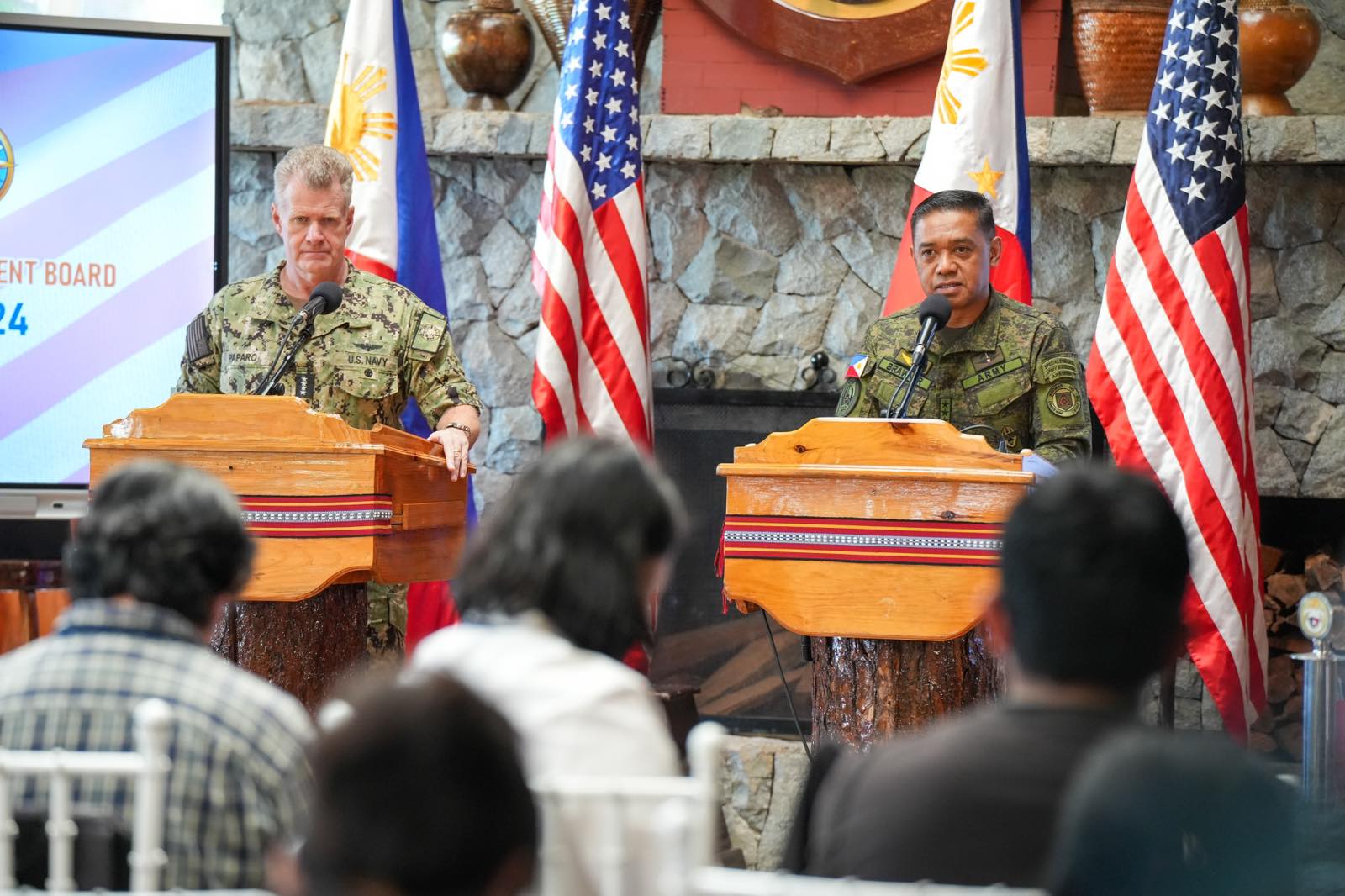
AFP Indopacom MDB-SEB.jpg
(L-R) Adm. Samuel John Paparo Jr., commander of the US Indo-Pacific Command, and Gen. Romeo Brawner Jr., Armed Forces of the Philippines chief, address questions from the media following the Mutual Defense Board and Security Engagement Board (MDB-SEB) Meeting at the Philippine Military Academy (PMA) in Baguio City on Aug. 29, 2024. (Photo: AFP)

Armed Forces of the Philippines (AFP) Chief, General Romeo Brawner Jr. said a “very bright” future awaits the long-standing military alliance between the Philippines and Unites States even as China warned that Manila should refrain from conducting “adventurous infringements” in the South China Sea (SCS).

This, as the AFP and the US Indo-Pacific Command (Indopacom) convened the Mutual Defense Board and Security Engagement Board (MDB-SEB) Meeting at the Philippine Military Academy (PMA) in Baguio City on Thursday, Aug. 29.

The meeting was presided over by Brawner and Admiral Samuel John Paparo Jr., commander of the US Indopacom.

“Today’s meeting is one of the major activities which the Philippines and the U.S. conduct bilaterally. Throughout the years we progress a lot, and I can say that the future between the Philippines-U.S. alliance through the US Indopacom is very bright,” he said in his speech.

Meanwhile, the US Indopacom said in a statement that the MDB-SEB meeting “provides opportunities to address conventional and non-conventional security challenges, leverages strength of the alliance to overcome emerging threats, and establishes the framework that directs defense cooperation for peace in the free and open Indo-Pacific.”

According to the AFP, the agenda of this year's MDB-SEB meeting focused on enhancing joint training exercises, defense capability building, maritime security cooperation, and other areas of shared interest by the two countries.

During the meeting, both the AFP and US Indopacom reaffirmed their shared commitment to uphold a rules-based international order, maintain freedom of navigation, and promote regional security and stability.

“The MDB-SEB continues to serve as a vital mechanism for advancing the mutual defense and security interests of the Philippines and the United States,” the AFP said.

The MDB-SEB meeting is an annual bilateral engagement between the AFP and US Indopacom aimed at discussing mutual defense concerns, enhancing military cooperation, and strengthening the security partnership between Manila and Washington.

The MDB was established in 1958 while the SEB was formed in 2006. Together, the two boards form the framework that directs and enables defense and security cooperation between the US and Philippine militaries.

Tension at Escoda continues

The top-level meet occurred in wake of an airdrop mission by the Philippine Coast Guard (PCG) to bring supplies to the crew of BRP Teresa Magbanua in Escoda Shoal on Aug. 28.

According to the China Coast Guard (CCG), a Philippine H-145 helicopter conducted the airdrop mission but it “monitored the entire process and dealt with it in accordance with regulations.”

CCG spokesperson Gan Yu said that the Philippines' “risky behavior can easily lead to accidents at sea and in the air.”

“[T]he Philippines has bet on the health and life safety of the officers and soldiers of Ship No. 9701, and committed ‘adventurous infringement’ in the name of ‘humanitarianism’, seriously infringing upon China,” he said.

The PCG has yet to respond to the CCG’s remarks but it earlier insisted that the patrol mission of the BRP Teresa Magbanua, which has been deployed to Escoda Shoal since April, will continue to guard against illegal poachers operating in the Philippines’ exclusive economic zone (EEZ) and reclamation activities.

Over the past week, Escoda Shoal has fast become the newest flashpoint in the South China Sea as Chinese maritime forces try to block resupply missions for BRP Teresa Magbanua, which resulted to collision of vessels.

Related Tags

INDOPACOM AFP WPS MDB-SEB General Romeo Brawner Jr. PH-China PH-US South China Sea Admiral Samuel Paparo
ADVERTISEMENT
.most-popular .layout-ratio{ padding-bottom: 79.13%; } @media (min-width: 768px) and (max-width: 1024px) { .widget-title { font-size: 15px !important; } }

{{ articles_filter_1561_widget.title }}

.most-popular .layout-ratio{ padding-bottom: 79.13%; } @media (min-width: 768px) and (max-width: 1024px) { .widget-title { font-size: 15px !important; } }

{{ articles_filter_1562_widget.title }}

.most-popular .layout-ratio{ padding-bottom: 79.13%; } @media (min-width: 768px) and (max-width: 1024px) { .widget-title { font-size: 15px !important; } }

{{ articles_filter_1563_widget.title }}

{{ articles_filter_1564_widget.title }}

.mb-article-details { position: relative; } .mb-article-details .article-body-preview, .mb-article-details .article-body-summary{ font-size: 17px; line-height: 30px; font-family: "Libre Caslon Text", serif; color: #000; } .mb-article-details .article-body-preview iframe , .mb-article-details .article-body-summary iframe{ width: 100%; margin: auto; } .read-more-background { background: linear-gradient(180deg, color(display-p3 1.000 1.000 1.000 / 0) 13.75%, color(display-p3 1.000 1.000 1.000 / 0.8) 30.79%, color(display-p3 1.000 1.000 1.000) 72.5%); position: absolute; height: 200px; width: 100%; bottom: 0; display: flex; justify-content: center; align-items: center; padding: 0; } .read-more-background a{ color: #000; } .read-more-btn { padding: 17px 45px; font-family: Inter; font-weight: 700; font-size: 18px; line-height: 16px; text-align: center; vertical-align: middle; border: 1px solid black; background-color: white; } .hidden { display: none; }
function initializeAllSwipers() { // Get all hidden inputs with cms_article_id document.querySelectorAll('[id^="cms_article_id_"]').forEach(function (input) { const cmsArticleId = input.value; const articleSelector = '#article-' + cmsArticleId + ' .body_images'; const swiperElement = document.querySelector(articleSelector); if (swiperElement && !swiperElement.classList.contains('swiper-initialized')) { new Swiper(articleSelector, { loop: true, pagination: false, navigation: { nextEl: '#article-' + cmsArticleId + ' .swiper-button-next', prevEl: '#article-' + cmsArticleId + ' .swiper-button-prev', }, }); } }); } setTimeout(initializeAllSwipers, 3000); const intersectionObserver = new IntersectionObserver( (entries) => { entries.forEach((entry) => { if (entry.isIntersecting) { const newUrl = entry.target.getAttribute("data-url"); if (newUrl) { history.pushState(null, null, newUrl); let article = entry.target; // Extract metadata const author = article.querySelector('.author-section').textContent.replace('By', '').trim(); const section = article.querySelector('.section-info ').textContent.replace(' ', ' '); const title = article.querySelector('.article-title h1').textContent; // Parse URL for Chartbeat path format const parsedUrl = new URL(newUrl, window.location.origin); const cleanUrl = parsedUrl.host + parsedUrl.pathname; // Update Chartbeat configuration if (typeof window._sf_async_config !== 'undefined') { window._sf_async_config.path = cleanUrl; window._sf_async_config.sections = section; window._sf_async_config.authors = author; } // Track virtual page view with Chartbeat if (typeof pSUPERFLY !== 'undefined' && typeof pSUPERFLY.virtualPage === 'function') { try { pSUPERFLY.virtualPage({ path: cleanUrl, title: title, sections: section, authors: author }); } catch (error) { console.error('ping error', error); } } // Optional: Update document title if (title && title !== document.title) { document.title = title; } } } }); }, { threshold: 0.1 } ); function showArticleBody(button) { const article = button.closest("article"); const summary = article.querySelector(".article-body-summary"); const body = article.querySelector(".article-body-preview"); const readMoreSection = article.querySelector(".read-more-background"); // Hide summary and read-more section summary.style.display = "none"; readMoreSection.style.display = "none"; // Show the full article body body.classList.remove("hidden"); } document.addEventListener("DOMContentLoaded", () => { let loadCount = 0; // Track how many times articles are loaded const offset = [1, 2, 3, 4, 5, 6, 7, 8, 9, 10]; // Offset values const currentUrl = window.location.pathname.substring(1); let isLoading = false; // Prevent multiple calls if (!currentUrl) { console.log("Current URL is invalid."); return; } const sentinel = document.getElementById("load-more-sentinel"); if (!sentinel) { console.log("Sentinel element not found."); return; } function isSentinelVisible() { const rect = sentinel.getBoundingClientRect(); return ( rect.top < window.innerHeight && rect.bottom >= 0 ); } function onScroll() { if (isLoading) return; if (isSentinelVisible()) { if (loadCount >= offset.length) { console.log("Maximum load attempts reached."); window.removeEventListener("scroll", onScroll); return; } isLoading = true; const currentOffset = offset[loadCount]; window.loadMoreItems().then(() => { let article = document.querySelector('#widget_1690 > div:nth-last-of-type(2) article'); intersectionObserver.observe(article) loadCount++; }).catch(error => { console.error("Error loading more items:", error); }).finally(() => { isLoading = false; }); } } window.addEventListener("scroll", onScroll); });

Sign up by email to receive news.