






 World
A Palestinian TikTok star who shared details of Gaza life under siege is killed by Israeli airstrike
World
A Palestinian TikTok star who shared details of Gaza life under siege is killed by Israeli airstrike
A Palestinian TikTok star who shared details of Gaza life under siege is killed by Israeli airstrike


CAIRO (AP) — It was another day of war in Gaza, another day of what 19-year-old Palestinian TikTok star Medo Halimy called his “Tent Life."
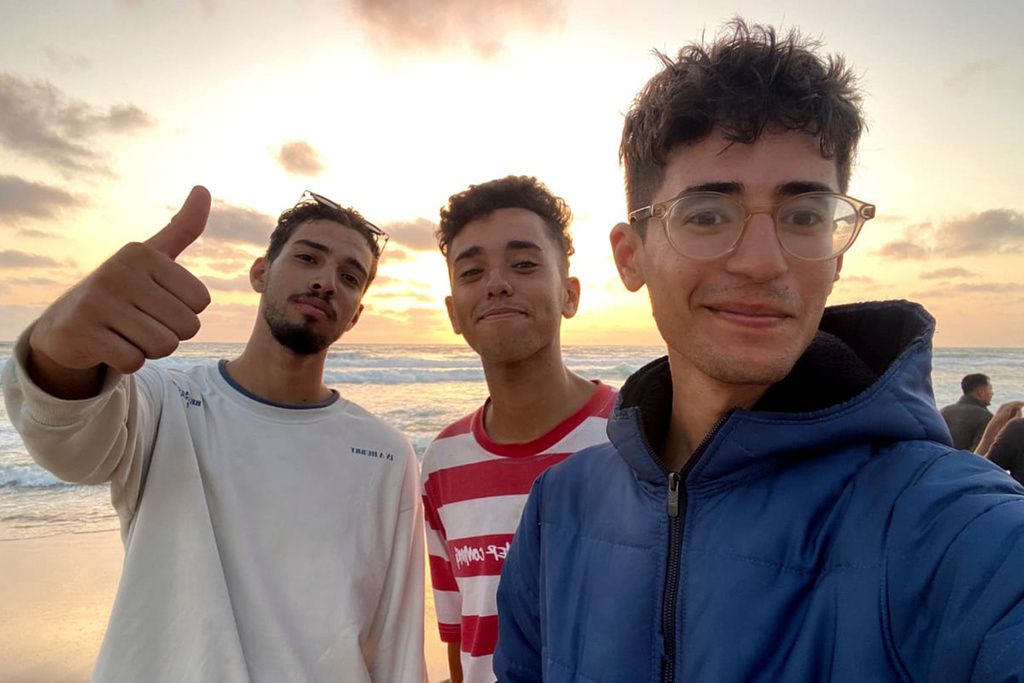
In this undated photo provided by Helmi Hirez, Mohamed (Medo) Halimy, left, and twin brothers Mohammed Hirez, center, and Helmi Hirez, right, stand on a beach in Gaza. (Helmi Hirez via AP).
As he often did in videos documenting life's mundane absurdities in the enclave, Halimy on Monday walked to his local internet cafe — rather, a tent with Wi-Fi where displaced Palestinians can connect to the outside world — to meet his friend and collaborator Talal Murad.
They snapped a selfie — “Finally Reunited" Halimy captioned it on Instagram — and started catching up.
Then came a flash of light, 18-year-old Murad said, an explosion of white heat and sprayed earth. Murad felt pain in his neck. Halimy was bleeding from his head. A car on the coastal road in front of them was engulfed in flames, the apparent target of an Israeli airstrike. It took 10 minutes for an ambulance to arrive. Hours later doctors pronounced Halimy dead.
“He represented a message,” Murad said on Friday, still recovering from his shrapnel wounds and reeling from the Israeli airstrike that killed his friend. “He represented hope and strength.”
The Israeli military said it was not aware of the strike that killed Halimy.
Tributes to Halimy kept pouring in Friday from friends as far afield as Harker Heights, Texas, where he spent a year in 2021 as part of an exchange program sponsored by the State Department.
“Medo was the life of the hangout ... humor and kindness and wit, all things that can never be forgotten,” said Heba al-Saidi, alumni coordinator for the Kennedy-Lugar Youth Exchange and Study program. “He was bound for greatness, but he was taken too soon.”
His death also catalyzed an outpouring of grief on social media, where his followers expressed shock and sadness as if they, too, had lost a close friend.
Israel's campaign in Gaza has killed more than 40,000 Palestinians — according to Gaza’s Health Ministry, which doesn't distinguish between civilians and militants — and spawned a humanitarian disaster. It has also transformed legions of ordinary teenagers, who have nothing to do every day but survive, into war correspondents for the social media age.
“We worked together, it was a kind of resistance that I hope to continue,” said Murad, who collaborated with Halimy on “The Gazan Experience,” an Instagram account that answered questions from followers around the world trying to understand their lives in the besieged enclave, which is inaccessible to foreign journalists.
Halimy launched his own TikTok account after taking refuge with his parents, four brothers and sister in Muwasi, the southern coastal area that Israel has designated a humanitarian safe zone. They had fled Israel’s invasion of Gaza City to the southern city of Khan Younis before escaping the bombardment again for the dusty encampment.
Sparked by Hamas’ surprise attack on Israel on Oct. 7 that killed 1,200 people and resulted in about 250 people taken hostage, the Israel-Hamas war has produced a torrent of images now numbingly familiar to viewers around the world: Bombed-out buildings, contorted bodies, chaotic hospital halls.
But Halimy’s content “came as a surprise,” said his friend, 19-year-old Helmi Hirez.
Turning his camera on the intimate details of his own life in Gaza, he reached viewers far and wide, revealing a maddening tedium that's largely left out of news coverage about the war.
“If you wonder what living in a tent is actually like, come with me to show you how I spend my day,” Halimy says in his first of many “tent life” diaries filmed from the sprawling encampment.
He filmed himself going about his day: waiting restlessly in long lines for drinking water, showering with a jar and a bucket (“there’s no shampoo or soap, of course"), scavenging ingredients to make a surprisingly tasty baba ganoush, the Middle East’s smoky eggplant dip ("Mama mia!" he marvels at his creation), and becoming very, very bored (“then I went back to the tent, and did nothing”).
Hundreds of thousands of people around the world were captivated. His videos went viral — some amassing more than 2 million views on TikTok.
Even when recounting tragedies (his grandmother died, he mentioned at one point, largely because of Gaza’s acute medication and equipment shortages ) or fretting over Israel's bombardment, Halimy's friends said that he found salve in channeling his grief and anxiety into deadpan humor.
“Very annoying,” he says with an eye roll when the buzz of an Israeli drone interrupts one of his TikTok recipe videos.
“As you can see, the transportation here is not five stars,” he says when crammed between men in a pickup truck heading to the nearby town of Deir al-Balah.
“We proceeded to play, anyway,” he says of his Monopoly game, when the whooshing of Israeli projectiles sounds in the skies above him and his friends. “Anyway, I lost.”
In his last video, posted hours before he was killed, Halimy films himself scribbling in a notebook, its pages covered with mysterious black redaction bars.
“I started designs for my new secret project,” he said from the tent cafe that would later be struck, in the same tone he always used, one part playful, one part serious.