

ADVERTISEMENT

Floods maroon many people in Bangladesh and India and cause at least 15 deaths

Published Aug 23, 2024 12:00 am

DHAKA, Bangladesh (AP) — Floodwaters have stranded hundreds of thousands of people in India’s northeast and neighboring Bangladesh’s eastern region, causing at least 15 deaths as rescuers struggled to reach those who needed help, officials and media reports said Thursday.
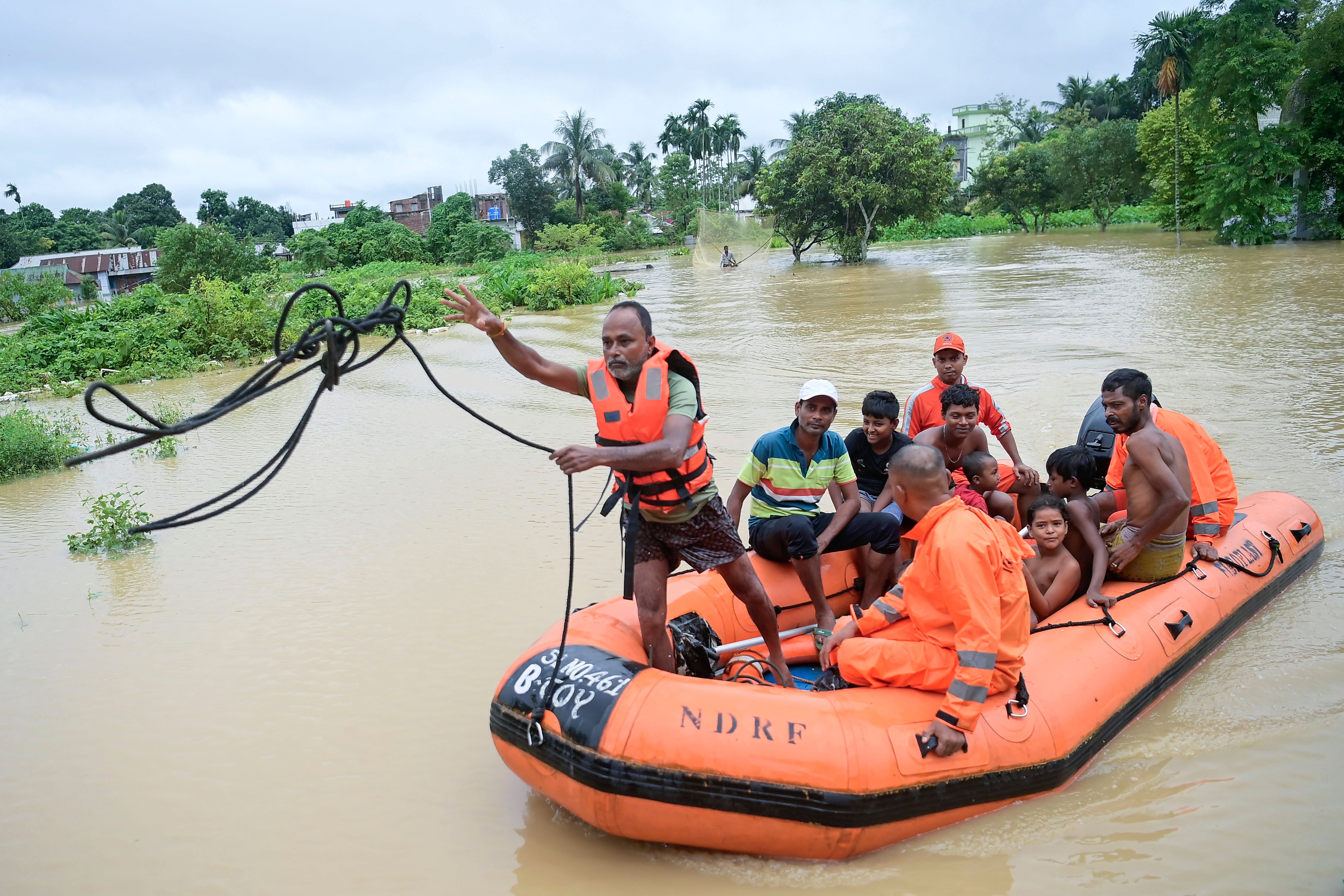
AP24235301224546.jpgA team from the National Disaster Response Force (NDRF) transports people to safety through a flooded area following incessant rains in Agartala, north eastern Tripura state, India, Thursday, Aug. 22, 2024. (AP Photo/Abhisek Saha)

At least 11 people were killed and thousands displaced from homes as floods and mudslides have ravaged India’s northeastern Tripura state, bordering Bangladesh, since Wednesday.

Another four were killed in Bangladesh as upstream India and downstream Bangladesh share common rivers along their border.

India’s Meteorological Department issued a “red” alert in Tripura on Wednesday, forcing authorities to announce a two-day closure of schools after heavy rains inundated several regions, including the state's capital, Agartala.

Authorities have opened more than 300 relief camps in Tripura, where the number of people shifting to the camps was estimated to run into thousands.

Of the 11 dead since the rains intensified Monday, seven drowned or washed away while four were buried by mudslides.

“We are closely monitoring the situation and are focusing on providing relief to those displaced from their homes,” Tripura’s Chief Minister Manik Saha said.

In Bangladesh, a pregnant woman died after she fell into raging waters at Akhaura in Brahmanbaria district, Bengali-language Kal Bela newspaper reported. Three other people died from drowning and electrocution, it said.

The rains and the rising waters from upstream Tripura state devastated many areas in eastern Bangladesh. Many in the worst-hit districts such as Cumilla, Feni and Noakhali called for rescue as power was cut and road links were disconnected. Travel and communication were severed between the capital, Dhaka, and the southeastern port city of Chattogram as parts of a major highway were under water.

The Bangladesh Flood Forecasting and Warning center said Thursday that the water levels in many rivers in the delta nation’s eastern, northeastern and southeastern regions were still increasing.

About a dozen volunteers who rushed to the scene with boats and speedboats in the region told The Associated Press by phone that they were struggling to reach many of the affected people as they failed to communicate with them because the victims’ mobile numbers could not be reached. Many areas have no electricity, the government said.

“We are taken shelter at a house where about 35 people need to be rescued soon. The water is still rising and now we are on the rooftop with our small kids and elderly family members,” Sonia Akter, a mother of 2-year-old girl, told AP by phone from the scene at Feni. “Please send us a boat. Please save us.”

The military and other authorities have started rescue operation in the region, the authorities said.

While the both neighbors have been affected in the flood, many Bangladeshis blamed India for the flash floods, saying that India opened a river dam in Tripura, causing sudden floods in Bangladesh. India’s Ministry of External Affairs denied that in a statement.

Monsoon rains in South Asian nations India and Bangladesh typically begin in June. India and Bangladesh share 54 common rivers that flow from the Himalayas to the Bay of Bengal. The countries have contention over the sharing of waters of the common rivers.

Related Tags

world news
ADVERTISEMENT
.most-popular .layout-ratio{ padding-bottom: 79.13%; } @media (min-width: 768px) and (max-width: 1024px) { .widget-title { font-size: 15px !important; } }

{{ articles_filter_1561_widget.title }}

.most-popular .layout-ratio{ padding-bottom: 79.13%; } @media (min-width: 768px) and (max-width: 1024px) { .widget-title { font-size: 15px !important; } }

{{ articles_filter_1562_widget.title }}

.most-popular .layout-ratio{ padding-bottom: 79.13%; } @media (min-width: 768px) and (max-width: 1024px) { .widget-title { font-size: 15px !important; } }

{{ articles_filter_1563_widget.title }}

{{ articles_filter_1564_widget.title }}

.mb-article-details { position: relative; } .mb-article-details .article-body-preview, .mb-article-details .article-body-summary{ font-size: 17px; line-height: 30px; font-family: "Libre Caslon Text", serif; color: #000; } .mb-article-details .article-body-preview iframe , .mb-article-details .article-body-summary iframe{ width: 100%; margin: auto; } .read-more-background { background: linear-gradient(180deg, color(display-p3 1.000 1.000 1.000 / 0) 13.75%, color(display-p3 1.000 1.000 1.000 / 0.8) 30.79%, color(display-p3 1.000 1.000 1.000) 72.5%); position: absolute; height: 200px; width: 100%; bottom: 0; display: flex; justify-content: center; align-items: center; padding: 0; } .read-more-background a{ color: #000; } .read-more-btn { padding: 17px 45px; font-family: Inter; font-weight: 700; font-size: 18px; line-height: 16px; text-align: center; vertical-align: middle; border: 1px solid black; background-color: white; } .hidden { display: none; }
function initializeAllSwipers() { // Get all hidden inputs with cms_article_id document.querySelectorAll('[id^="cms_article_id_"]').forEach(function (input) { const cmsArticleId = input.value; const articleSelector = '#article-' + cmsArticleId + ' .body_images'; const swiperElement = document.querySelector(articleSelector); if (swiperElement && !swiperElement.classList.contains('swiper-initialized')) { new Swiper(articleSelector, { loop: true, pagination: false, navigation: { nextEl: '#article-' + cmsArticleId + ' .swiper-button-next', prevEl: '#article-' + cmsArticleId + ' .swiper-button-prev', }, }); } }); } setTimeout(initializeAllSwipers, 3000); const intersectionObserver = new IntersectionObserver( (entries) => { entries.forEach((entry) => { if (entry.isIntersecting) { const newUrl = entry.target.getAttribute("data-url"); if (newUrl) { history.pushState(null, null, newUrl); let article = entry.target; // Extract metadata const author = article.querySelector('.author-section').textContent.replace('By', '').trim(); const section = article.querySelector('.section-info ').textContent.replace(' ', ' '); const title = article.querySelector('.article-title h1').textContent; // Parse URL for Chartbeat path format const parsedUrl = new URL(newUrl, window.location.origin); const cleanUrl = parsedUrl.host + parsedUrl.pathname; // Update Chartbeat configuration if (typeof window._sf_async_config !== 'undefined') { window._sf_async_config.path = cleanUrl; window._sf_async_config.sections = section; window._sf_async_config.authors = author; } // Track virtual page view with Chartbeat if (typeof pSUPERFLY !== 'undefined' && typeof pSUPERFLY.virtualPage === 'function') { try { pSUPERFLY.virtualPage({ path: cleanUrl, title: title, sections: section, authors: author }); } catch (error) { console.error('ping error', error); } } // Optional: Update document title if (title && title !== document.title) { document.title = title; } } } }); }, { threshold: 0.1 } ); function showArticleBody(button) { const article = button.closest("article"); const summary = article.querySelector(".article-body-summary"); const body = article.querySelector(".article-body-preview"); const readMoreSection = article.querySelector(".read-more-background"); // Hide summary and read-more section summary.style.display = "none"; readMoreSection.style.display = "none"; // Show the full article body body.classList.remove("hidden"); } document.addEventListener("DOMContentLoaded", () => { let loadCount = 0; // Track how many times articles are loaded const offset = [1, 2, 3, 4, 5, 6, 7, 8, 9, 10]; // Offset values const currentUrl = window.location.pathname.substring(1); let isLoading = false; // Prevent multiple calls if (!currentUrl) { console.log("Current URL is invalid."); return; } const sentinel = document.getElementById("load-more-sentinel"); if (!sentinel) { console.log("Sentinel element not found."); return; } function isSentinelVisible() { const rect = sentinel.getBoundingClientRect(); return ( rect.top < window.innerHeight && rect.bottom >= 0 ); } function onScroll() { if (isLoading) return; if (isSentinelVisible()) { if (loadCount >= offset.length) { console.log("Maximum load attempts reached."); window.removeEventListener("scroll", onScroll); return; } isLoading = true; const currentOffset = offset[loadCount]; window.loadMoreItems().then(() => { let article = document.querySelector('#widget_1690 > div:nth-last-of-type(2) article'); intersectionObserver.observe(article) loadCount++; }).catch(error => { console.error("Error loading more items:", error); }).finally(() => { isLoading = false; }); } } window.addEventListener("scroll", onScroll); });

Sign up by email to receive news.