ADVERTISEMENT

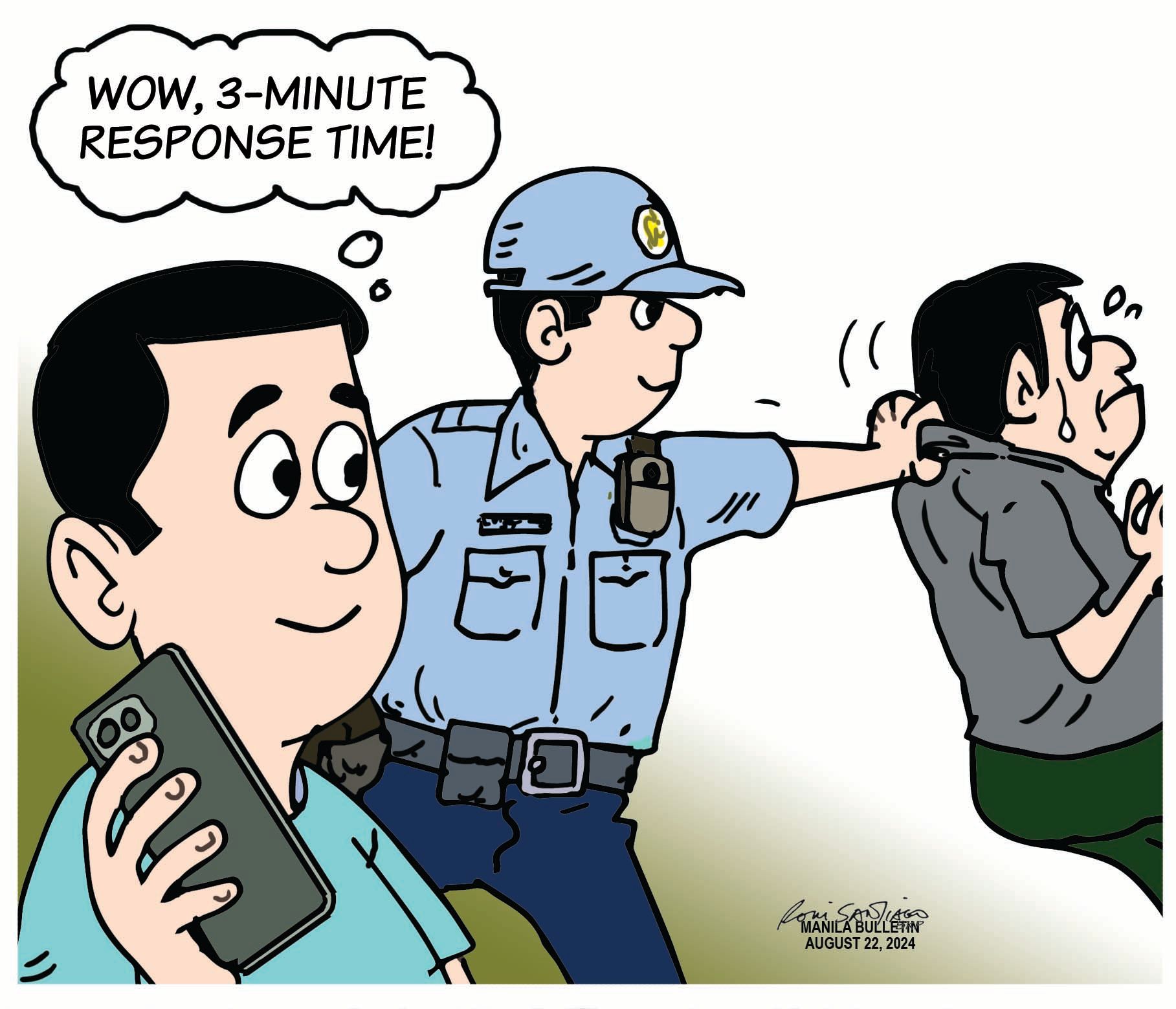
PNP boosts anti-criminality efforts with 3-minute response time to 911 calls and AI in bodycam plan

Published Aug 21, 2024 04:03 pm

E CARTOON AUG 22, 2024.jpg

Three-minute response time to all requests for police assistance, especially those channeled via the 911 emergency calls, or E911.

Body cameras with artificial intelligence that can automatically access the database of the Philippine National Police (PNP) to check on the identity or past offenses of an apprehended person.

These were among the major programs discussed by PNP chief Gen. Rommel Francisco Marbil last week which are part of the PNP’s aggressive anti-criminality efforts.

Last week, the Department of the Interior and Local Government (DILG) reported a 3.29 percent decrease in total crime incidents in the country during the first half of the year. This has been due to the “sustained and aggressive anti-criminality efforts of the PNP,” said DILG Undersecretary Marlo Iringan during a budget hearing. He said the PNP has sustained a crime efficiency rate of more than 94 percent and crime solution efficiency of more than 87 percent.

Marbil’s two big plans are laudable and deserve support. That he has set a specific response time of three minutes to all requests for police assistance shows he is very serious about getting things done to make peace and order more than just a concept but a reality that will make the citizens feel safe. Although the three-minute response time may not be fulfilled all the time because of uncontrolled circumstances, such as traffic conditions, it is a good thing to know that the policemen are around one’s community – ready to follow that order.

The policy is part of the PNP’s reform program to ensure quick police presence and counter-action against criminal elements. Recently, the three-minute response rule led to the immediate arrest of crime perpetrators in Metro Manila and in the Davao Region.

Marbil said “every Filipino deserves a quick and efficient police response, regardless of location or status. The revitalized 911 hotline is not just a technological improvement; it is a crucial component of our mission to make every community feel secure and supported by the PNP.”

Citizens can help strengthen the system by using the 911 service responsibly – absolutely no prank calls, please! Marbil said the system's effectiveness depends on the cooperation and good judgment of all citizens.

Another plan to fight crime – using AI in bodycams to spot criminals – is a welcome development. Imagine this scenario: A policeman wearing a bodycam with AI is apprehending a motorist in a road rage incident. A beep sound from the bodycam alerts the law enforcer of what the AI has discovered: the motorist is wanted for a case of murder. That is the kind of AI technology that the PNP chief wants to integrate in the existing and to-be acquired police body cameras.

“That’s a new technology that we want because in responding to any incident, bodycams can always be active if they monitor people with warrants. And this means that they can be easily arrested,” he said. “This is what we want in the future. We will be pursuing this in our next procurement.”

Plans like these that will soon be implemented, and a response time rule will make the citizenry sleep better or walk without fear at all times.

Related Tags

Philippine National Police (PNP) Roni Santiago
ADVERTISEMENT
.most-popular .layout-ratio{ padding-bottom: 79.13%; } @media (min-width: 768px) and (max-width: 1024px) { .widget-title { font-size: 15px !important; } }

{{ articles_filter_1561_widget.title }}

.most-popular .layout-ratio{ padding-bottom: 79.13%; } @media (min-width: 768px) and (max-width: 1024px) { .widget-title { font-size: 15px !important; } }

{{ articles_filter_1562_widget.title }}

.most-popular .layout-ratio{ padding-bottom: 79.13%; } @media (min-width: 768px) and (max-width: 1024px) { .widget-title { font-size: 15px !important; } }

{{ articles_filter_1563_widget.title }}

{{ articles_filter_1564_widget.title }}

.mb-article-details { position: relative; } .mb-article-details .article-body-preview, .mb-article-details .article-body-summary{ font-size: 17px; line-height: 30px; font-family: "Libre Caslon Text", serif; color: #000; } .mb-article-details .article-body-preview iframe , .mb-article-details .article-body-summary iframe{ width: 100%; margin: auto; } .read-more-background { background: linear-gradient(180deg, color(display-p3 1.000 1.000 1.000 / 0) 13.75%, color(display-p3 1.000 1.000 1.000 / 0.8) 30.79%, color(display-p3 1.000 1.000 1.000) 72.5%); position: absolute; height: 200px; width: 100%; bottom: 0; display: flex; justify-content: center; align-items: center; padding: 0; } .read-more-background a{ color: #000; } .read-more-btn { padding: 17px 45px; font-family: Inter; font-weight: 700; font-size: 18px; line-height: 16px; text-align: center; vertical-align: middle; border: 1px solid black; background-color: white; } .hidden { display: none; }
function initializeAllSwipers() { // Get all hidden inputs with cms_article_id document.querySelectorAll('[id^="cms_article_id_"]').forEach(function (input) { const cmsArticleId = input.value; const articleSelector = '#article-' + cmsArticleId + ' .body_images'; const swiperElement = document.querySelector(articleSelector); if (swiperElement && !swiperElement.classList.contains('swiper-initialized')) { new Swiper(articleSelector, { loop: true, pagination: false, navigation: { nextEl: '#article-' + cmsArticleId + ' .swiper-button-next', prevEl: '#article-' + cmsArticleId + ' .swiper-button-prev', }, }); } }); } setTimeout(initializeAllSwipers, 3000); const intersectionObserver = new IntersectionObserver( (entries) => { entries.forEach((entry) => { if (entry.isIntersecting) { const newUrl = entry.target.getAttribute("data-url"); if (newUrl) { history.pushState(null, null, newUrl); let article = entry.target; // Extract metadata const author = article.querySelector('.author-section').textContent.replace('By', '').trim(); const section = article.querySelector('.section-info ').textContent.replace(' ', ' '); const title = article.querySelector('.article-title h1').textContent; // Parse URL for Chartbeat path format const parsedUrl = new URL(newUrl, window.location.origin); const cleanUrl = parsedUrl.host + parsedUrl.pathname; // Update Chartbeat configuration if (typeof window._sf_async_config !== 'undefined') { window._sf_async_config.path = cleanUrl; window._sf_async_config.sections = section; window._sf_async_config.authors = author; } // Track virtual page view with Chartbeat if (typeof pSUPERFLY !== 'undefined' && typeof pSUPERFLY.virtualPage === 'function') { try { pSUPERFLY.virtualPage({ path: cleanUrl, title: title, sections: section, authors: author }); } catch (error) { console.error('ping error', error); } } // Optional: Update document title if (title && title !== document.title) { document.title = title; } } } }); }, { threshold: 0.1 } ); function showArticleBody(button) { const article = button.closest("article"); const summary = article.querySelector(".article-body-summary"); const body = article.querySelector(".article-body-preview"); const readMoreSection = article.querySelector(".read-more-background"); // Hide summary and read-more section summary.style.display = "none"; readMoreSection.style.display = "none"; // Show the full article body body.classList.remove("hidden"); } document.addEventListener("DOMContentLoaded", () => { let loadCount = 0; // Track how many times articles are loaded const offset = [1, 2, 3, 4, 5, 6, 7, 8, 9, 10]; // Offset values const currentUrl = window.location.pathname.substring(1); let isLoading = false; // Prevent multiple calls if (!currentUrl) { console.log("Current URL is invalid."); return; } const sentinel = document.getElementById("load-more-sentinel"); if (!sentinel) { console.log("Sentinel element not found."); return; } function isSentinelVisible() { const rect = sentinel.getBoundingClientRect(); return ( rect.top < window.innerHeight && rect.bottom >= 0 ); } function onScroll() { if (isLoading) return; if (isSentinelVisible()) { if (loadCount >= offset.length) { console.log("Maximum load attempts reached."); window.removeEventListener("scroll", onScroll); return; } isLoading = true; const currentOffset = offset[loadCount]; window.loadMoreItems().then(() => { let article = document.querySelector('#widget_1690 > div:nth-last-of-type(2) article'); intersectionObserver.observe(article) loadCount++; }).catch(error => { console.error("Error loading more items:", error); }).finally(() => { isLoading = false; }); } } window.addEventListener("scroll", onScroll); });

Sign up by email to receive news.