







NMC open to bringing West PH Sea case vs China to UN


The National Maritime Council (NMC) is looking into the possibility of elevating China’s recent aggressive action in the vicinity of Escoda (Sabina) Shoal before a United Nations (UN) body.
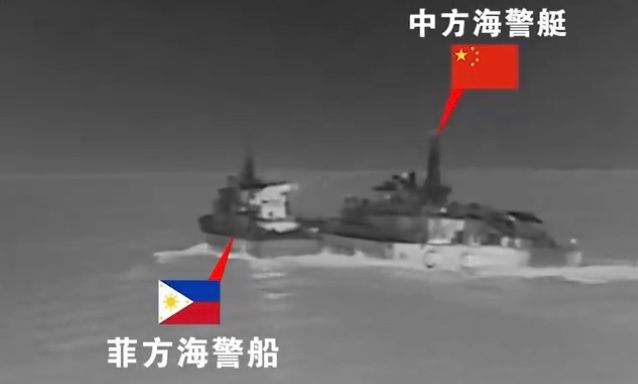
China Coast Guard (CCG) and Philippine Coast Guard (PCG) vessels collide near Escoda Shoal in the West Philippine Sea on Aug. 19, 2024. (Screengrab from CCG)
While NMC spokesperson Alexander Lopez said during a Palace press briefing on Tuesday, Aug. 20, that filing cases involving the South China Sea dispute is better left with the Department of Foreign Affairs (DFA) and the Philippines Coast Guard (PCG), he insisted that proper mechanisms are in place to pursue this track.
“We are looking at that, especially for the part of the Coast Guard because they know how to go about it. So, maybe we will get back to you later on as long as we get more inputs from the Coast Guard,” he answered, when asked about the possibility of raising the issue regarding the violation of the Convention on the International Regulations for Preventing Collisions at Sea (COLREGs).
Describing the COLREG as “a code of conduct among seafarers,” the NMC official explained that the PCG has “a channel communicating such infringes or violations of the international law.”
But while “the principle behind it is to ensure safety among the vessels at the high seas,” Lopez lamented that China Coast Guard (CCG) “went through the extreme of putting a vessel at risk so it is ridiculous on their part.”
“Coast Guard sila eh. Dapat nga sila yung nage-ensure ng (They are the Coast Guard. They should ensure the) safety of life and property at sea and yet they are the ones doing it so it doesn't make sense,” he added.
Presidential Assistant on Maritime Concerns Andres Centino said that with the inclusion of the Solicitor General, along with the National Security Adviser (NSA) and the National Intelligence Coordinating Agency (NICA), in the NMC, a mechanism is in place for the government to opt for a case before the UN.
“So, that actually signifies the intent of the government to consider the filing of a case. The Solicitor General is tasked to do these things and I would suppose that its inclusion in the council means that is one of the options that will be considered,” he explained.
Lopez also stressed that in dealing with an international maritime issue, the DFA must be at the forefront of any policy to resolve the dispute.
“Actually it is the purview of the Department of Foreign Affairs to really come up with those because other agencies may come up with proposed activities, but if the DFA will say no, it is contradictory to the Code of Conduct then, that is when the DFA will come in,” he said.
Contrary to China’s claims that Philippine Coast Guard (PCG) vessels deliberately collided with its vessels, the NMC said that CCG vessels “rammed and damaged” the PCG vessels on early Monday, Aug. 19, in the vicinity of Escoda Shoal.
The Escoda Shoal sits merely 75 nautical miles or about 140 kilometers off Palawan and is deep within the Philippines’ 200-nautical-mile EEZ.
The Philippines and China have had repeated confrontations in the disputed waters, specifically near the Ayungin (Second Thomas) Shoal, which led to a recent provisional agreement regarding resupply missions to a grounded military ship there.
The Escoda Shoal has also been the site of a standoff between the Philippines and China since April after the former sent one of the PCG’s largest ships, the BRP Teresa Magbanua, there amid reports of Beijing’s reclamation attempts.
China has maintained its claim of the entire South China Sea, including waters and features inside the Philippines’ EEZ, rejecting also the 2016 arbitral tribunal ruling that invalidated the basis of such claims.