







China claims CCG, PCG vessels collided near Escoda Shoal


The China Coast Guard (CCG) claimed that Philippine and Chinese vessels collided near the Sabina or Escoda Shoal in the disputed South China Sea on Monday, Aug. 19.
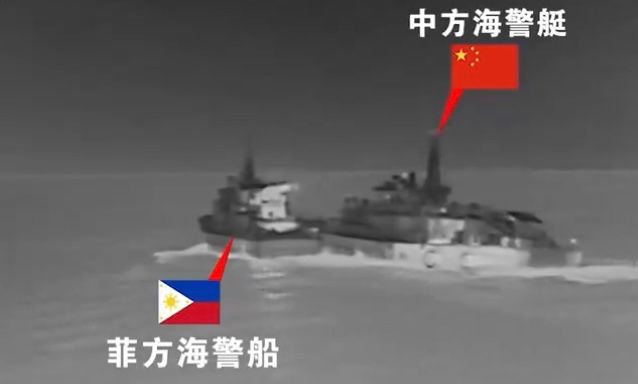 (China Coast Guard screenshot)
In a statement, CCG spokesperson Gan Yu said that two Philippine Coast Guard (PCG) vessels—No. 4410 and No. 4411–“illegally entered the waters near Xianbin Reef in China's Nansha Islands without the permission of the Chinese government.”
Xianbin Reef and Nansha Islands are Chinese names for Escoda Shoal and Spratly Islands, respectively.
“The Chinese Coast Guard took control measures against the Philippine ships in accordance with the law,” the statement read.
“At 03:24, the Philippine ship No. 4410 ignored China's repeated solemn warnings and deliberately collided with China's 21551 boat, which was in a normal law enforcement and protection of rights, in an unprofessional and dangerous manner, resulting in a collision,” it added.
A 15-second video of the said collision was also posted on state-owned Shanghai Daily’s X (formerly Twitter) page.
In the statement, China stressed its “indisputable sovereignty” over the Spratly Islands, including the Escoda Shoal, which sits merely 75 nautical miles or about 140 kilometers off Palawan and is within the Philippines’ 200-nautical-mile exclusive economic zone (EEZ).
“The responsibility lies entirely with the Philippines. We warn the Philippines to immediately stop its infringement and provocation, otherwise all the consequences arising from this will be borne by the Philippines,” Yu said.
“The Chinese Coast Guard will continue to carry out law enforcement activities in China's jurisdiction in accordance with the law, and resolutely safeguard the country's territorial sovereignty and maritime rights and interests,” the official added.
The Philippines and China have had repeated confrontations in the disputed waters, specifically near the Ayungin (Second Thomas) Shoal, which led to a recent agreement regarding resupply missions to the grounded Second Thomas Shoal there.
China has maintained its claim of the entire South China Sea, including waters and features inside the Philippines’ EEZ, rejecting also the 2016 arbitral tribunal ruling that invalidated the basis of such claims.