






 Philippines
National
House bill to 'future-proof' public school textbooks; here's how
Philippines
National
House bill to 'future-proof' public school textbooks; here's how
House bill to 'future-proof' public school textbooks; here's how


At A Glance
- Bicol Saro Party-list Rep. Brian Raymund Yamsuan has filed a House bill filed in the 19th Congress that seeks to "future-proof" learning materials in the country's basic education system.
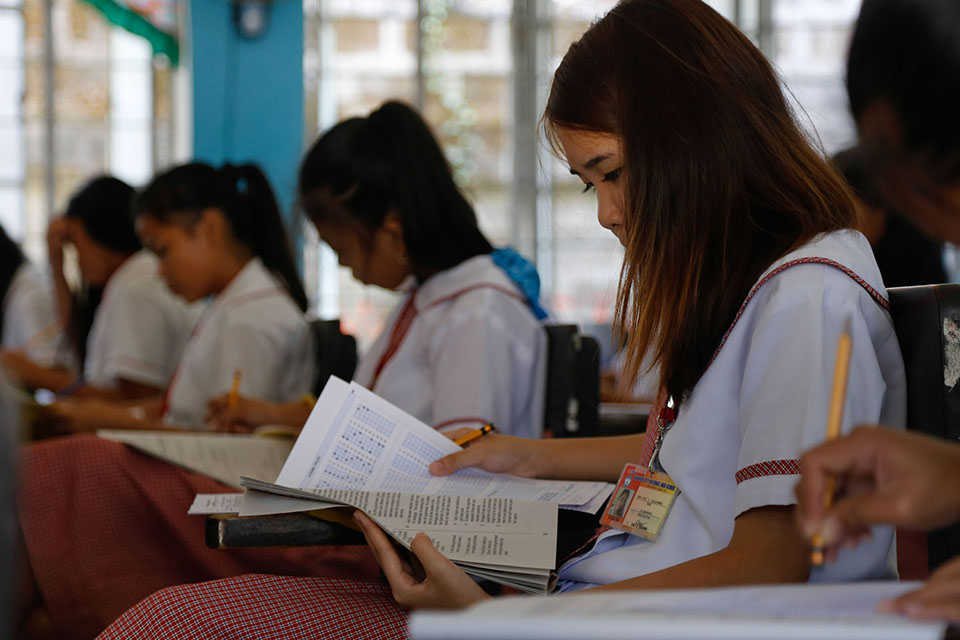 (MANILA BULLETIN)
A House bill filed in the 19th Congress will “future-proof” learning materials in the country’s basic education system.
Authored by Bicol Saro Party-list Rep. Brian Raymund Yamsuan, House Bill (HB) No.10734 also seeks to resolve the longstanding problem of inadequate textbooks for students in public schools.
Yamsuan says the key to achieving these twin goals is to strengthen the partnership between the Department of Education (DepEd) and the National Book Development Board (NBDB), which, under the bill, shall be jointly tasked to formulate and implement a National Textbook and Learning Resources Plan.
Yamsuan said he filed the bill after the Second Congressional Commission on Education (Edcom II) found out that students in public elementary and high schools have struggled to learn for about a decade with incomplete or no textbooks at all.
“Ang ating bill ay sagot sa matagal ng problema ng ating mga public school learners na hirap sa pag-aaral dahil kulang o wala man lang silang magamit na textbooks. Malaking kawalan ito sa kanilang abilidad na makapag-aral ng maayos lalo na sa mga subjects na Math, Science at Reading, kung saan nakitaan ng mababang test scores and mga mag-aaral na Pilipino,” he said.
(Our bill provides the answer to the longstanding problem of our public school learners who find it hard to study because of the lack, and even the complete absence, of textbooks. This has a big negative impact on their ability to study efficiently, especially in the subjects of Math, Science and Reading, where Filipino students have logged low test scores.)
He was referring to the 2022 findings of the Program for International Student Assessment (PISA), which showed that Filipino students were still among the weakest in the subjects of math, reading and science and even in creative thinking skills among learners from 81 countries that took part in the global study.
Another study—the Southeast Asian Primary Learning Metrics (SEA-PLM)--indicated that learners who shared the use of textbooks and those who did not have these learning materials scored significantly lower than those who had their own textbooks.
To “future-proof” public school textbooks, HB No.10734 redefines the meaning of the term “book” to include electronic publications.
“As our world becomes increasingly digital, aligning the definition of books to cover electronic forms reflects the way Filipinos consume information today. Ang bagong kahulugang ng salitang ‘book’ o aklat na ngayon ay kasama na ang mga e-books at iba pang katulad nito ay magtitiyak na laging nakasabay ang mga estudyanteng Pilipino sa mabilis na pagbabago ng teknolohiya,” said the neophyte lawmaker.
(The new definition of the word ‘book’ to include e-books and other similar forms will ensure that Filipino students can keep up with rapid technological changes.)
Yamsuan pointed out that despite having the budget available to buy textbooks, the DepEd was able to procure only 27 types of textbooks for Grades 1 to 10 since 2012. Moreover, since the K-to-12 curriculum was introduced, only textbooks for Grades 5 to 6 have been procured.
The delays have been traced to various factors such as the insufficient period given to the DepEd to develop textbooks; prolonged review processes; high participation costs for bidders; and pricing issues, according to the Edcom II findings.
Yamsuan said these problems can be resolved by amending the provisions of the NBDB Charter under Republic Act (RA) No.8047.
His proposed measure--HB 10734—gives the NBDB a more active role in the preparation and production of textbooks, by mandating the DepEd to jointly work with it in preparing the specific policies, guidelines and measures on the provision of public school textbooks and learning resources.
HB No.10734 also requires the DepEd to phase out its elementary and secondary textbook publication and distribution functions within a three-year period and support the phasing in of private sector publishers to assume these tasks.
Yamsuan said the National Textbook and Learning Resources Plan under his bill also champions inclusive education, as it directs the establishment of consultative mechanisms among the DepEd, NBDB, and players in the book publishing industry to provide learning materials for persons with disabilities (PWDs).
The bill also creates a Textbook Review Committee which is primarily tasked to evaluate and select textbooks and teachers’ manuals for use in public schools.
“This dedicated committee will guarantee that the quality of textbooks procured meets educational and industry standards. The bill requires that public school textbooks be reviewed, evaluated and revised ,if necessary, every five years,” he said.