






 Philippines
National
West PH Sea patrols to continue despite China's aggression, says gov't task force
Philippines
National
West PH Sea patrols to continue despite China's aggression, says gov't task force
West PH Sea patrols to continue despite China's aggression, says gov't task force


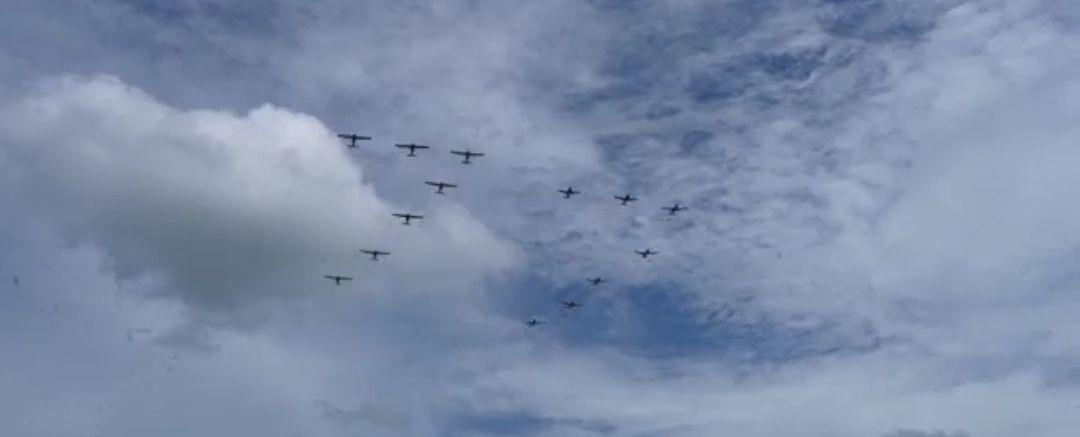
The aerial and maritime patrols being conducted by the Armed Forces of the Philippines (AFP) in contested features in the West Philippine Sea (WPS) will push through despite the renewed aggression of China.
The National Task Force for the West Philippine Sea (NTF-WPS) reiterated this on Monday, Aug. 12, as it “strongly condemned” the “irresponsible, unprofessional, illegal and dangerous acts” of the People's Liberation Army Air Force (PLAAF) that harassed a Philippine Air Force (PAF) patrol aircraft last week in the skies near Bajo de Masinloc (Scarborough or Panatag Shoal).
“Just when the waters of the West Philippine Sea seemed to show calm, the airspace above it was disturbed with acts of aggression. Our pilots and crew responded with focus, restraint, and professionalism, unfazed by the aggressive PLAAF jets,” the NTF-WPS said in a statement.
“Air and maritime security patrol missions will continue within our sovereign territory, airspace, and Exclusive Economic Zone. The monitoring of our country's airspace will be intensified,” it added.
The Armed Forces of the Philippines (AFP) reported that two PLAAF multi-role fighters (MRFs) conducted dangerous maneuvers in close proximity to a PAF NC-212i patrol aircraft during a routine survey over Bajo de Masinloc last August 8.
The Chinese MRFs were monitored by the AFP radars at a close distance of 2,000 feet from the NC-212i before it dropped flares which emitted heat and light to confuse the PAF aircraft.
“The PAF NC-212i aircraft never posed a threat to the PLAAF jets. By launching flares in the
flight path of the PAF plane, the PLAAF fighters exhibited hazardous intent,” the NTF-WPS said.
The task force then called on the People’s Republic of China (PRC) to “cease all forms of provocative and hazardous acts” that it said could “undermine the safety of Filipino military and civilian personnel in the waters or in the skies, destabilize regional peace, and erode the trust and confidence of the international community in the PRC.”
China claims almost the entire South China Sea (SCS) based on its so-called 10-dash line, including some features located within the Philippines’ 200-nautical mile exclusive economic zone (EEZ).
An arbitral ruling in 2016 rejected China’s claims in favor of the Philippines’ protest but it continues to ignore the decision.
Last month, Manila and Beijing co-chaired a bilateral consultative mechanism (BCM) where both nations agreed to deescalate the tension in the WPS.