ADVERTISEMENT

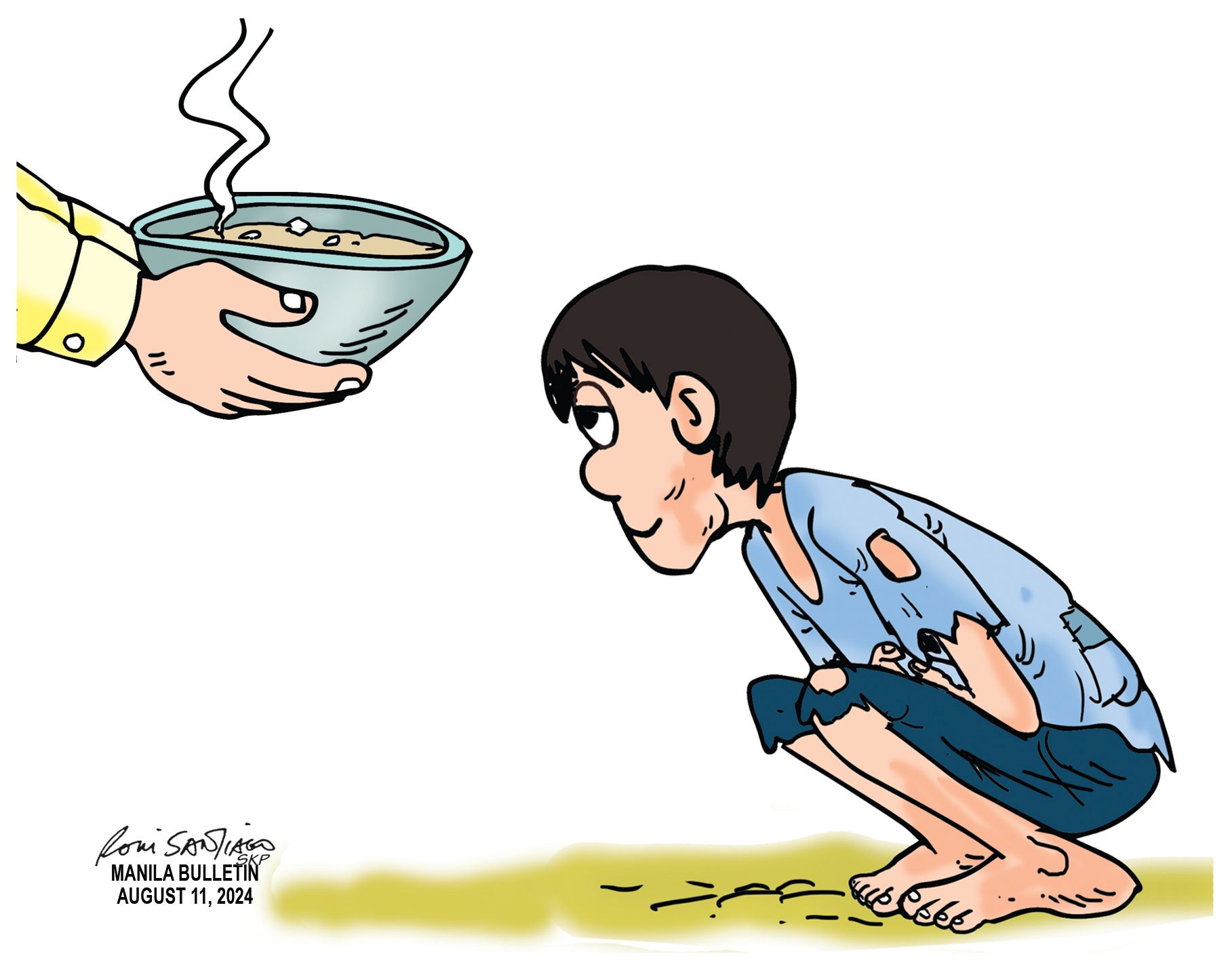
Zero Hunger: A legacy we can all work on

Published Aug 10, 2024 04:02 pm

E CARTOON AUG 11, 2024.jpg

Hunger – that “feeling of discomfort or weakness caused by lack of food, coupled with the desire to eat” – is a condition that millions of people feel many times during the day. Hunger is a problem that governments deal with, and which many private citizens working with non-government organizations (NGOs) and foundations, have devoted much of their lives to.


Days ago, President Marcos, for the second time, reorganized the government's Task Force on Zero Hunger (TFZH) to add more members to create a whole-of-government approach to address the problem. The composition of the task force brings together several relevant government agencies that can help eradicate hunger. The task force is led by the Department of Social Welfare and Development (DSWD) secretary and the National Nutrition Council executive director.


The new members are the Secretaries of the following departments: Agrarian Reform (DAR), Health (DOH); Interior and Local Government (DILG); Presidential Communications Office (PCO), and the director-general of the Technical Education and Skills Development Authority (TESDA).


The TFZH, created in 2020, has a big task: To eradicate hunger in the Philippines in 10 years by ensuring that government policies, initiatives, and projects on attaining zero hunger shall be coordinated, responsive, and effective.


That is the legacy that President Marcos aims to leave behind –“No more hunger. No more hungry Filipinos.” In an interview last June, he said: “That is my dream. No hungry Filipino.”


Citing data from the DSWD, the President said around three million households still suffer from involuntary hunger.


A flagship government program to address hunger is the “Walang Gutom 2027: Food Stamp Program” which was established in October 2023. It provides monetary assistance to targeted beneficiaries to purchase food commodities from eligible partner merchant stores. The beneficiaries are the one million households who are classified as belonging to the food-poor criteria defined by the Philippine Statistics Authority (PSA).


In the private sector, a small news item that’s happening in the Paris Olympics, which has been overshadowed by the stories of victories and defeats, are the efforts of private groups to see to it that “food that goes uneaten at the Games — by the athletes, the spectators and the workers — is helping those in need around the French capital.” The initiative is part of an effort to cut down on waste and contribute to organizers' commitment to sustainability.
One organization which has collected uneaten food from various stadiums since 2014, manned by about a hundred volunteers, go to the Olympic sites early in the morning and within hours, deliver that to other charities that distribute the food to people in need. They have gathered about nine tons of food so far. Another organization, a food bank, sends vans to Olympic sites late each night to collect leftover food, and bring it to a warehouse where volunteers sort it out for distribution. Early this week, the food bank had collected 30 tons of food.


Similar initiatives are being done by private groups here in the country, most of them silently, and not too well-organized to make it to the news. Its brief appearance in social media is unable to stoke a deeper awareness to make one go out of his or her way to do something to help take away the “feeling of discomfort or weakness caused by lack of food” – which community members may be going through.


Today is Sunday, a good time to think about what we can do to help fight hunger.

Related Tags

Editorial zEro hunger
ADVERTISEMENT
.most-popular .layout-ratio{ padding-bottom: 79.13%; } @media (min-width: 768px) and (max-width: 1024px) { .widget-title { font-size: 15px !important; } }

{{ articles_filter_1561_widget.title }}

.most-popular .layout-ratio{ padding-bottom: 79.13%; } @media (min-width: 768px) and (max-width: 1024px) { .widget-title { font-size: 15px !important; } }

{{ articles_filter_1562_widget.title }}

.most-popular .layout-ratio{ padding-bottom: 79.13%; } @media (min-width: 768px) and (max-width: 1024px) { .widget-title { font-size: 15px !important; } }

{{ articles_filter_1563_widget.title }}

{{ articles_filter_1564_widget.title }}

.mb-article-details { position: relative; } .mb-article-details .article-body-preview, .mb-article-details .article-body-summary{ font-size: 17px; line-height: 30px; font-family: "Libre Caslon Text", serif; color: #000; } .mb-article-details .article-body-preview iframe , .mb-article-details .article-body-summary iframe{ width: 100%; margin: auto; } .read-more-background { background: linear-gradient(180deg, color(display-p3 1.000 1.000 1.000 / 0) 13.75%, color(display-p3 1.000 1.000 1.000 / 0.8) 30.79%, color(display-p3 1.000 1.000 1.000) 72.5%); position: absolute; height: 200px; width: 100%; bottom: 0; display: flex; justify-content: center; align-items: center; padding: 0; } .read-more-background a{ color: #000; } .read-more-btn { padding: 17px 45px; font-family: Inter; font-weight: 700; font-size: 18px; line-height: 16px; text-align: center; vertical-align: middle; border: 1px solid black; background-color: white; } .hidden { display: none; }
function initializeAllSwipers() { // Get all hidden inputs with cms_article_id document.querySelectorAll('[id^="cms_article_id_"]').forEach(function (input) { const cmsArticleId = input.value; const articleSelector = '#article-' + cmsArticleId + ' .body_images'; const swiperElement = document.querySelector(articleSelector); if (swiperElement && !swiperElement.classList.contains('swiper-initialized')) { new Swiper(articleSelector, { loop: true, pagination: false, navigation: { nextEl: '#article-' + cmsArticleId + ' .swiper-button-next', prevEl: '#article-' + cmsArticleId + ' .swiper-button-prev', }, }); } }); } setTimeout(initializeAllSwipers, 3000); const intersectionObserver = new IntersectionObserver( (entries) => { entries.forEach((entry) => { if (entry.isIntersecting) { const newUrl = entry.target.getAttribute("data-url"); if (newUrl) { history.pushState(null, null, newUrl); let article = entry.target; // Extract metadata const author = article.querySelector('.author-section').textContent.replace('By', '').trim(); const section = article.querySelector('.section-info ').textContent.replace(' ', ' '); const title = article.querySelector('.article-title h1').textContent; // Parse URL for Chartbeat path format const parsedUrl = new URL(newUrl, window.location.origin); const cleanUrl = parsedUrl.host + parsedUrl.pathname; // Update Chartbeat configuration if (typeof window._sf_async_config !== 'undefined') { window._sf_async_config.path = cleanUrl; window._sf_async_config.sections = section; window._sf_async_config.authors = author; } // Track virtual page view with Chartbeat if (typeof pSUPERFLY !== 'undefined' && typeof pSUPERFLY.virtualPage === 'function') { try { pSUPERFLY.virtualPage({ path: cleanUrl, title: title, sections: section, authors: author }); } catch (error) { console.error('ping error', error); } } // Optional: Update document title if (title && title !== document.title) { document.title = title; } } } }); }, { threshold: 0.1 } ); function showArticleBody(button) { const article = button.closest("article"); const summary = article.querySelector(".article-body-summary"); const body = article.querySelector(".article-body-preview"); const readMoreSection = article.querySelector(".read-more-background"); // Hide summary and read-more section summary.style.display = "none"; readMoreSection.style.display = "none"; // Show the full article body body.classList.remove("hidden"); } document.addEventListener("DOMContentLoaded", () => { let loadCount = 0; // Track how many times articles are loaded const offset = [1, 2, 3, 4, 5, 6, 7, 8, 9, 10]; // Offset values const currentUrl = window.location.pathname.substring(1); let isLoading = false; // Prevent multiple calls if (!currentUrl) { console.log("Current URL is invalid."); return; } const sentinel = document.getElementById("load-more-sentinel"); if (!sentinel) { console.log("Sentinel element not found."); return; } function isSentinelVisible() { const rect = sentinel.getBoundingClientRect(); return ( rect.top < window.innerHeight && rect.bottom >= 0 ); } function onScroll() { if (isLoading) return; if (isSentinelVisible()) { if (loadCount >= offset.length) { console.log("Maximum load attempts reached."); window.removeEventListener("scroll", onScroll); return; } isLoading = true; const currentOffset = offset[loadCount]; window.loadMoreItems().then(() => { let article = document.querySelector('#widget_1690 > div:nth-last-of-type(2) article'); intersectionObserver.observe(article) loadCount++; }).catch(error => { console.error("Error loading more items:", error); }).finally(() => { isLoading = false; }); } } window.addEventListener("scroll", onScroll); });

Sign up by email to receive news.