ADVERTISEMENT

Phivolcs detects increase in seismic activity at Kanlaon Volcano

Published Jul 3, 2024 06:15 am
IMG_3948.jpeg
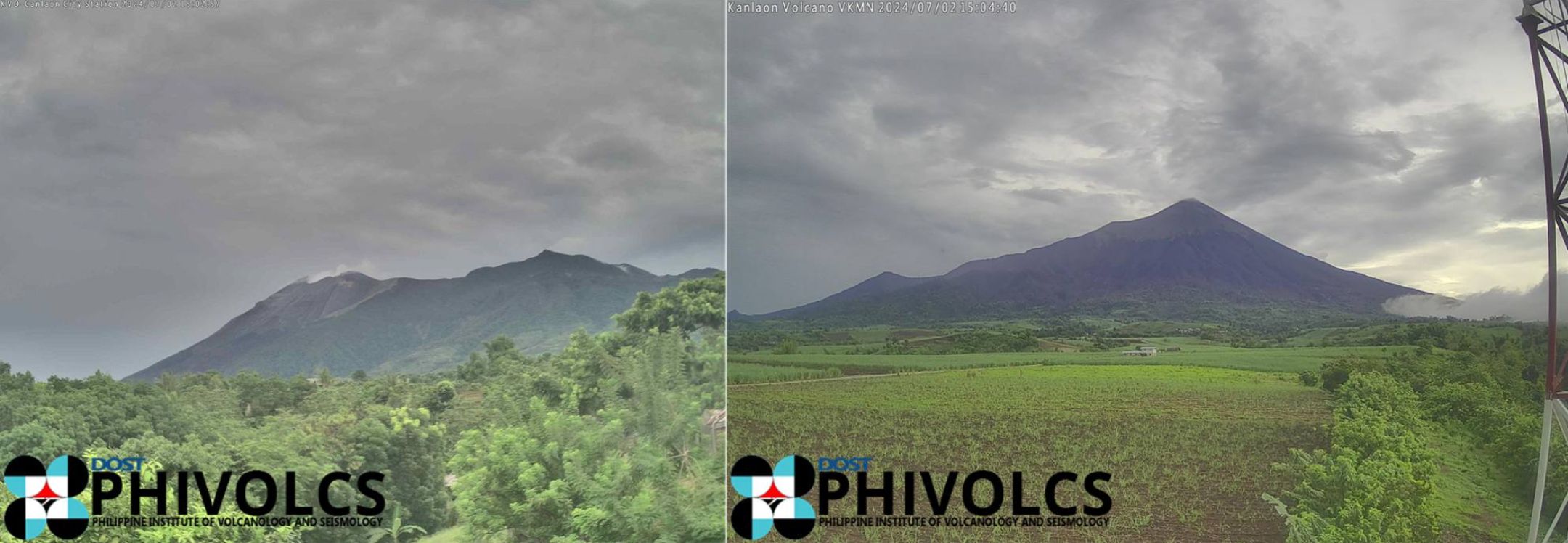
IP Camera snapshots of Kanlaon Volcano around 3 p.m. on July 2, 2024, taken from the observation stations in Canlaon City (KVO-CC; left) and Mansalanao, La Castellana (VKMN; right). (Phivolcs/Facebook)

The Philippine Institute of Volcanology and Seismology (Phivolcs) has detected a significant increase in seismic activity at Kanlaon Volcano over the past 24 hours.

In a notice issued at 1:15 p.m. on Wednesday, July 3, Phivolcs said that the Kanlaon Volcano Network recorded 90 volcanic earthquakes between 3 p.m. on July 2, and 12 p.m. on July 3.

Most of these earthquakes originated within a depth of 20 kilometers beneath the southeastern sector volcano, which included five volcano-tectonic events caused by rock fracturing and 85 weak low-frequency events indicating movement of volcanic fluids.

In addition, volcanic sulfur dioxide (SO2) gas emissions from the summit crater have remained persistently elevated since the eruption on June 3, averaging 3,254 tons per day and peaking at 5,083 tons on July 2.

“Ground deformation data from continuous GPS and electronic tilt measurements have been recording medium-term inflation of the Kanlaon edifice since March 2022 and a shorter-term inflation of the eastern flank since 2023, indicating slow but sustained pressurization within the volcano,” it explained.

These findings suggest magmatic processes drive current unrest, leading to “increased volcanic earthquake activity, persistently high concentrations of volcanic gas emission and swelling of the edifice.”

Phivolcs said Alert Level 2 remains in effect over Kanlaon Volcano due to the ongoing unrest.

Under Alert Level 2, Phivolcs warned of the potential for explosive eruptions driven by shallow magmatic processes.

The public is strongly advised to avoid the four-kilometer-radius permanent danger zone (PDZ) around the summit crater to minimize risks such as pyroclastic density currents, ballistic projectiles, and rockfalls.

Residents in areas downwind of Kanlaon are urged to prepare for ash fall events by covering their nose and mouth with a damp cloth or mask.

Communities residing along river systems on the southern and western slopes are advised to take precautionary measures in anticipation of heavy rainfall, which could trigger lahars and muddy streamflows.

Related Tags

volcanic earthquakes Kanlaon Volcano PHIVOLCS Alert Level 2
ADVERTISEMENT
.most-popular .layout-ratio{ padding-bottom: 79.13%; } @media (min-width: 768px) and (max-width: 1024px) { .widget-title { font-size: 15px !important; } }

{{ articles_filter_1561_widget.title }}

.most-popular .layout-ratio{ padding-bottom: 79.13%; } @media (min-width: 768px) and (max-width: 1024px) { .widget-title { font-size: 15px !important; } }

{{ articles_filter_1562_widget.title }}

.most-popular .layout-ratio{ padding-bottom: 79.13%; } @media (min-width: 768px) and (max-width: 1024px) { .widget-title { font-size: 15px !important; } }

{{ articles_filter_1563_widget.title }}

{{ articles_filter_1564_widget.title }}

.mb-article-details { position: relative; } .mb-article-details .article-body-preview, .mb-article-details .article-body-summary{ font-size: 17px; line-height: 30px; font-family: "Libre Caslon Text", serif; color: #000; } .mb-article-details .article-body-preview iframe , .mb-article-details .article-body-summary iframe{ width: 100%; margin: auto; } .read-more-background { background: linear-gradient(180deg, color(display-p3 1.000 1.000 1.000 / 0) 13.75%, color(display-p3 1.000 1.000 1.000 / 0.8) 30.79%, color(display-p3 1.000 1.000 1.000) 72.5%); position: absolute; height: 200px; width: 100%; bottom: 0; display: flex; justify-content: center; align-items: center; padding: 0; } .read-more-background a{ color: #000; } .read-more-btn { padding: 17px 45px; font-family: Inter; font-weight: 700; font-size: 18px; line-height: 16px; text-align: center; vertical-align: middle; border: 1px solid black; background-color: white; } .hidden { display: none; }
function initializeAllSwipers() { // Get all hidden inputs with cms_article_id document.querySelectorAll('[id^="cms_article_id_"]').forEach(function (input) { const cmsArticleId = input.value; const articleSelector = '#article-' + cmsArticleId + ' .body_images'; const swiperElement = document.querySelector(articleSelector); if (swiperElement && !swiperElement.classList.contains('swiper-initialized')) { new Swiper(articleSelector, { loop: true, pagination: false, navigation: { nextEl: '#article-' + cmsArticleId + ' .swiper-button-next', prevEl: '#article-' + cmsArticleId + ' .swiper-button-prev', }, }); } }); } setTimeout(initializeAllSwipers, 3000); const intersectionObserver = new IntersectionObserver( (entries) => { entries.forEach((entry) => { if (entry.isIntersecting) { const newUrl = entry.target.getAttribute("data-url"); if (newUrl) { history.pushState(null, null, newUrl); let article = entry.target; // Extract metadata const author = article.querySelector('.author-section').textContent.replace('By', '').trim(); const section = article.querySelector('.section-info ').textContent.replace(' ', ' '); const title = article.querySelector('.article-title h1').textContent; // Parse URL for Chartbeat path format const parsedUrl = new URL(newUrl, window.location.origin); const cleanUrl = parsedUrl.host + parsedUrl.pathname; // Update Chartbeat configuration if (typeof window._sf_async_config !== 'undefined') { window._sf_async_config.path = cleanUrl; window._sf_async_config.sections = section; window._sf_async_config.authors = author; } // Track virtual page view with Chartbeat if (typeof pSUPERFLY !== 'undefined' && typeof pSUPERFLY.virtualPage === 'function') { try { pSUPERFLY.virtualPage({ path: cleanUrl, title: title, sections: section, authors: author }); } catch (error) { console.error('ping error', error); } } // Optional: Update document title if (title && title !== document.title) { document.title = title; } } } }); }, { threshold: 0.1 } ); function showArticleBody(button) { const article = button.closest("article"); const summary = article.querySelector(".article-body-summary"); const body = article.querySelector(".article-body-preview"); const readMoreSection = article.querySelector(".read-more-background"); // Hide summary and read-more section summary.style.display = "none"; readMoreSection.style.display = "none"; // Show the full article body body.classList.remove("hidden"); } document.addEventListener("DOMContentLoaded", () => { let loadCount = 0; // Track how many times articles are loaded const offset = [1, 2, 3, 4, 5, 6, 7, 8, 9, 10]; // Offset values const currentUrl = window.location.pathname.substring(1); let isLoading = false; // Prevent multiple calls if (!currentUrl) { console.log("Current URL is invalid."); return; } const sentinel = document.getElementById("load-more-sentinel"); if (!sentinel) { console.log("Sentinel element not found."); return; } function isSentinelVisible() { const rect = sentinel.getBoundingClientRect(); return ( rect.top < window.innerHeight && rect.bottom >= 0 ); } function onScroll() { if (isLoading) return; if (isSentinelVisible()) { if (loadCount >= offset.length) { console.log("Maximum load attempts reached."); window.removeEventListener("scroll", onScroll); return; } isLoading = true; const currentOffset = offset[loadCount]; window.loadMoreItems().then(() => { let article = document.querySelector('#widget_1690 > div:nth-last-of-type(2) article'); intersectionObserver.observe(article) loadCount++; }).catch(error => { console.error("Error loading more items:", error); }).finally(() => { isLoading = false; }); } } window.addEventListener("scroll", onScroll); });

Sign up by email to receive news.