

ADVERTISEMENT

Thousands in Ukraine honor soldiers killed in blast and urge government to get prisoners freed

Published Jul 29, 2024 12:17 am

KYIV, Ukraine (AP) — Ukrainians urged their government to do more to get Russia to release prisoners of war, voicing their anger on Sunday at a ceremony commemorating the second anniversary of an explosion that killed more than 50.
AP24210604419270.jpg
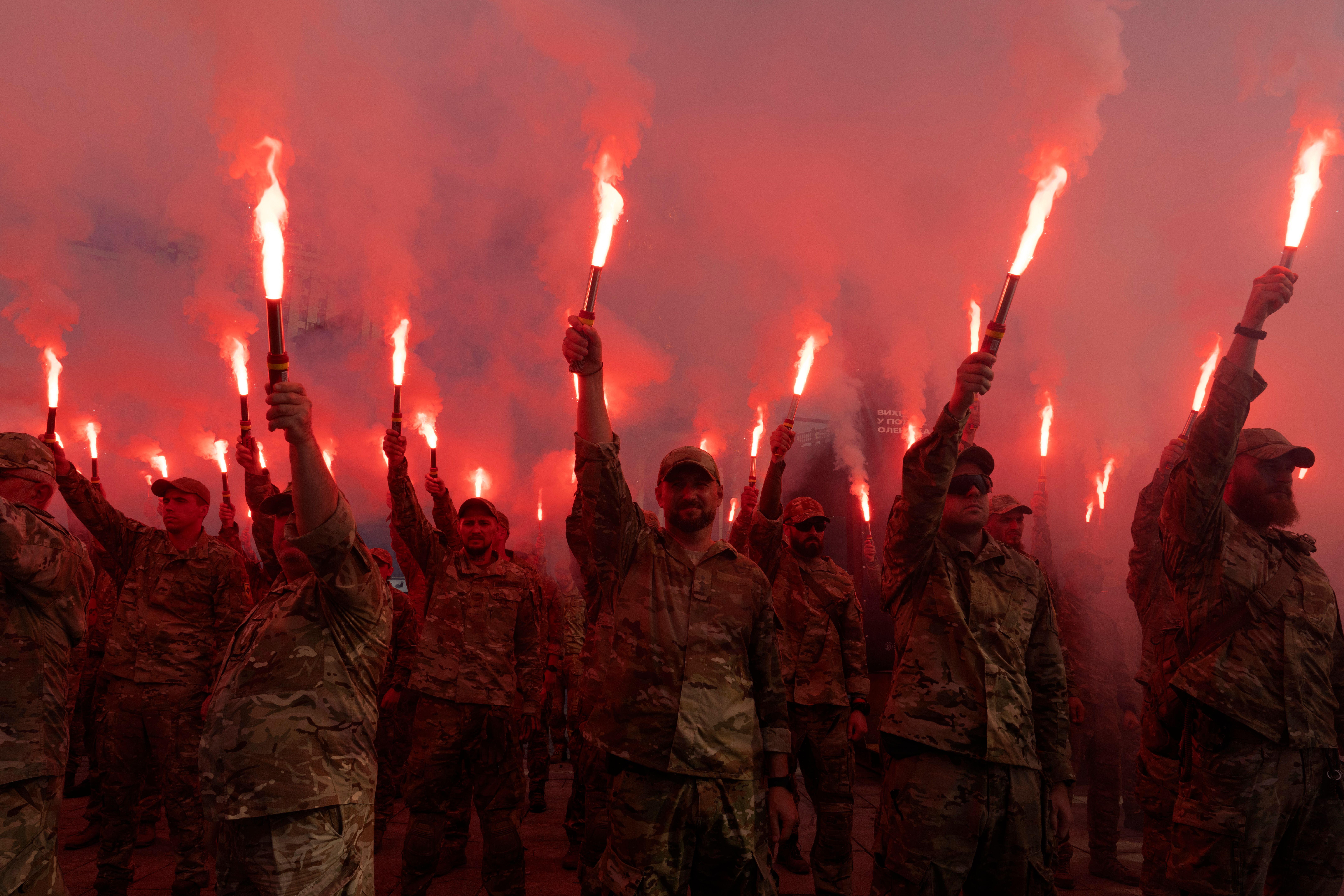
Soldiers of Ukraine's Azov battalion light flares at a rally demanding the release of Ukrainian prisoners of war who are held in captivity in Russia, at Independence Square in Kyiv, Ukraine, Sunday, July 28, 2024. Several thousand people and soldiers gathered to commemorate the second anniversary of a Russia-orchestrated explosion that killed more than 50 Ukrainian prisoners of war in the Russian-held Olenivka prison barracks. (AP Photo/Efrem Lukatsky)

Several thousand soldiers and civilians gathered at Kyiv’s Independence Square Sunday to commemorate the second anniversary of an explosion that killed more than 50 Ukrainians that Russia held in the Olenivka prison barracks.

Impassioned speakers at the ceremony urged the Ukrainian government to work harder to get the soldiers freed in a prisoner exchange.

The Olenivka explosion was one of the most painful pages in the war, according to many soldiers.

“I was there in Olenivka. I was rocked by the explosion,” said Sgt. Kyrylo Masalitin, who was later released. “Never before have I felt so helpless. And those still in captivity feel that helplessness every day. They must know that we have done everything we can do to get them released.”

Behind Masalitin, more than 300 soldiers of the Azov brigade stood in formation. In unison they recited a prayer before holding aloft red flares to honor their comrades.

Russia has claimed that the Olenivka explosion was caused by Ukrainian forces firing a missile that hit the prison barracks. But increasing evidence suggests that Russian forces set off the explosion, according to an investigation by The Associated Press.

The AP interviewed more than a dozen people with direct knowledge of details of the attack, including survivors, investigators and families of the dead and missing. All described evidence they believe points directly to Russia as the culprit. AP also obtained an internal United Nations analysis that found the same. Despite the conclusion of the internal analysis that found Russia planned and executed the attack, the U.N. stopped short of accusing Russia in public statements.

Two years after the explosion, many Ukrainians still want to know exactly how it happened. The demonstration Sunday brought together people who are commemorating Olenivka with others who are protesting Russia’s imprisonment of Ukrainian fighters who defended the Azovstal steel works and were taken prisoner when Russia seized the city of Mariupol.

Many were also pressing for the release of Ukrainian soldiers who were defending the Avovstal steel works and were captured when Mariupol fell in 2022. At least 900 soldiers from the Azov brigade are held as prisoners of war by Russia. The “Free Azov” campaign has become a vociferous pressure group in Kyiv and holds weekly vigils to urge President Volodymyr Zelenskyy's government to do a prisoner exchange to get free Ukrainian prisoners held by Russia.

“We’re here to remember those who died and also those in captivity. We’re here to push our government to work hard on this,” said a soldier who identified himself as Stanislav.

He said he had been a defender of Mariupol when the Russians invaded in February 2022 and he was injured in an artillery attack, losing his left arm. He was treated in the army base inside the Azovstal steel works before he was taken captive by the Russian forces and then released. After physical rehabilitation, Stanislav returned to the army and now works in military headquarters in Kyiv.

He said he will keep pushing for the release of captive soldiers.

“We’re here for a special reason, to see that our brothers-in-arms in captivity come back," he said. “All of those in captivity.”

The event in the center of Kyiv drew together many families, including the mothers, wives and children of soldiers who were killed at Olenivka or are currently imprisoned by Russia.

Her voice cracking with emotion, Halyna Stafiichuk, 71, said her son is being held by the Russians and she hasn't heard from him in more than two years.

“I'm crying every day. I'm just praying for a note from him that says he is OK and that he will be home soon,” said Stafiichuk. “We trust that God and our government will bring all our soldiers back."

Related Tags

WORLDNEWS
ADVERTISEMENT
.most-popular .layout-ratio{ padding-bottom: 79.13%; } @media (min-width: 768px) and (max-width: 1024px) { .widget-title { font-size: 15px !important; } }

{{ articles_filter_1561_widget.title }}

.most-popular .layout-ratio{ padding-bottom: 79.13%; } @media (min-width: 768px) and (max-width: 1024px) { .widget-title { font-size: 15px !important; } }

{{ articles_filter_1562_widget.title }}

.most-popular .layout-ratio{ padding-bottom: 79.13%; } @media (min-width: 768px) and (max-width: 1024px) { .widget-title { font-size: 15px !important; } }

{{ articles_filter_1563_widget.title }}

{{ articles_filter_1564_widget.title }}

.mb-article-details { position: relative; } .mb-article-details .article-body-preview, .mb-article-details .article-body-summary{ font-size: 17px; line-height: 30px; font-family: "Libre Caslon Text", serif; color: #000; } .mb-article-details .article-body-preview iframe , .mb-article-details .article-body-summary iframe{ width: 100%; margin: auto; } .read-more-background { background: linear-gradient(180deg, color(display-p3 1.000 1.000 1.000 / 0) 13.75%, color(display-p3 1.000 1.000 1.000 / 0.8) 30.79%, color(display-p3 1.000 1.000 1.000) 72.5%); position: absolute; height: 200px; width: 100%; bottom: 0; display: flex; justify-content: center; align-items: center; padding: 0; } .read-more-background a{ color: #000; } .read-more-btn { padding: 17px 45px; font-family: Inter; font-weight: 700; font-size: 18px; line-height: 16px; text-align: center; vertical-align: middle; border: 1px solid black; background-color: white; } .hidden { display: none; }
function initializeAllSwipers() { // Get all hidden inputs with cms_article_id document.querySelectorAll('[id^="cms_article_id_"]').forEach(function (input) { const cmsArticleId = input.value; const articleSelector = '#article-' + cmsArticleId + ' .body_images'; const swiperElement = document.querySelector(articleSelector); if (swiperElement && !swiperElement.classList.contains('swiper-initialized')) { new Swiper(articleSelector, { loop: true, pagination: false, navigation: { nextEl: '#article-' + cmsArticleId + ' .swiper-button-next', prevEl: '#article-' + cmsArticleId + ' .swiper-button-prev', }, }); } }); } setTimeout(initializeAllSwipers, 3000); const intersectionObserver = new IntersectionObserver( (entries) => { entries.forEach((entry) => { if (entry.isIntersecting) { const newUrl = entry.target.getAttribute("data-url"); if (newUrl) { history.pushState(null, null, newUrl); let article = entry.target; // Extract metadata const author = article.querySelector('.author-section').textContent.replace('By', '').trim(); const section = article.querySelector('.section-info ').textContent.replace(' ', ' '); const title = article.querySelector('.article-title h1').textContent; // Parse URL for Chartbeat path format const parsedUrl = new URL(newUrl, window.location.origin); const cleanUrl = parsedUrl.host + parsedUrl.pathname; // Update Chartbeat configuration if (typeof window._sf_async_config !== 'undefined') { window._sf_async_config.path = cleanUrl; window._sf_async_config.sections = section; window._sf_async_config.authors = author; } // Track virtual page view with Chartbeat if (typeof pSUPERFLY !== 'undefined' && typeof pSUPERFLY.virtualPage === 'function') { try { pSUPERFLY.virtualPage({ path: cleanUrl, title: title, sections: section, authors: author }); } catch (error) { console.error('ping error', error); } } // Optional: Update document title if (title && title !== document.title) { document.title = title; } } } }); }, { threshold: 0.1 } ); function showArticleBody(button) { const article = button.closest("article"); const summary = article.querySelector(".article-body-summary"); const body = article.querySelector(".article-body-preview"); const readMoreSection = article.querySelector(".read-more-background"); // Hide summary and read-more section summary.style.display = "none"; readMoreSection.style.display = "none"; // Show the full article body body.classList.remove("hidden"); } document.addEventListener("DOMContentLoaded", () => { let loadCount = 0; // Track how many times articles are loaded const offset = [1, 2, 3, 4, 5, 6, 7, 8, 9, 10]; // Offset values const currentUrl = window.location.pathname.substring(1); let isLoading = false; // Prevent multiple calls if (!currentUrl) { console.log("Current URL is invalid."); return; } const sentinel = document.getElementById("load-more-sentinel"); if (!sentinel) { console.log("Sentinel element not found."); return; } function isSentinelVisible() { const rect = sentinel.getBoundingClientRect(); return ( rect.top < window.innerHeight && rect.bottom >= 0 ); } function onScroll() { if (isLoading) return; if (isSentinelVisible()) { if (loadCount >= offset.length) { console.log("Maximum load attempts reached."); window.removeEventListener("scroll", onScroll); return; } isLoading = true; const currentOffset = offset[loadCount]; window.loadMoreItems().then(() => { let article = document.querySelector('#widget_1690 > div:nth-last-of-type(2) article'); intersectionObserver.observe(article) loadCount++; }).catch(error => { console.error("Error loading more items:", error); }).finally(() => { isLoading = false; }); } } window.addEventListener("scroll", onScroll); });

Sign up by email to receive news.