






 Business
Yuchengco-led PetroGreen inks deal for solar rooftop installation at Isuzu manufacturing facility
Business
Yuchengco-led PetroGreen inks deal for solar rooftop installation at Isuzu manufacturing facility
Yuchengco-led PetroGreen inks deal for solar rooftop installation at Isuzu manufacturing facility


At A Glance
- Embracing this renewable energy (RE) solution is not just a preeminent nod to environmental responsibility for end-user Isuzu, but it is also a strategic step in achieving cost savings on its energy usage.
- The solar rooftop project will take off from the drawing board by the fourth quarter of this year; and will reach commercial operations by the second quarter of 2025.
Yuchengco-led PetroGreen Energy Corporation (PGEC) has cemented a partnership deal with Japanese firm Isuzu Autoparts Manufacturing Corporation (IAMC) for the installation of 3.002-megawatt peak (MWp) solar rooftop solution at the latter’s manufacturing facility in Laguna.
In a statement to the media, PetroGreen indicated that the project will take off from the drawing board by the fourth quarter of this year; and will reach commercial operations by the second quarter of 2025.
Embracing this renewable energy (RE) solution is not just a preeminent nod to environmental responsibility for end-user Isuzu, but it is also a strategic step in achieving cost savings on its energy usage.
According to PetroGreen, when the facility gets into commercial stream, “it will be among the largest commercial and industrial (C&I) rooftop solar facilities in Laguna.”
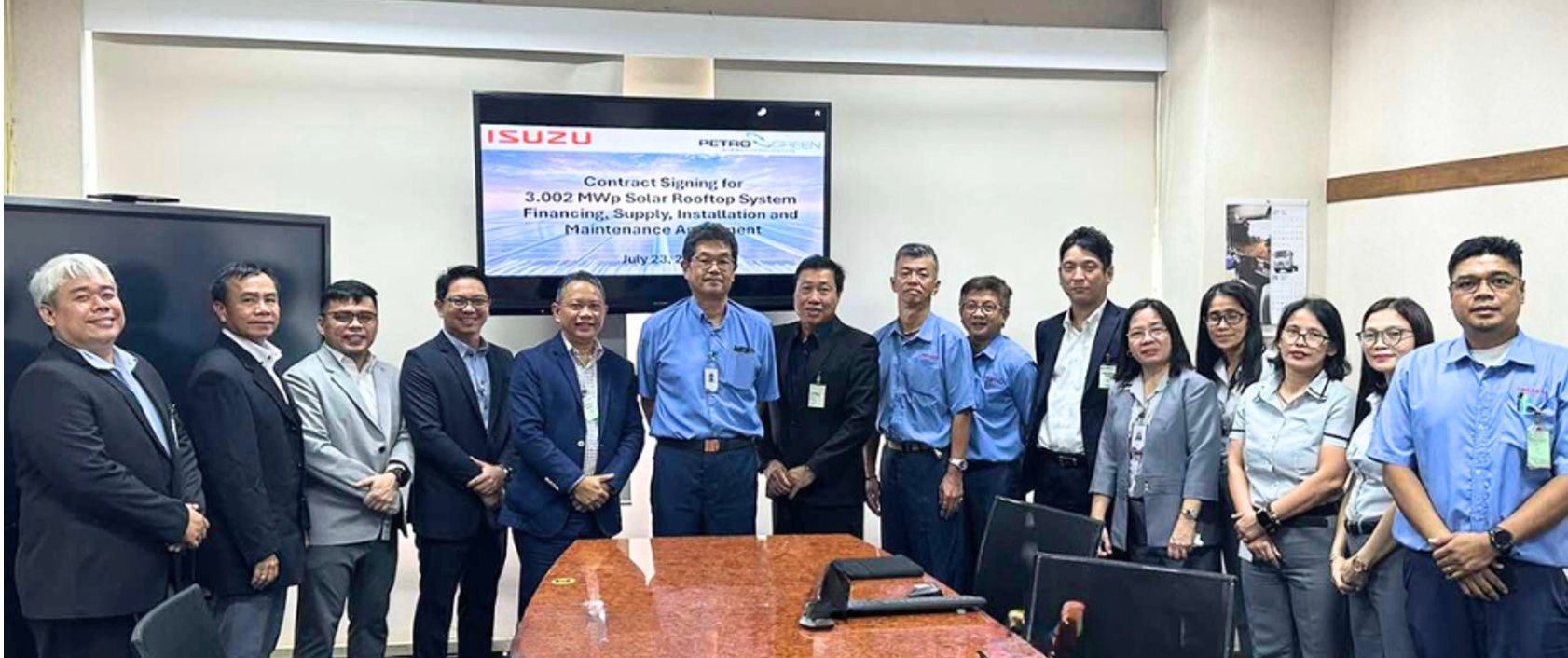
As emphasized by IAMC President Seiji Mizutani, the company’s tie-up with PetroGreen on the solar rooftop development “is more than about energy efficiency and power cost reduction; it is a testament of IAMC’s corporate commitment to Isuzu Environmental Vision 2050 to environmental stewardship.”
Most corporates in the developed world have already framed net zero goals and well-defined decarbonization targets through the chain of their operations as their share in addressing global risks of climate change.
Isuzu’s major business decision to opt for green technology in satisfying its energy needs is also aligned with the Sustainable Development Goals (SDG) of the United Nations as well as the Ambisyon Natin 2040 that had been cast by the Philippine government.
PetroGreen said the solar rooftop facility “will feature state-of-the-art solar panels and inverters, optimized for high efficiency and reliability.”
While power supply drawn from incumbent power utilities would typically be generated from amalgamation of both fossil fuels and RE technologies and the rates could also turn very volatile most of the time, solar rooftop installations often provide a counter-narrative because it is certain that it will yield generated electricity from clean resources and it will also come at a lower cost to the end-user.
PetroGreen President and CEO Francisco G. Delfin Jr. expounded “this project is the latest and biggest addition to our growing C&I solar portfolio that now includes commercial, educational, and manufacturing partners.”
Essentially, the blueprinted project will have 4,000 megawatt-hours (MWh) output annually – and that will greatly enable Isuzu’s shift to clean power generated through the use of the rooftop of its own facility - veering away from its traditional reliance on externally-drawn electricity supply.
Beyond that, the solar facility’s allure likewise leans on the scale of carbon emissions reduction that it could achieve at 3,000 metric tons per year – which will be Isuzu’s compelling contribution to abating global warming in line with climate diplomacy covenant under the Paris Agreement.
Further, Delfin highlighted that the project “contributes to DOE’s (Department of Energy’s) goals of greater energy efficiency and clean energy use in the auto manufacturing sector.”
Even President Marcos has declared in his State of the Nation Address (SONA) this year that solar installations will be among the innovative approaches that the government will continue to promote, primarily in addressing the C&I sector’s bid for cost-competitive energy source.