

ADVERTISEMENT

Marcos to young Pinoys: Take inspiration from Apolinario Mabini

Published Jul 23, 2024 02:50 am

Young Filipinos were encouraged by President Marcos to take inspiration from Apolinario Mabini to succeed in life.
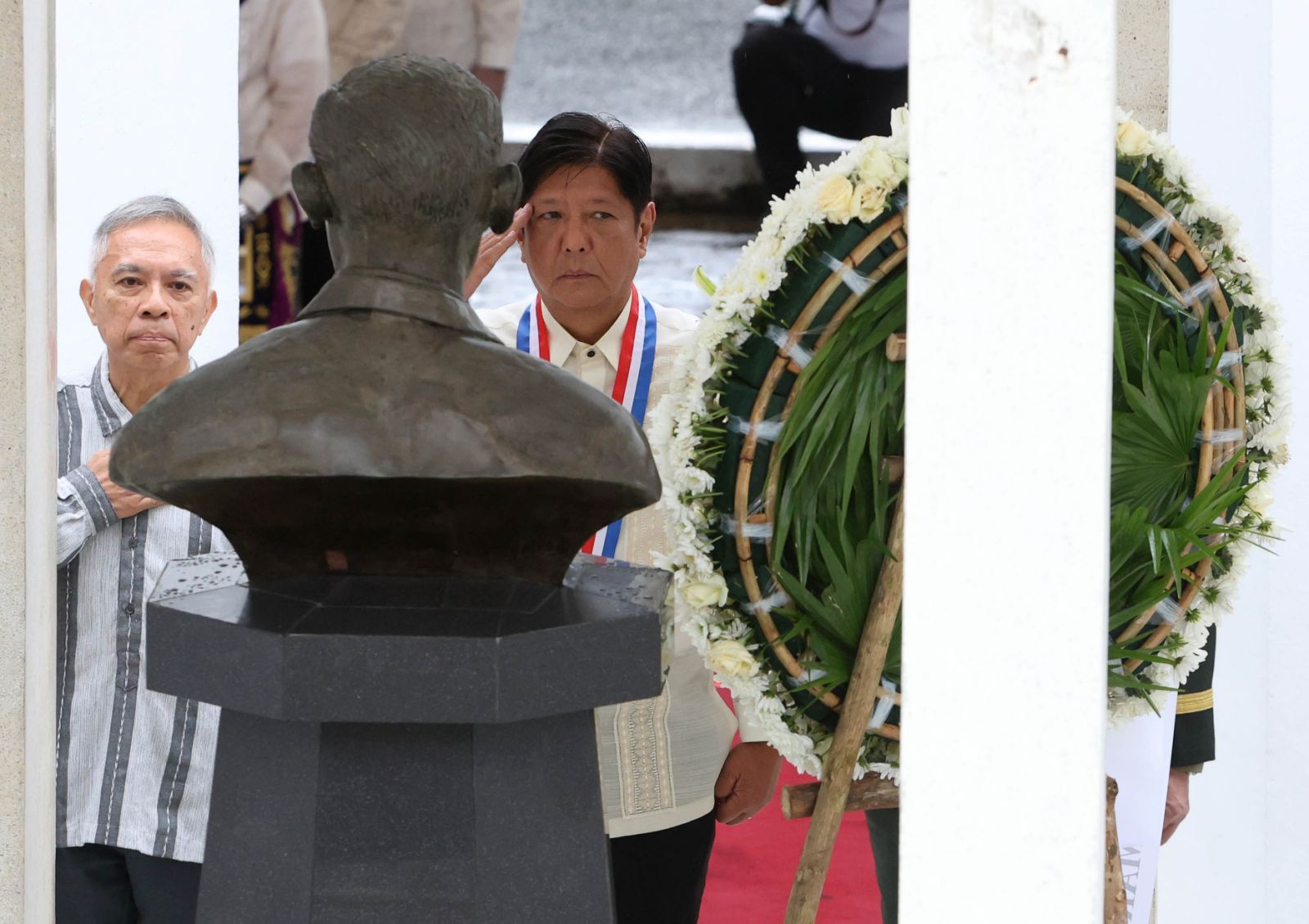
BBM Apolinario Mabini.jpg
President Ferdinand 'Bongbong' Marcos Jr. leads the commemoration of the 160th birthday anniversary of Mabini in Tanauan City, Batangas on July 23, 2024. (Photo courtesy of PPA/Marianne Bermudez)

Leading the commemoration of the 160th birthday anniversary of Mabini in Tanauan City, Batangas on Tuesday, July 23, Marcos urged young Filipinos to continue immortalizing the life of Mabini towards a more progressive nation.

“Tinatawagan ko ang mga kabataang Pilipino ngayon na gawing inspirasyon at halimbawa ang buhay ni Apolinario Mabini upang magpunyagi sa buhay (I call on the Filipino youth to make Apolinario Mabini as an inspiration and example to strive in life),” Marcos said in his speech.

“Nawa’y higit [na] maunawaan ng mga [nakababatang] henerasyon ang kaniyang mga pilosopiyang pampulitika at panlipunan upang sila ay mahikayat na mag-ambag sa pagsulong ng ating bansa (May the younger generation understand his political and societal philosophies to encourage them to contribute in the progress of our nation),” Marcos added.

In his speech, the President honored Mabini's life which proved that every Filipino has the capability to succeed in life despite all the challenges.

He urged Filipinos to stand united in fulfilling the aspirations of Mabini towards a “Bagong Pilipinas” where everyone has an opportunity to become a productive member of a compassionate and united community.

Often referred to as the Sublime Paralytic, Mabini was born in poverty on July 23, 1864 in Talaga, Tanauan, Batangas. He received his law degree in 1894 from the University of Santo Tomas. He contracted an illness in his 30’s, paralyzing his legs.

Despite the disability, Mabini developed an impressive mind and deep patriotism and lived a selfless life motivated by high ideals.

Mabini went to the forefront of the 1898 revolution against Spain. He became known as the brains of the revolution against the United States, and Chief adviser of General Emilio Aguinaldo in the same year.

He crafted the Constitution for the First Philippine Republic, including the framework of the revolutionary government implemented in Malolos, Bulacan in 1899. He was appointed as Prime Minister and Foreign Minister of then newly independent government of President Aguinaldo.

Mabini was arrested twice by the Americans, set free, and exiled to Guam. He expressed his love for the country through his passion for literature. And, one of his notable works was his memoir titled: “La Revolucion Filipina.”

Mabini died of cholera in 1903 at the age of 38.

Related Tags

filipino youth apolinario mabini President Marcos
ADVERTISEMENT
.most-popular .layout-ratio{ padding-bottom: 79.13%; } @media (min-width: 768px) and (max-width: 1024px) { .widget-title { font-size: 15px !important; } }

{{ articles_filter_1561_widget.title }}

.most-popular .layout-ratio{ padding-bottom: 79.13%; } @media (min-width: 768px) and (max-width: 1024px) { .widget-title { font-size: 15px !important; } }

{{ articles_filter_1562_widget.title }}

.most-popular .layout-ratio{ padding-bottom: 79.13%; } @media (min-width: 768px) and (max-width: 1024px) { .widget-title { font-size: 15px !important; } }

{{ articles_filter_1563_widget.title }}

{{ articles_filter_1564_widget.title }}

.mb-article-details { position: relative; } .mb-article-details .article-body-preview, .mb-article-details .article-body-summary{ font-size: 17px; line-height: 30px; font-family: "Libre Caslon Text", serif; color: #000; } .mb-article-details .article-body-preview iframe , .mb-article-details .article-body-summary iframe{ width: 100%; margin: auto; } .read-more-background { background: linear-gradient(180deg, color(display-p3 1.000 1.000 1.000 / 0) 13.75%, color(display-p3 1.000 1.000 1.000 / 0.8) 30.79%, color(display-p3 1.000 1.000 1.000) 72.5%); position: absolute; height: 200px; width: 100%; bottom: 0; display: flex; justify-content: center; align-items: center; padding: 0; } .read-more-background a{ color: #000; } .read-more-btn { padding: 17px 45px; font-family: Inter; font-weight: 700; font-size: 18px; line-height: 16px; text-align: center; vertical-align: middle; border: 1px solid black; background-color: white; } .hidden { display: none; }
function initializeAllSwipers() { // Get all hidden inputs with cms_article_id document.querySelectorAll('[id^="cms_article_id_"]').forEach(function (input) { const cmsArticleId = input.value; const articleSelector = '#article-' + cmsArticleId + ' .body_images'; const swiperElement = document.querySelector(articleSelector); if (swiperElement && !swiperElement.classList.contains('swiper-initialized')) { new Swiper(articleSelector, { loop: true, pagination: false, navigation: { nextEl: '#article-' + cmsArticleId + ' .swiper-button-next', prevEl: '#article-' + cmsArticleId + ' .swiper-button-prev', }, }); } }); } setTimeout(initializeAllSwipers, 3000); const intersectionObserver = new IntersectionObserver( (entries) => { entries.forEach((entry) => { if (entry.isIntersecting) { const newUrl = entry.target.getAttribute("data-url"); if (newUrl) { history.pushState(null, null, newUrl); let article = entry.target; // Extract metadata const author = article.querySelector('.author-section').textContent.replace('By', '').trim(); const section = article.querySelector('.section-info ').textContent.replace(' ', ' '); const title = article.querySelector('.article-title h1').textContent; // Parse URL for Chartbeat path format const parsedUrl = new URL(newUrl, window.location.origin); const cleanUrl = parsedUrl.host + parsedUrl.pathname; // Update Chartbeat configuration if (typeof window._sf_async_config !== 'undefined') { window._sf_async_config.path = cleanUrl; window._sf_async_config.sections = section; window._sf_async_config.authors = author; } // Track virtual page view with Chartbeat if (typeof pSUPERFLY !== 'undefined' && typeof pSUPERFLY.virtualPage === 'function') { try { pSUPERFLY.virtualPage({ path: cleanUrl, title: title, sections: section, authors: author }); } catch (error) { console.error('ping error', error); } } // Optional: Update document title if (title && title !== document.title) { document.title = title; } } } }); }, { threshold: 0.1 } ); function showArticleBody(button) { const article = button.closest("article"); const summary = article.querySelector(".article-body-summary"); const body = article.querySelector(".article-body-preview"); const readMoreSection = article.querySelector(".read-more-background"); // Hide summary and read-more section summary.style.display = "none"; readMoreSection.style.display = "none"; // Show the full article body body.classList.remove("hidden"); } document.addEventListener("DOMContentLoaded", () => { let loadCount = 0; // Track how many times articles are loaded const offset = [1, 2, 3, 4, 5, 6, 7, 8, 9, 10]; // Offset values const currentUrl = window.location.pathname.substring(1); let isLoading = false; // Prevent multiple calls if (!currentUrl) { console.log("Current URL is invalid."); return; } const sentinel = document.getElementById("load-more-sentinel"); if (!sentinel) { console.log("Sentinel element not found."); return; } function isSentinelVisible() { const rect = sentinel.getBoundingClientRect(); return ( rect.top < window.innerHeight && rect.bottom >= 0 ); } function onScroll() { if (isLoading) return; if (isSentinelVisible()) { if (loadCount >= offset.length) { console.log("Maximum load attempts reached."); window.removeEventListener("scroll", onScroll); return; } isLoading = true; const currentOffset = offset[loadCount]; window.loadMoreItems().then(() => { let article = document.querySelector('#widget_1690 > div:nth-last-of-type(2) article'); intersectionObserver.observe(article) loadCount++; }).catch(error => { console.error("Error loading more items:", error); }).finally(() => { isLoading = false; }); } } window.addEventListener("scroll", onScroll); });

Sign up by email to receive news.