







3 out of 5 Filipinos support economic Cha-cha — survey


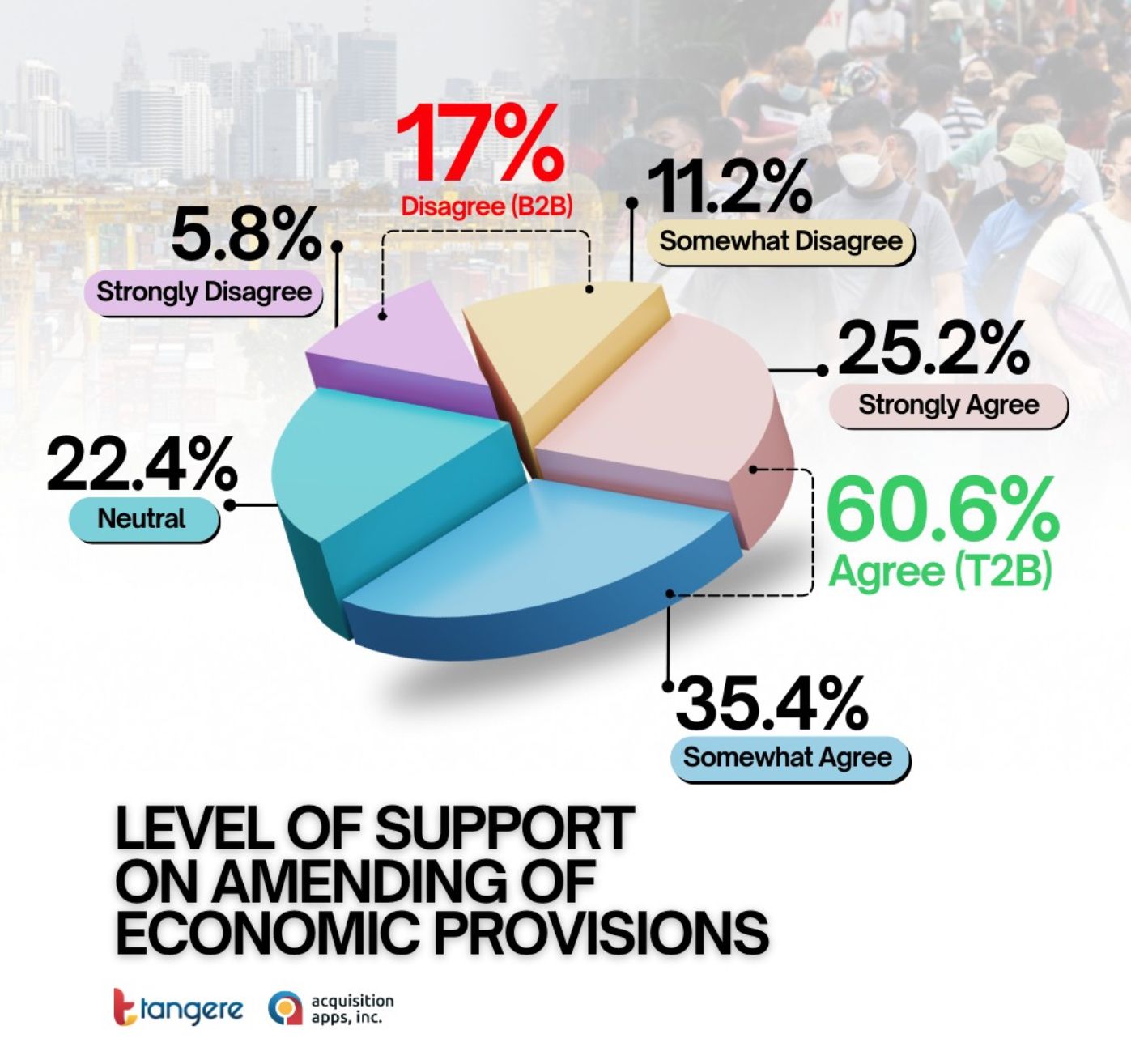
A survey conducted by Tangere from July 16 to 18 revealed that 60.6 percent of Filipinos support the proposed amendments to the economic provisions of the 1987 Constitution.
Of the 60.6 percent of Filipinos who agree, 25.2 percent “strongly agree” and 35.4 percent “somewhat agree” with the proposed economic Charter change (Cha-cha).
Meanwhile, 17 percent disagree with the proposal (5.8 percent strongly agree, 11.2 percent somewhat disagree), while 22.4 percent were “neutral” about the proposal.
Tangere said that similar to the June survey results, strong support was observed among respondents from Metro Manila, Northern Luzon, and Central Luzon.
It added that there was a notable increase in support recorded in the Visayas.
Meanwhile, disagreement was more common among respondents from Mindanao, Southern Luzon, and Bicol Region.
Perceived advantages, disadvantages
When asked about the perceived advantages of the proposed amendments to the 1987 Constitution’s economic provisions, respondents cited the following top five advantages—creation of more jobs (72.5 percent), higher economic growth (68.7 percent), increase in salaries and work benefits (68.5 percent), decrease in the prices of goods and services (67 percent), and improvement in the quality of jobs in the country (66 percent).
Meanwhile, when asked about the perceived disadvantages of the proposed economic Cha-cha, respondents mentioned the following top three disadvantages—potential worsening of corruption (29.5 percent), increase in foreign competitors for local businesses (26 percent), and various national issues will not be prioritized (23.5 percent).
The survey was conducted using a mobile-based respondent application with a sample size of 1,500 participants, with a +/-2.5 percent margin of error at a 95 percent confidence level.
It employed a stratified or quota-based random sampling method.
Respondents were proportionately spread across the Philippines, with 12 percent from Metro Manila, 23 percent from Northern Luzon, 22 percent from Southern Luzon, 20 percent from Visayas, and 23 percent from Mindanao.