







How Healthy Are The Tuna?


By JUNEP OCAMPO
GENERAL SANTOS CITY -- A group of students from the Mindanao State University (MSU) in this city is poised to dive deep into the science behind the tuna living in Sarangani Bay to explore the health of one of the region's most vital marine inhabitants.
Fifteen undergraduate students will undertake a 15-month study aptly called the “Tuna Research Exploring Keynotes (TREK): Charting the Health and Ecology of Tuna Species in Sarangani Bay.” Their work will be funded by the Philippine Council for Agriculture, Aquatic, and Natural Resources Research of the Department of Science and Technology (DOST-PCAARD) under its Undergraduate Research and Education Assistanship for Technology (uGREAT) program.
According to DOST-PCAARD, their funding aims to foster a new generation of Filipino agricultural scientists, especially in the fisheries sector.
The study will be conducted under the leadership of Dr. Christine Dawn G. Obemio who will guide the 15 students in examining the intricate web of factors impacting tuna health.
Their research will encompass a variety of aspects, ranging from the effects of parasites and microplastics on the tunapopulation as well the the presence of heavy metals in the water of Saranggani Bay.
Dr. Obemio said these findings will contribute to the students' academic achievements since the study will serve as their undergraduate thesis. However, she expects that the study would provide the students critical insights into the ecological dynamics of tuna population, thereby making them young "experts" in this field.
THRIVING TUNA CAPITAL
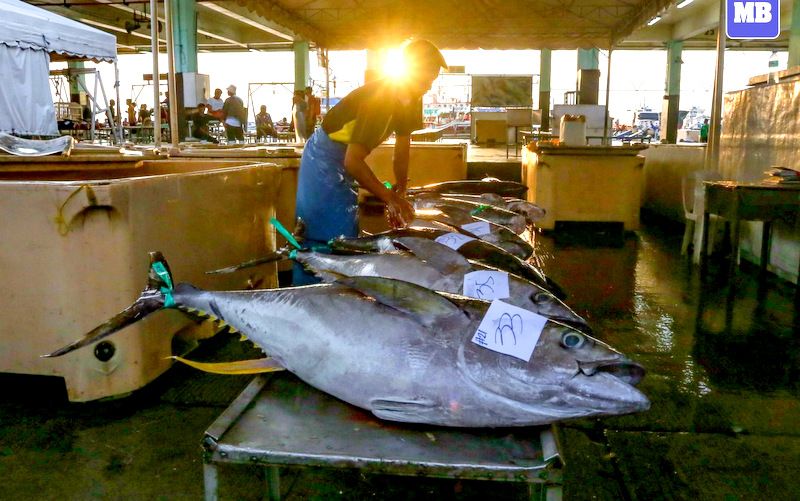
General Santos City is known as the Tuna Capital of the Philippines. As photos on this page will show, it hums with the activity tuna canneries and fishing companies. According to the city government, the tuna industry is the lifeblood of the local economy, employing over 120,000 people and generating countless indirect job opportunities.
The Socsksargen Federation of Fishing and Allied Industries, Inc. (SFFAII) underscores the industry's significance, noting its vast contributions to both the local and national economies. The federation organizes the annual Tuna Festival every September.
On the global stage, the Philippines remains a formidable player in the tuna market, exporting around USD 400 million worth of tuna products annually to major markets like the United States, Japan, and the European Union.
CHALLENGES TO THE INDUSTRY
However, GenSan's tuna industry is not without its challenges. Overfishing and climate change have led to at least 10-percent decline in tuna catches over the past five years, compelling local fishers to venture into more distant and perilous waters.
Competition from neighboring countries, equipped with more advanced fishing fleets and processing facilities, adds another layer of difficulty.
Despite these hurdles, the government says the local tuna industry is resilient and adaptive and innovations such as fish aggregating devices, locally known as "payaos", and satellite-based tracking systems have enhanced efficiency and minimized environmental impact.
SUSTAINABILITY AND VALUE ADDING
Sustainable fishing practices are also being promoted through local government and industry initiatives, supported by international organizations.
According to the local government, there is a strategic shift towards value-added products. Companies are exploring high-value markets for fresh and sashimi-grade tuna, diversifying beyond traditional canned products. One city official said this move not only opens new revenue streams but also strengthens the industry’s ability to weather market fluctuations.
BROADER IMPLOCATIONS
Dr. Mari-Ann Acedera, Director of PCAARRD's Marine Resources Research Division, emphasizes the broader implications of the MSU research project.
“This new project aims to further understand the ecological dynamics affecting tuna health, contributing to the broader goal of sustainable tuna management in the region,” she said.
Earlier, MSU GenSan also undertook a study entitled "Unlocking the Blue Economy: Insights on the Reproductive Biology, Dietary Analysis, and Life History of Tuna Species in the Philippines."
This study showed that there are six stages in the reproductive development of neritic tuna species, or those that thrive in shallow waters such as Saranggani Bay. The study also identified nursery areas for tuna in the bay.
In understanding these findings, fishermen can avoid catching fish during peak spawning periods, ensuring mature fish reproduce and maintaining healthy population levels.
The DOST-PCAARD says the two studies it funded are both meant to ensure the long-term sustainability of tuna stocks in Mindanao.