

ADVERTISEMENT

Phoenix using ice immersion to treat heatstroke victims as Southwest bakes in triple digits

Published Jun 5, 2024 02:15 pm

PHOENIX (AP) — The season's first heat wave is already baking the Southwest with triple-digit temperatures as firefighters in Phoenix — America's hottest big city — employ new tactics in hopes of saving more lives in a county that saw 645 heat-related deaths last year.
AP24155863817773.jpg
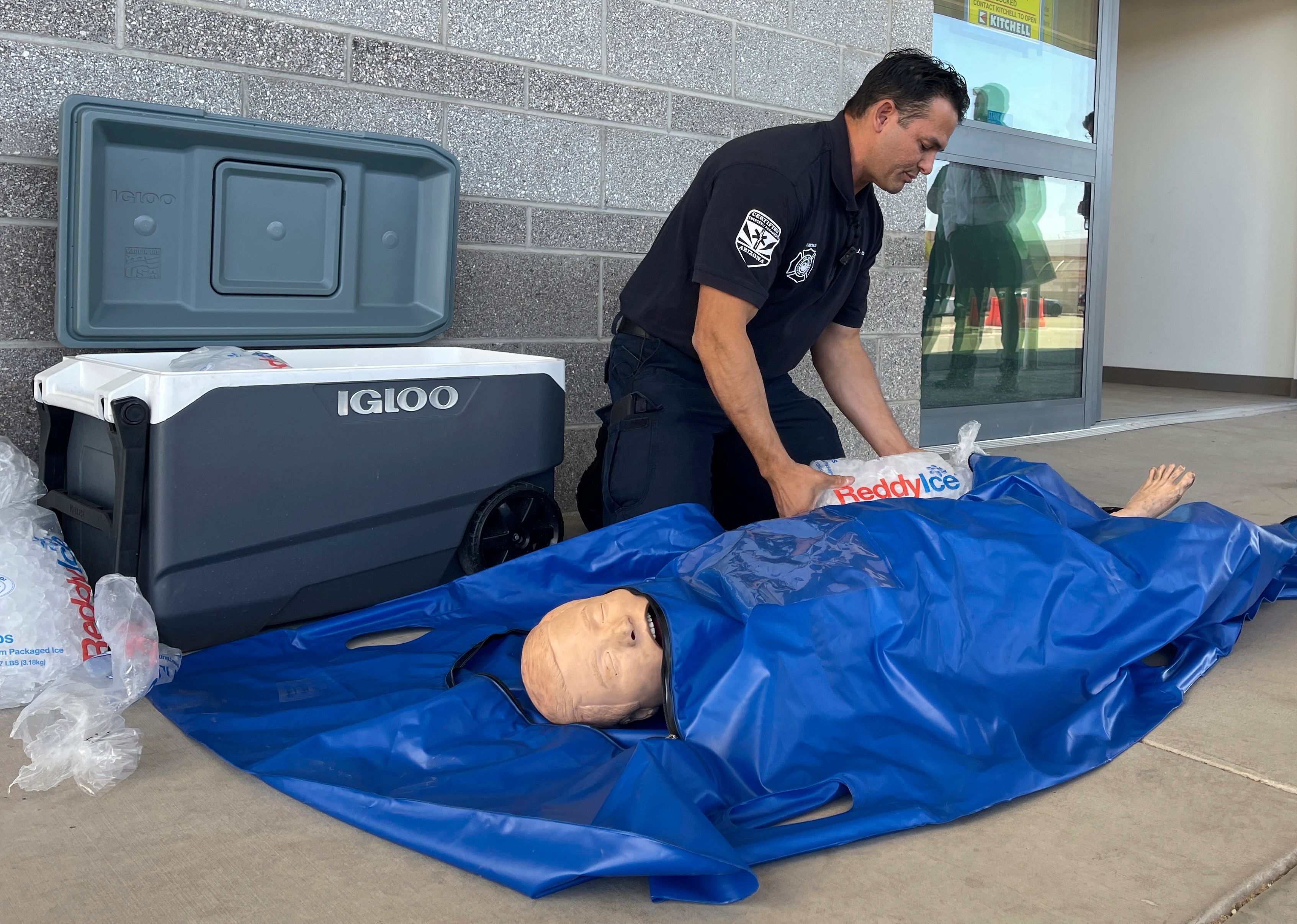
Phoenix Fire Capt. John Prato demonstrates a new protocol that the fire department in America’s hottest big city is adopting as the West braces for the first heat wave of the summer season, Monday, June 3, 2024, in Phoenix. The cold water immersion therapy already used by hospitals in the area will also now be used by Phoenix fire and paramedics personnel on every patient they encounter this season with signs of heat stroke. (AP Photo/Anita Snow)

Starting this season, the Phoenix Fire Department is immersing heatstroke victims in ice on the way to area hospitals. The medical technique, known as cold water immersion, is familiar to marathon runners and military service members and has also recently been adopted by Phoenix hospitals as a go-to protocol, said Fire Capt. John Prato.

Prato demonstrated the method earlier this week outside the emergency department of Valleywise Health Medical Center in Phoenix, packing ice cubes inside an impermeable blue bag around a medical dummy representing a patient. He said the technique could dramatically lower body temperature in minutes.

“Just last week we had a critical patient that we were able to bring back before we walked through the emergency room doors,” Prato said. “That's our goal — to improve patient survivability.”

The heatstroke treatment has made ice and human-sized immersion bags standard equipment on all Phoenix fire department emergency vehicles. It is among measures the city adopted this year as temperatures and their human toll soar ever higher. Phoenix for the first time is also keeping two cooling stations open overnight this season.

Emergency responders in much of an area stretching from southeast California to central Arizona are preparing for what the National Weather Service said would be “easily their hottest” weather since last September.

Excessive heat warnings were issued for Wednesday morning through Friday evening for parts of southern Nevada and Arizona, with highs expected to top 110 degrees Fahrenheit (43.3 Celsius) in Las Vegas and Phoenix. The unseasonably hot weather was expected to spread northward and make its way into parts of the Pacific Northwest by the weekend.

Officials in Maricopa County were stunned earlier this year when final numbers showed 645 heat-related deaths in Arizona's largest county, a majority of them in Phoenix. The most brutal period was a heat wave with 31 subsequent days of temperatures of 110 degrees Fahrenheit (43.4 Celsius) or higher, which claimed more than 400 lives.

“We’ve been seeing a severe uptick in the past three years in cases of severe heat illness,” said Dr. Paul Pugsley, medical director of emergency medicine with Valleywise Health. Of those, about 40% do not survive.

Cooling down patients long before they get to the emergency department could change the equation, he said.

The technique “is not very widely spread in non-military hospitals in the U.S., nor in the prehospital setting among fire departments or first responders,” Pugsley said. He said part of that may be a longstanding perception that the technique's use for all cases of heatstroke by first responders or even hospitals was impractical or impossible.

Pugsley said he was aware of limited use of the technique in some places in California, including Stanford Medical Center in Palo Alto and Community Regional Medical Center in Fresno, and by the San Antonio Fire Department in Texas.

Banner University Medical Center in Phoenix embraced the protocol last summer, said Dr. Aneesh Narang, assistant medical director of emergency medicine there.

“This cold water immersion therapy is really the standard of care to treat heatstroke patients,” he said.

Related Tags

WORLDNEWS
ADVERTISEMENT
.most-popular .layout-ratio{ padding-bottom: 79.13%; } @media (min-width: 768px) and (max-width: 1024px) { .widget-title { font-size: 15px !important; } }

{{ articles_filter_1561_widget.title }}

.most-popular .layout-ratio{ padding-bottom: 79.13%; } @media (min-width: 768px) and (max-width: 1024px) { .widget-title { font-size: 15px !important; } }

{{ articles_filter_1562_widget.title }}

.most-popular .layout-ratio{ padding-bottom: 79.13%; } @media (min-width: 768px) and (max-width: 1024px) { .widget-title { font-size: 15px !important; } }

{{ articles_filter_1563_widget.title }}

{{ articles_filter_1564_widget.title }}

.mb-article-details { position: relative; } .mb-article-details .article-body-preview, .mb-article-details .article-body-summary{ font-size: 17px; line-height: 30px; font-family: "Libre Caslon Text", serif; color: #000; } .mb-article-details .article-body-preview iframe , .mb-article-details .article-body-summary iframe{ width: 100%; margin: auto; } .read-more-background { background: linear-gradient(180deg, color(display-p3 1.000 1.000 1.000 / 0) 13.75%, color(display-p3 1.000 1.000 1.000 / 0.8) 30.79%, color(display-p3 1.000 1.000 1.000) 72.5%); position: absolute; height: 200px; width: 100%; bottom: 0; display: flex; justify-content: center; align-items: center; padding: 0; } .read-more-background a{ color: #000; } .read-more-btn { padding: 17px 45px; font-family: Inter; font-weight: 700; font-size: 18px; line-height: 16px; text-align: center; vertical-align: middle; border: 1px solid black; background-color: white; } .hidden { display: none; }
function initializeAllSwipers() { // Get all hidden inputs with cms_article_id document.querySelectorAll('[id^="cms_article_id_"]').forEach(function (input) { const cmsArticleId = input.value; const articleSelector = '#article-' + cmsArticleId + ' .body_images'; const swiperElement = document.querySelector(articleSelector); if (swiperElement && !swiperElement.classList.contains('swiper-initialized')) { new Swiper(articleSelector, { loop: true, pagination: false, navigation: { nextEl: '#article-' + cmsArticleId + ' .swiper-button-next', prevEl: '#article-' + cmsArticleId + ' .swiper-button-prev', }, }); } }); } setTimeout(initializeAllSwipers, 3000); const intersectionObserver = new IntersectionObserver( (entries) => { entries.forEach((entry) => { if (entry.isIntersecting) { const newUrl = entry.target.getAttribute("data-url"); if (newUrl) { history.pushState(null, null, newUrl); let article = entry.target; // Extract metadata const author = article.querySelector('.author-section').textContent.replace('By', '').trim(); const section = article.querySelector('.section-info ').textContent.replace(' ', ' '); const title = article.querySelector('.article-title h1').textContent; // Parse URL for Chartbeat path format const parsedUrl = new URL(newUrl, window.location.origin); const cleanUrl = parsedUrl.host + parsedUrl.pathname; // Update Chartbeat configuration if (typeof window._sf_async_config !== 'undefined') { window._sf_async_config.path = cleanUrl; window._sf_async_config.sections = section; window._sf_async_config.authors = author; } // Track virtual page view with Chartbeat if (typeof pSUPERFLY !== 'undefined' && typeof pSUPERFLY.virtualPage === 'function') { try { pSUPERFLY.virtualPage({ path: cleanUrl, title: title, sections: section, authors: author }); } catch (error) { console.error('ping error', error); } } // Optional: Update document title if (title && title !== document.title) { document.title = title; } } } }); }, { threshold: 0.1 } ); function showArticleBody(button) { const article = button.closest("article"); const summary = article.querySelector(".article-body-summary"); const body = article.querySelector(".article-body-preview"); const readMoreSection = article.querySelector(".read-more-background"); // Hide summary and read-more section summary.style.display = "none"; readMoreSection.style.display = "none"; // Show the full article body body.classList.remove("hidden"); } document.addEventListener("DOMContentLoaded", () => { let loadCount = 0; // Track how many times articles are loaded const offset = [1, 2, 3, 4, 5, 6, 7, 8, 9, 10]; // Offset values const currentUrl = window.location.pathname.substring(1); let isLoading = false; // Prevent multiple calls if (!currentUrl) { console.log("Current URL is invalid."); return; } const sentinel = document.getElementById("load-more-sentinel"); if (!sentinel) { console.log("Sentinel element not found."); return; } function isSentinelVisible() { const rect = sentinel.getBoundingClientRect(); return ( rect.top < window.innerHeight && rect.bottom >= 0 ); } function onScroll() { if (isLoading) return; if (isSentinelVisible()) { if (loadCount >= offset.length) { console.log("Maximum load attempts reached."); window.removeEventListener("scroll", onScroll); return; } isLoading = true; const currentOffset = offset[loadCount]; window.loadMoreItems().then(() => { let article = document.querySelector('#widget_1690 > div:nth-last-of-type(2) article'); intersectionObserver.observe(article) loadCount++; }).catch(error => { console.error("Error loading more items:", error); }).finally(() => { isLoading = false; }); } } window.addEventListener("scroll", onScroll); });

Sign up by email to receive news.