ADVERTISEMENT

Kanlaon Volcano's second-highest sulfur dioxide emission recorded post-eruption, says Phivolcs

Published Jun 5, 2024 03:10 am
IMG_3858.jpeg
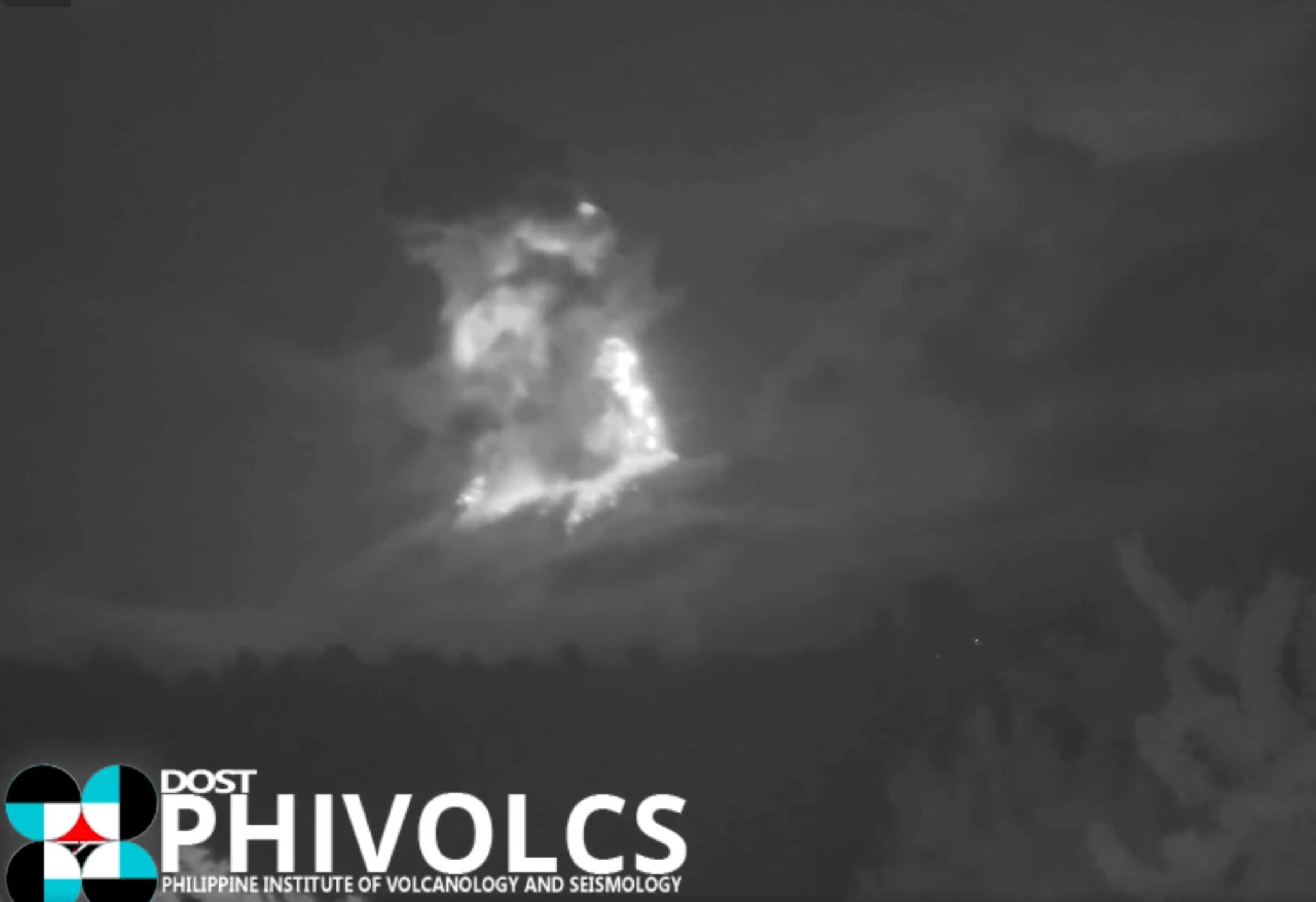
Screenshot of the time-lapse IP camera footage from 6:51 p.m. to 6:57 p.m. of the explosive eruption at the Kanlaon Volcano summit crater, taken by the Canlaon City (VKCC) observation station on June 3, 2024. The plume can be seen rising 5,000 meters above the vent. (Phivolcs/Facebook)

The Philippine Institute of Volcanology and Seismology (Phivolcs) said Kanlaon Volcano recorded its second-highest ever sulfur dioxide (SO2) emissions, following its “explosive eruption” on June 3.

Based on Phivolcs’ volcano bulletin released on Wednesday, June 5, SO2 emissions from Kanlaon Volcano reached 4,133 tons per day when it was last measured on June 4.

This marks the highest flux of SO2 emissions this year and the second-highest ever measured from Kanlaon.

Phivolcs noted that the June 3 eruption was “immediately succeeded by profuse degassing from the summit crater that waned by 8:20 a.m. on June 4.”

“Volcanic SO2 gas emission has been unsteadily increasing since May 2023 and has averaged 1,273 tons per day this year, substantially above the background emission of <300 tons per day,” it pointed out.

Phivolcs also noted that Kanlaon Volcano has experienced increased seismic activity in the past 24 hours, with 53 volcanic earthquakes recorded.

“Kanlaon has been exhibiting periodic swarms of VT (volcanic tremor) earthquakes since Alert Level 1 was raised in March 2020. Since 2023 alone, five advisories on increased seismic activity have been released, the latest of which was last May 26, 2024,” it said.

Alert Level 2 maintained

Phivolcs said Alert Level 2 is still in effect as Kanlaon Volcano is still experiencing “moderate” volcanic unrest.

This indicates the presence of elevated levels of any of the following parameters: volcanic earthquake, temperature, acidity, and volcanic gas concentrations in monitored springs and fumaroles, steam and ash explosions from the summit crater or new vents, and inflation or swelling of the edifice.

Phivolcs reminded the public that entry into the four-kilometer radius permanent danger zone (PDZ) is strictly prohibited.

Some parts of these barangays (villages) are located within the PDZ, which includes Ara-al and Yubo in La Carlota City; Sag-ang, Mansalanao, Cabagnaan, and Biaknabato in La Castellana; Minoyan, Murcia; Masolog, Pula, and Lumapao in Canlaon City; and Codcod in San Carlos City.

Phivolcs urged the local government units, disaster officials, and the public to avoid the PDZ because the likelihood of similar explosive eruptions occurring is high, increasing the threat of volcanic hazards such as pyroclastic density currents and ballistic projectiles within the PDZ.

It noted that Kanlaon occasionally has phreatic and short-lived explosive eruptions that cause minor hazards. 

Of the 43 eruptions recorded since 1866, Phivolcs said only the 1902 eruption was magmatic.

Phreatic eruption involves water coming into contact with hot volcanic materials—hot gases or hot rocks—leading to explosive steam, while the magmatic eruption is driven by the release of magma and volcanic gases.

Kanlaon Volcano’s last phreatic eruption occurred in December 2017.

Related Tags

sulfur dioxide emission Kanlaon Volcano Eruption PHIVOLCS
ADVERTISEMENT
.most-popular .layout-ratio{ padding-bottom: 79.13%; } @media (min-width: 768px) and (max-width: 1024px) { .widget-title { font-size: 15px !important; } }

{{ articles_filter_1561_widget.title }}

.most-popular .layout-ratio{ padding-bottom: 79.13%; } @media (min-width: 768px) and (max-width: 1024px) { .widget-title { font-size: 15px !important; } }

{{ articles_filter_1562_widget.title }}

.most-popular .layout-ratio{ padding-bottom: 79.13%; } @media (min-width: 768px) and (max-width: 1024px) { .widget-title { font-size: 15px !important; } }

{{ articles_filter_1563_widget.title }}

{{ articles_filter_1564_widget.title }}

.mb-article-details { position: relative; } .mb-article-details .article-body-preview, .mb-article-details .article-body-summary{ font-size: 17px; line-height: 30px; font-family: "Libre Caslon Text", serif; color: #000; } .mb-article-details .article-body-preview iframe , .mb-article-details .article-body-summary iframe{ width: 100%; margin: auto; } .read-more-background { background: linear-gradient(180deg, color(display-p3 1.000 1.000 1.000 / 0) 13.75%, color(display-p3 1.000 1.000 1.000 / 0.8) 30.79%, color(display-p3 1.000 1.000 1.000) 72.5%); position: absolute; height: 200px; width: 100%; bottom: 0; display: flex; justify-content: center; align-items: center; padding: 0; } .read-more-background a{ color: #000; } .read-more-btn { padding: 17px 45px; font-family: Inter; font-weight: 700; font-size: 18px; line-height: 16px; text-align: center; vertical-align: middle; border: 1px solid black; background-color: white; } .hidden { display: none; }
function initializeAllSwipers() { // Get all hidden inputs with cms_article_id document.querySelectorAll('[id^="cms_article_id_"]').forEach(function (input) { const cmsArticleId = input.value; const articleSelector = '#article-' + cmsArticleId + ' .body_images'; const swiperElement = document.querySelector(articleSelector); if (swiperElement && !swiperElement.classList.contains('swiper-initialized')) { new Swiper(articleSelector, { loop: true, pagination: false, navigation: { nextEl: '#article-' + cmsArticleId + ' .swiper-button-next', prevEl: '#article-' + cmsArticleId + ' .swiper-button-prev', }, }); } }); } setTimeout(initializeAllSwipers, 3000); const intersectionObserver = new IntersectionObserver( (entries) => { entries.forEach((entry) => { if (entry.isIntersecting) { const newUrl = entry.target.getAttribute("data-url"); if (newUrl) { history.pushState(null, null, newUrl); let article = entry.target; // Extract metadata const author = article.querySelector('.author-section').textContent.replace('By', '').trim(); const section = article.querySelector('.section-info ').textContent.replace(' ', ' '); const title = article.querySelector('.article-title h1').textContent; // Parse URL for Chartbeat path format const parsedUrl = new URL(newUrl, window.location.origin); const cleanUrl = parsedUrl.host + parsedUrl.pathname; // Update Chartbeat configuration if (typeof window._sf_async_config !== 'undefined') { window._sf_async_config.path = cleanUrl; window._sf_async_config.sections = section; window._sf_async_config.authors = author; } // Track virtual page view with Chartbeat if (typeof pSUPERFLY !== 'undefined' && typeof pSUPERFLY.virtualPage === 'function') { try { pSUPERFLY.virtualPage({ path: cleanUrl, title: title, sections: section, authors: author }); } catch (error) { console.error('ping error', error); } } // Optional: Update document title if (title && title !== document.title) { document.title = title; } } } }); }, { threshold: 0.1 } ); function showArticleBody(button) { const article = button.closest("article"); const summary = article.querySelector(".article-body-summary"); const body = article.querySelector(".article-body-preview"); const readMoreSection = article.querySelector(".read-more-background"); // Hide summary and read-more section summary.style.display = "none"; readMoreSection.style.display = "none"; // Show the full article body body.classList.remove("hidden"); } document.addEventListener("DOMContentLoaded", () => { let loadCount = 0; // Track how many times articles are loaded const offset = [1, 2, 3, 4, 5, 6, 7, 8, 9, 10]; // Offset values const currentUrl = window.location.pathname.substring(1); let isLoading = false; // Prevent multiple calls if (!currentUrl) { console.log("Current URL is invalid."); return; } const sentinel = document.getElementById("load-more-sentinel"); if (!sentinel) { console.log("Sentinel element not found."); return; } function isSentinelVisible() { const rect = sentinel.getBoundingClientRect(); return ( rect.top < window.innerHeight && rect.bottom >= 0 ); } function onScroll() { if (isLoading) return; if (isSentinelVisible()) { if (loadCount >= offset.length) { console.log("Maximum load attempts reached."); window.removeEventListener("scroll", onScroll); return; } isLoading = true; const currentOffset = offset[loadCount]; window.loadMoreItems().then(() => { let article = document.querySelector('#widget_1690 > div:nth-last-of-type(2) article'); intersectionObserver.observe(article) loadCount++; }).catch(error => { console.error("Error loading more items:", error); }).finally(() => { isLoading = false; }); } } window.addEventListener("scroll", onScroll); });

Sign up by email to receive news.