







Beyond the forecast
A weather specialist's story of chasing storms, fulfilling dreams



Obet Badrina of Philippine Atmospheric, Geophysical and Astronomical Services Administration, forecasts the weather. He also serves as a symbol of pursuing one’s aspirations.
Originally from Bataan, Badrina earned a Bachelor of Science in Geography from the University of the Philippines Diliman (UP Diliman).
Despite his certainty about continuing his education after graduation, he remained unsure about the path to his master’s degree.
It was in 2009, amid the onslaught of Tropical Storm Ondoy (Ketsana), that Badrina discovered his passion for meteorology.
It was through an upperclassman, who had also graduated from the BS Geography program and was pursuing an MS in Meteorology at UP Diliman's Institute of Environmental Science and Meteorology (IESM) at that time, that he learned about the opportunity to study this specific field in graduate school.
From then on, Badrina’s journey to becoming a meteorologist began to take shape.
Career path
A scholarship from the Department of Science and Technology (DOST) supported Badrina’s pursuit of higher education, allowing him to realize his dream of becoming a meteorologist in 2014.
Badrina began his career at PAGASA in 2015 when he was assigned as a weather specialist to the Marine Meteorological Services Section of the Weather Division.
However, in 2018, he temporarily left to pursue a different path, enrolling in a seminary.
But after a few years, Badrina said he realized that seminary or religious life was not for him.
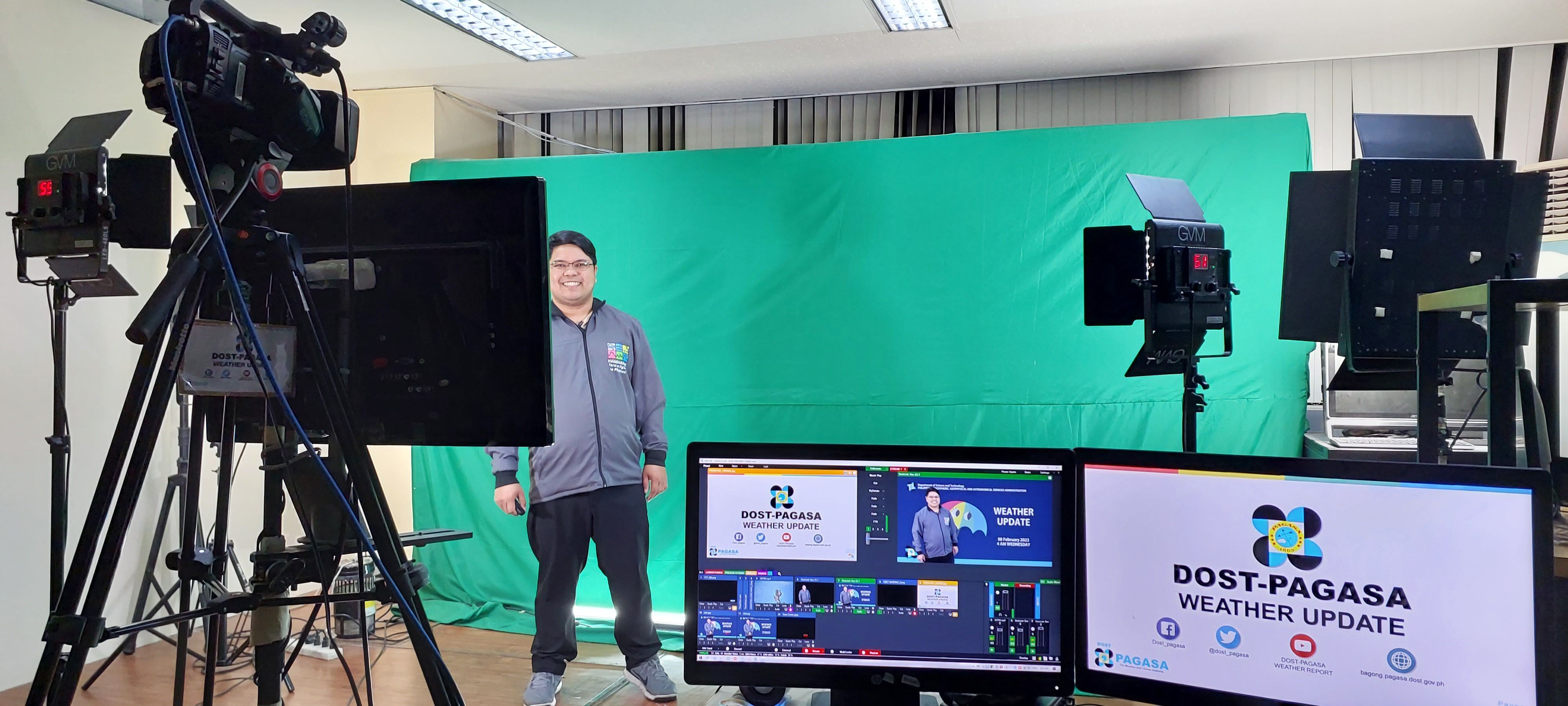
“When I was discerning kung anong klaseng buhay ‘yung gusto kong balikan, malinaw sa ‘kin na gusto ko pa ring ipursue ‘yung pagiging weather forecaster or meteorologist. So sa field pa rin ng sciences ‘yung gusto kong gawin (When I was discerning what kind of life I wanted to return to, it was clear to me that I still wanted to pursue being a weather forecaster or meteorologist. So I still want to work in the field of science),” he said.
Following a period of reflection, he returned to PAGASA in 2022, reaffirming his dedication to meteorology up until now.
Challenges
For Badrina, navigating the complexities of meteorology entails managing pressure and uncertainties, exemplified by the recent Typhoon Aghon (Ewiniar).
He pointed out the significance of being “very careful,” making the most use of available resources, and effectively communicating available data to manage stress.
“Meteorology is very challenging, kasi marami siyang limitations. So I think one way to manage our stress is to make the most of what we have. May mga times, may mga late na darating na data for various reasons, kaya hindi perfect ang forecast kasi maraming limitations. So we manage stress by means of maximizing what we have (Meteorology is very challenging because it has many limitations. So I think one way to manage our stress is to make the most of what we have. There are times when data arrives late for various reasons, so the forecast is not perfect because there are many limitations. So we manage stress by means of maximizing what we have),” he said.
Memorable experiences
Badrina also recalled significant moments in his career, such as presenting forecasts during a meeting of the National Disaster Risk Reduction and Management Council (NDRRMC) attended by President Ferdinand R. Marcos Jr.
“Noong 2022, ‘yung bagyong Karding, hindi ko ‘yun makalimutan kasi it was the first time na nandun ako during the meeting ng NDRRMC, nandun si President Bongbong Marcos (I’ll never forget the Typhoon Karding in 2022 because it was the first time I attended a NDRRMC meeting where President Bongbong Marcos was present),” he said.
“Hindi man ako ‘yung nag-present, pero ako ‘yung nagbibigay ng inputs sa aming undersecretary at administrator at that time (I was not the one who presented, but I was the one who gave inputs to our undersecretary and administrator at that time),” he added, highlighting the difficulty of forecasting Typhoon Karding (Noru), which rapidly intensified into a super typhoon before its landfall.
During that time, Badrina also recognized the importance of putting aside his usual cheerful demeanor to effectively convey the seriousness of the situation to the public.
“Very memorable din siya kasi ako ‘yung forecaster na magsasabi sa mga tao na super typhoon na ‘to. Ang personality ko, very jolly ako na person. I really need to get out of that kind of personality. When I was doing the live forecast at 5 a.m. at that time, I needed to show to the people through my update how serious the situation was. Na super typhoon na ito at tatama na ito sa lupa and we need to prepare (It was also particularly memorable because I was the forecaster who informed people that it was a super typhoon. My personality is very jolly. I really needed to get out of that type of personality and when I was doing the live forecast at 5 a.m. I needed to show to the people through my update how serious the situation was. That this is a super typhoon, and that it will hit land, so we must prepare),” he said.
Fulfillment
The ultimate reward for Badrina lies in safeguarding lives and facilitating preparedness.
Knowing that accurate forecasts contribute to minimizing casualties and enhancing community resilience fuels his sense of purpose and fulfillment.
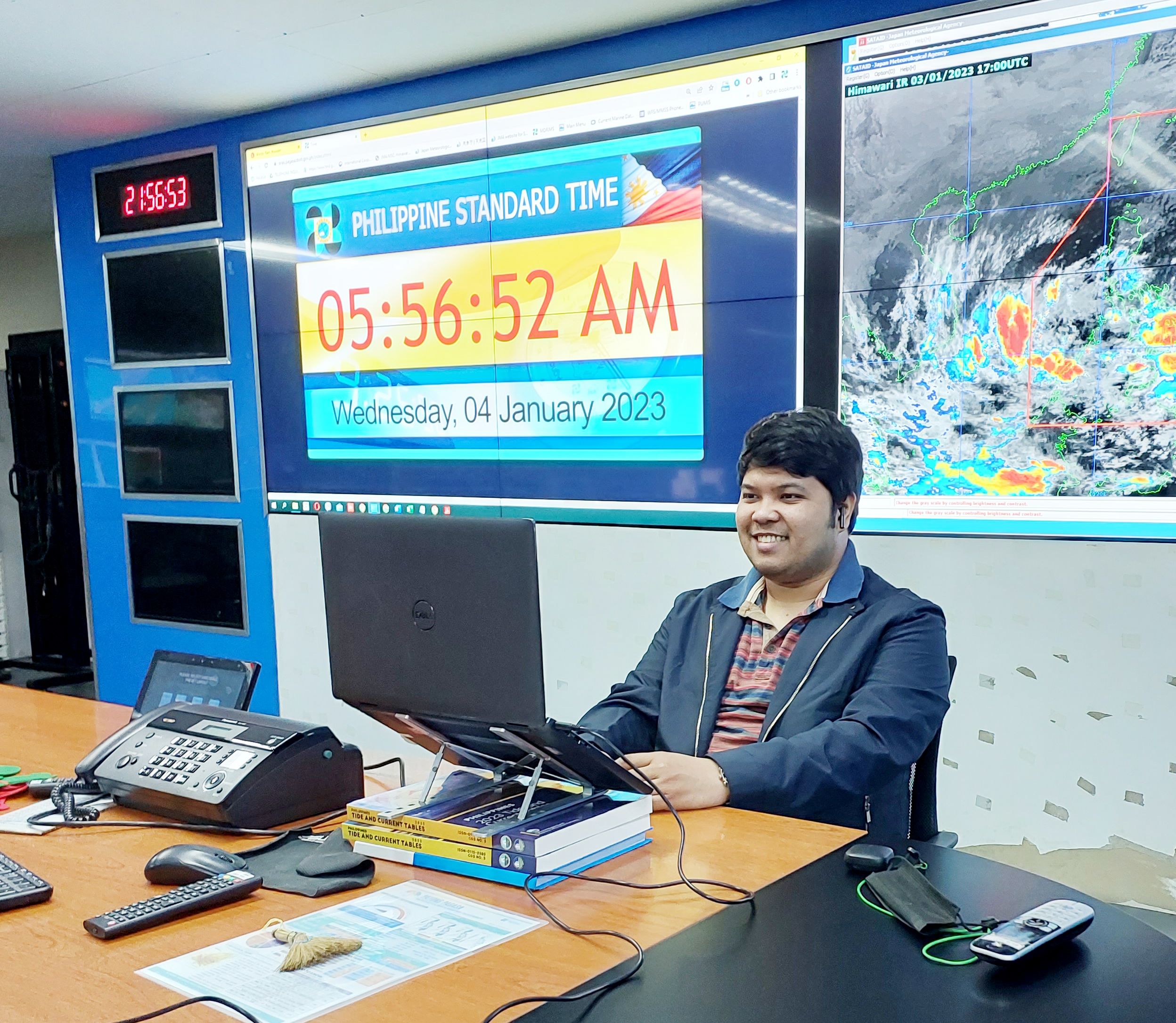
“Kapag nalalaman namin na walang casualty tapos nakapagprepare ang mga tao, we’re very grateful for that. ‘Yun ang nagbibigay sa akin ng fulfillment na masasabi ko na maybe I am doing something good at effective (When we learn that there are no casualty, and that people are prepared, we’re very grateful for that. That gives me the fulfillment that I can say, maybe I am doing something good and effective),” Badrina said.
He also pointed out that communicating the weather forecast is just as important as the science itself.
No matter how precise the forecast is, it is still useless if it is not properly conveyed, he added.
Inspiring future meteorologists
Drawing from his experiences, Badrina advised aspiring meteorologists to seize the moment.
“Sa mga gusto magpursue ng meteorology. As early as now, you should be already prepared in terms of understanding the science. Something that I learned the past few years, especially after the seminary, is that there’s only one moment and that’s the present moment. At ganun din kasi and meteorology. We make the most of what is available at the present moment. Kasi hindi mo mafo-forecast ‘yung future kapag hindi mo naunawaan ang present (To those who want to pursue meteorology. As early as now, you should already be prepared in terms of understanding the science. Something that I learned the past few years, especially after the seminary, is that there’s only one moment and that’s the present moment. And it’s the same with meteorology. We make most of what is available at the present moment. Because you can’t forecast the future if you don’t understand the present),” he said.
Badrina also emphasized that meteorology encompasses a wide range of disciplines and “is not just about weather forecasting.”
“Maraming field siya like climatology, numerical weather prediction, meron din sa engineering part, meron ding research. Sakop din niya ‘yung sa dams, flood warning. Ang alam lang usually ng mga tao weather forecasting lang pero ang daming iba’t ibang fields ang meteorology na pwedeng pagpilian ng mga estudyante or mga gusto magpursue ng meteorology as a career (It has many fields, including climatology, numerical weather prediction, engineering, and research. It also includes dams and flood warnings. People typically only know about weather forecasting, but meteorology has many fields that students or those who want to pursue meteorology as a career can choose from),” he said.
Badrina also encouraged students to pursue science courses, not just meteorology, as scholarships and partnerships are available in nurturing future generations of science experts.
He said PAGASA works closely with the DOST, particularly through the Science Education Institute, which is responsible for offering scholarships.
“Through our numerous collaborations with DOST-SEI, we encourage students to enroll in science courses. They provide other sciences in addition to meteorology,” he added.