

ADVERTISEMENT

Ultra-Orthodox Jews block highway to protest Israel's new mandatory military service ruling

Published Jun 27, 2024 11:23 pm

BNEI BRAK, Israel (AP) — Hundreds of ultra-Orthodox Jewish men blocked a major highway in central Israel for two hours on Thursday to protest a recent Supreme Court decision ordering young religious men to enlist for military service.
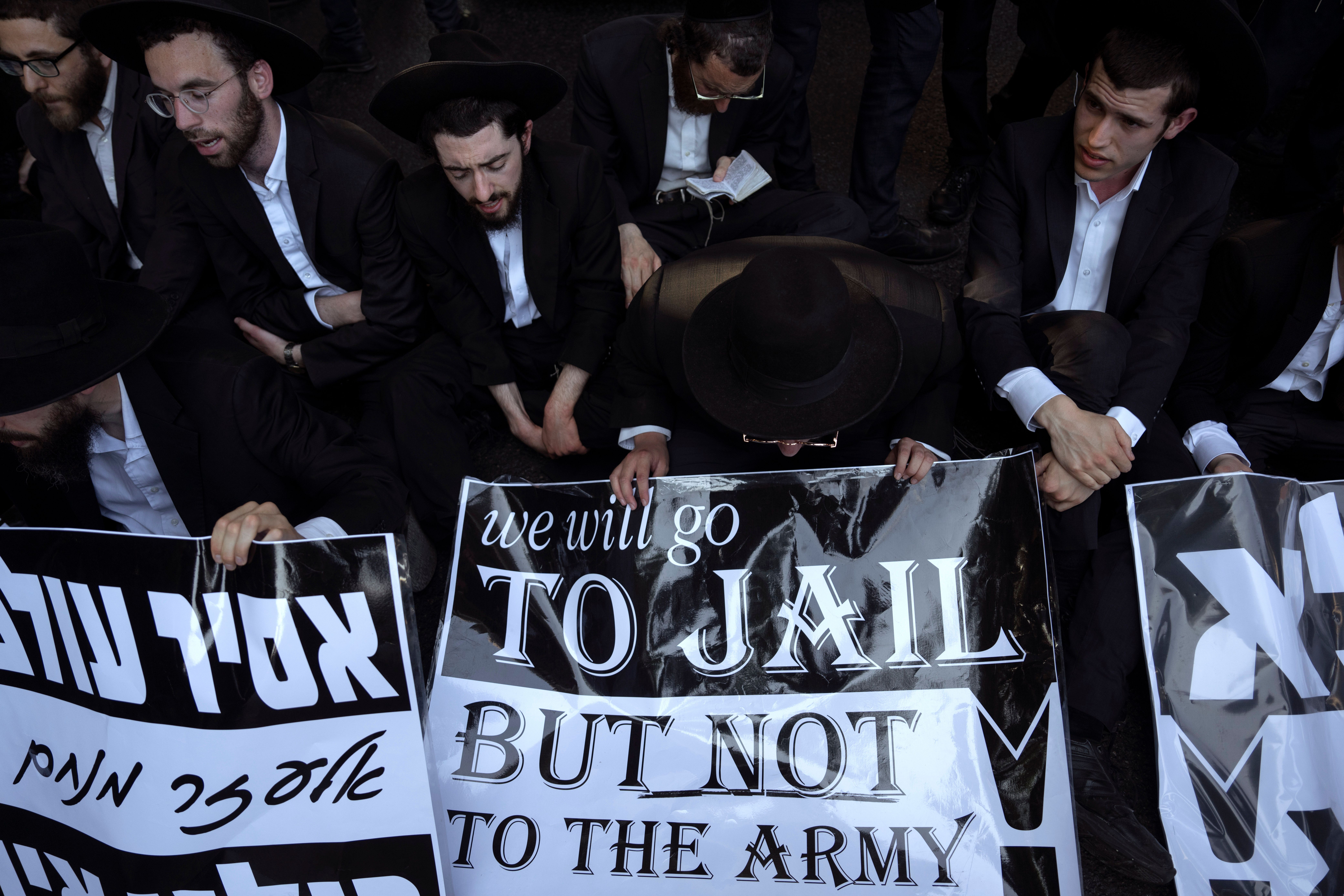
AP24179639230467.jpg
Ultra-Orthodox Jewish men block a highway as they take part in a protest against army recruitment in Bnei Brak, Israel, Thursday, June 27, 2024. Israel's Supreme Court unanimously ordered the government to begin drafting ultra-Orthodox Jewish men into the army, a landmark ruling seeking to end a system that has allowed them to avoid enlistment into compulsory military service. (AP Photo/Oded Balilty)

Military service is compulsory for most Jewish men and women in Israel. But politically powerful ultra-Orthodox parties have won draft exemptions for their followers that allow them instead to study in religious seminaries.

This long-standing arrangement has bred widespread resentment among the broader public — a sentiment that has grown stronger during the eight-month war against Hamas in Gaza. Over 600 soldiers have been killed, and tens of thousands of reservists have been activated, straining careers, businesses and family lives.

Protesters sat on the highway and lay on the ground as police lifted them up and dragged them away. Officers mounted on horseback charged into the crowd. Many demonstrators held signs and chanted “To prison! Not to the army!”

“We all came here for one goal, we reflect the position of all the Orthodox public," said a young man, identifying himself only by his first name Ozer. “All the Orthodox public prefers to go to prison and not to the army.”

The ultra-Orthodox see their full-time religious study as their part in protecting the state. Many fear that greater contact with secular society through the military will distance adherents from strict observance of the faith.

The Supreme Court this week ordered the government to begin drafting ultra-Orthodox men, saying the system of exemptions is unequal.

The decision could lead to the collapse of Prime Minister Benjamin Netanyahu's government. Ultra-Orthodox parties and their followers oppose any change in the system.

The ultra-Orthodox make up roughly 13% of Israel's population. But under the country's fragmented political system, they wield significant political power and often serve as political kingmakers.

The parties are key members of Netanyahu’s governing coalition and could potentially force new elections if they decide to leave the government.

Ultra-Orthodox leaders have not yet said whether they will quit the government, but their followers have scheduled a large protest in Jerusalem on Sunday.

Related Tags

WORLDNEWS
ADVERTISEMENT
.most-popular .layout-ratio{ padding-bottom: 79.13%; } @media (min-width: 768px) and (max-width: 1024px) { .widget-title { font-size: 15px !important; } }

{{ articles_filter_1561_widget.title }}

.most-popular .layout-ratio{ padding-bottom: 79.13%; } @media (min-width: 768px) and (max-width: 1024px) { .widget-title { font-size: 15px !important; } }

{{ articles_filter_1562_widget.title }}

.most-popular .layout-ratio{ padding-bottom: 79.13%; } @media (min-width: 768px) and (max-width: 1024px) { .widget-title { font-size: 15px !important; } }

{{ articles_filter_1563_widget.title }}

{{ articles_filter_1564_widget.title }}

.mb-article-details { position: relative; } .mb-article-details .article-body-preview, .mb-article-details .article-body-summary{ font-size: 17px; line-height: 30px; font-family: "Libre Caslon Text", serif; color: #000; } .mb-article-details .article-body-preview iframe , .mb-article-details .article-body-summary iframe{ width: 100%; margin: auto; } .read-more-background { background: linear-gradient(180deg, color(display-p3 1.000 1.000 1.000 / 0) 13.75%, color(display-p3 1.000 1.000 1.000 / 0.8) 30.79%, color(display-p3 1.000 1.000 1.000) 72.5%); position: absolute; height: 200px; width: 100%; bottom: 0; display: flex; justify-content: center; align-items: center; padding: 0; } .read-more-background a{ color: #000; } .read-more-btn { padding: 17px 45px; font-family: Inter; font-weight: 700; font-size: 18px; line-height: 16px; text-align: center; vertical-align: middle; border: 1px solid black; background-color: white; } .hidden { display: none; }
function initializeAllSwipers() { // Get all hidden inputs with cms_article_id document.querySelectorAll('[id^="cms_article_id_"]').forEach(function (input) { const cmsArticleId = input.value; const articleSelector = '#article-' + cmsArticleId + ' .body_images'; const swiperElement = document.querySelector(articleSelector); if (swiperElement && !swiperElement.classList.contains('swiper-initialized')) { new Swiper(articleSelector, { loop: true, pagination: false, navigation: { nextEl: '#article-' + cmsArticleId + ' .swiper-button-next', prevEl: '#article-' + cmsArticleId + ' .swiper-button-prev', }, }); } }); } setTimeout(initializeAllSwipers, 3000); const intersectionObserver = new IntersectionObserver( (entries) => { entries.forEach((entry) => { if (entry.isIntersecting) { const newUrl = entry.target.getAttribute("data-url"); if (newUrl) { history.pushState(null, null, newUrl); let article = entry.target; // Extract metadata const author = article.querySelector('.author-section').textContent.replace('By', '').trim(); const section = article.querySelector('.section-info ').textContent.replace(' ', ' '); const title = article.querySelector('.article-title h1').textContent; // Parse URL for Chartbeat path format const parsedUrl = new URL(newUrl, window.location.origin); const cleanUrl = parsedUrl.host + parsedUrl.pathname; // Update Chartbeat configuration if (typeof window._sf_async_config !== 'undefined') { window._sf_async_config.path = cleanUrl; window._sf_async_config.sections = section; window._sf_async_config.authors = author; } // Track virtual page view with Chartbeat if (typeof pSUPERFLY !== 'undefined' && typeof pSUPERFLY.virtualPage === 'function') { try { pSUPERFLY.virtualPage({ path: cleanUrl, title: title, sections: section, authors: author }); } catch (error) { console.error('ping error', error); } } // Optional: Update document title if (title && title !== document.title) { document.title = title; } } } }); }, { threshold: 0.1 } ); function showArticleBody(button) { const article = button.closest("article"); const summary = article.querySelector(".article-body-summary"); const body = article.querySelector(".article-body-preview"); const readMoreSection = article.querySelector(".read-more-background"); // Hide summary and read-more section summary.style.display = "none"; readMoreSection.style.display = "none"; // Show the full article body body.classList.remove("hidden"); } document.addEventListener("DOMContentLoaded", () => { let loadCount = 0; // Track how many times articles are loaded const offset = [1, 2, 3, 4, 5, 6, 7, 8, 9, 10]; // Offset values const currentUrl = window.location.pathname.substring(1); let isLoading = false; // Prevent multiple calls if (!currentUrl) { console.log("Current URL is invalid."); return; } const sentinel = document.getElementById("load-more-sentinel"); if (!sentinel) { console.log("Sentinel element not found."); return; } function isSentinelVisible() { const rect = sentinel.getBoundingClientRect(); return ( rect.top < window.innerHeight && rect.bottom >= 0 ); } function onScroll() { if (isLoading) return; if (isSentinelVisible()) { if (loadCount >= offset.length) { console.log("Maximum load attempts reached."); window.removeEventListener("scroll", onScroll); return; } isLoading = true; const currentOffset = offset[loadCount]; window.loadMoreItems().then(() => { let article = document.querySelector('#widget_1690 > div:nth-last-of-type(2) article'); intersectionObserver.observe(article) loadCount++; }).catch(error => { console.error("Error loading more items:", error); }).finally(() => { isLoading = false; }); } } window.addEventListener("scroll", onScroll); });

Sign up by email to receive news.