

ADVERTISEMENT

Military flees Bolivia government palace after coup attempt fails, general taken into custody

Published Jun 27, 2024 12:38 am

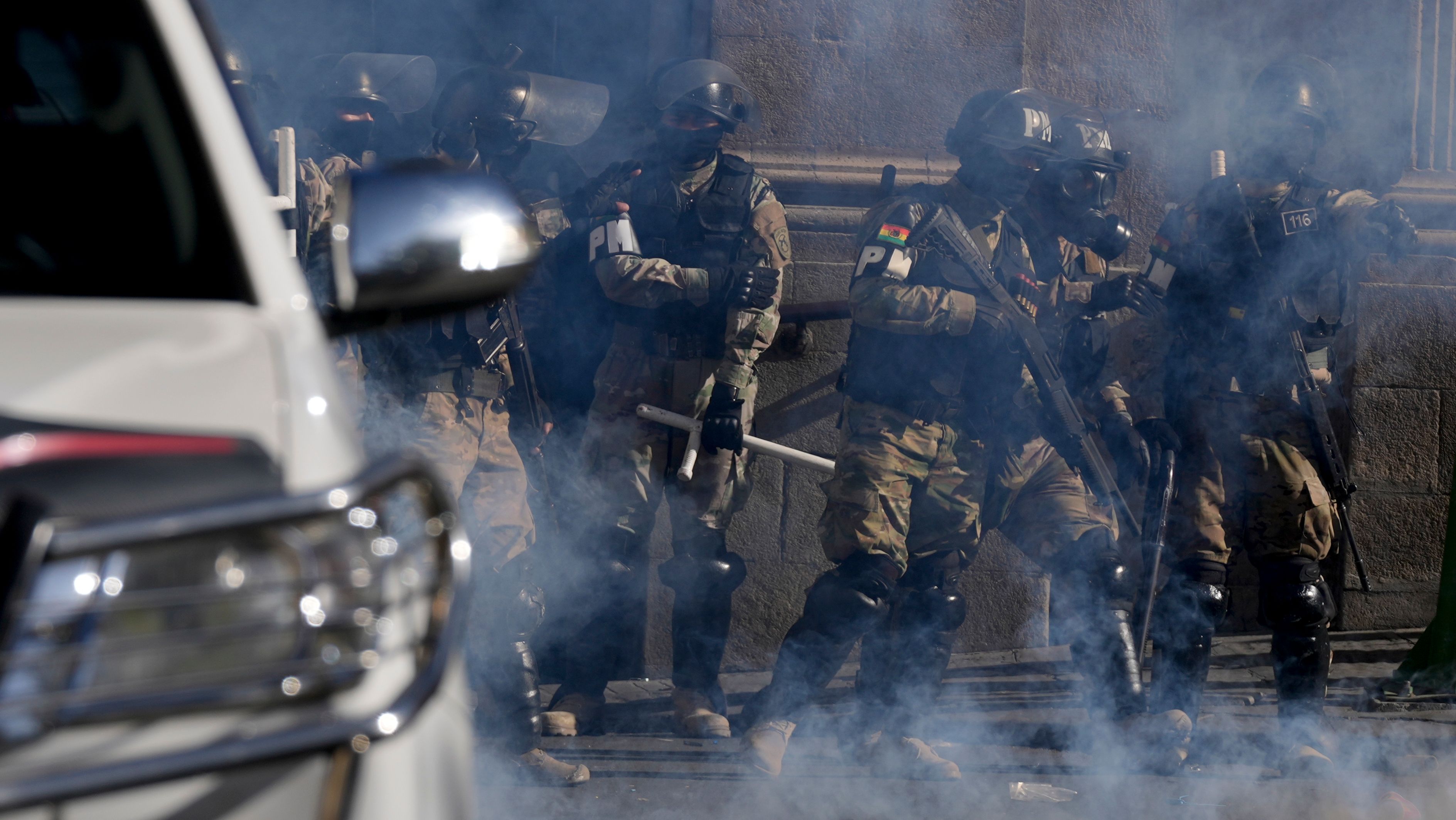
LA PAZ, Bolivia (AP) — Armored vehicles rammed the doors of Bolivia’s government palace Wednesday in an apparent coup attempt, but President Luis Arce vowed to stand firm and named a new army commander who ordered troops to stand down.
AP24178717458199.jpg
Military Police stand amid tear gas they fired outside the presidential palace in Plaza Murillo in La Paz, Bolivia, Wednesday, June 26, 2024. (AP Photo/Juan Karita)

Soon the soldiers pulled back, along with a line of military vehicles, as hundreds of Arce's supporters rushed the square outside the palace, waving Bolivian flags, singing the national anthem and cheering.

Arce, surrounded by ministers, waved at the crowd. “Thank you to the Bolivian people,” he said. “ Let democracy live on.”

Hours later, the Bolivian general who appeared to be behind the rebellion, Juan José Zúñiga, was arrested after the attorney general opened an investigation. It wasn’t immediately clear what the charges were against him.

However, in a twist, Zúñiga claimed before his arrest that Arce himself told the general to storm the palace in a political move. “The president told me: ‘The situation is very screwed up, very critical. It is necessary to prepare something to raise my popularity’,” Zúñiga told reporters.

Zúñiga sajd he asked Arce if he should “take out the armored vehicles?” and Arce replied, “Take them out.”

Wednesday’s rebellion followed months of tensions, with economic hardship and protests growing ever stronger as two political titans — Arce and his one-time ally, leftist former President Evo Morales — battled for control of the ruling party.

Still, the apparent attempt to depose the sitting president appeared to lack any meaningful support, and even Arce’s rivals closed ranks to defend democracy and repudiate the uprising.

The spectacle shocked Bolivians, no stranger to political unrest; in 2019 Morales was ousted as president following an earlier political crisis.

As the crisis unfolded Wednesday, military vehicles flooded into the plaza. Before entering the government building, Zúñiga, general commander of the army, told journalists: “Surely soon there will be a new Cabinet of ministers; our country, our state cannot go on like this.” Zúñiga said that “for now,” though, he recognized Arce as commander in chief.

Zúñiga did not explicitly say he was leading a coup, but in the palace, he said the army was trying to “restore democracy and free our political prisoners.”

Shortly after, Arce confronted Zúñiga in the palace hallway, as shown on video on Bolivian television. “I am your captain, and I order you to withdraw your soldiers, and I will not allow this insubordination,” Arce said.

Surrounded by ministers, he added: “Here we are, firm in Casa Grande, to confront any coup attempt. We need the Bolivian people to organize.”

He added in a video message that he would not ”“allow, once again, coup attempts to take the lives of Bolivians.”

Less than an hour later, Arce announced new heads of the army, navy and air force amid the roar of supporters, and thanked the country’s police and regional allies for standing by him. Arce said the troops who rose against him were “staining the uniform” of the military.

“I order all that are mobilized to return to their units," said the newly named army chief José Wilson Sánchez. “No one wants the images we’re seeing in the streets.”

Shortly after, the armored vehicles roared out of the plaza, tailed by hundreds of military fighters as police in riot gear set up blockades outside the government palace.

The incident was met with a wave of outrage by other regional leaders, including the Organization of American States, Chilean President Gabriel Boric, the leader of Honduras, and former Bolivian leaders.

Bolivia, a country of 12 million people, has seen intensifying protests in recent months over the economy’s precipitous decline from one of the continent’s fastest-growing two decades ago to one of its most crisis-stricken.

The country also has seen a high-profile rift at the highest levels of the governing party. Arce and his one-time ally, Morales, have been battling for the future of Bolivia’s splintering Movement for Socialism, known by its Spanish acronym MAS, ahead of elections in 2025.

Following Wednesday's chaos, reports on local media showed Bolivians stocking up on food and other essentials in supermarkets, concerned about what will come next.

But before supporters outside the presidential palace the country’s Vice President David Choquehuanca vowed: "Never again will the Bolivian people permit coup attempts.”

Related Tags

WORLDNEWS
ADVERTISEMENT
.most-popular .layout-ratio{ padding-bottom: 79.13%; } @media (min-width: 768px) and (max-width: 1024px) { .widget-title { font-size: 15px !important; } }

{{ articles_filter_1561_widget.title }}

.most-popular .layout-ratio{ padding-bottom: 79.13%; } @media (min-width: 768px) and (max-width: 1024px) { .widget-title { font-size: 15px !important; } }

{{ articles_filter_1562_widget.title }}

.most-popular .layout-ratio{ padding-bottom: 79.13%; } @media (min-width: 768px) and (max-width: 1024px) { .widget-title { font-size: 15px !important; } }

{{ articles_filter_1563_widget.title }}

{{ articles_filter_1564_widget.title }}

.mb-article-details { position: relative; } .mb-article-details .article-body-preview, .mb-article-details .article-body-summary{ font-size: 17px; line-height: 30px; font-family: "Libre Caslon Text", serif; color: #000; } .mb-article-details .article-body-preview iframe , .mb-article-details .article-body-summary iframe{ width: 100%; margin: auto; } .read-more-background { background: linear-gradient(180deg, color(display-p3 1.000 1.000 1.000 / 0) 13.75%, color(display-p3 1.000 1.000 1.000 / 0.8) 30.79%, color(display-p3 1.000 1.000 1.000) 72.5%); position: absolute; height: 200px; width: 100%; bottom: 0; display: flex; justify-content: center; align-items: center; padding: 0; } .read-more-background a{ color: #000; } .read-more-btn { padding: 17px 45px; font-family: Inter; font-weight: 700; font-size: 18px; line-height: 16px; text-align: center; vertical-align: middle; border: 1px solid black; background-color: white; } .hidden { display: none; }
function initializeAllSwipers() { // Get all hidden inputs with cms_article_id document.querySelectorAll('[id^="cms_article_id_"]').forEach(function (input) { const cmsArticleId = input.value; const articleSelector = '#article-' + cmsArticleId + ' .body_images'; const swiperElement = document.querySelector(articleSelector); if (swiperElement && !swiperElement.classList.contains('swiper-initialized')) { new Swiper(articleSelector, { loop: true, pagination: false, navigation: { nextEl: '#article-' + cmsArticleId + ' .swiper-button-next', prevEl: '#article-' + cmsArticleId + ' .swiper-button-prev', }, }); } }); } setTimeout(initializeAllSwipers, 3000); const intersectionObserver = new IntersectionObserver( (entries) => { entries.forEach((entry) => { if (entry.isIntersecting) { const newUrl = entry.target.getAttribute("data-url"); if (newUrl) { history.pushState(null, null, newUrl); let article = entry.target; // Extract metadata const author = article.querySelector('.author-section').textContent.replace('By', '').trim(); const section = article.querySelector('.section-info ').textContent.replace(' ', ' '); const title = article.querySelector('.article-title h1').textContent; // Parse URL for Chartbeat path format const parsedUrl = new URL(newUrl, window.location.origin); const cleanUrl = parsedUrl.host + parsedUrl.pathname; // Update Chartbeat configuration if (typeof window._sf_async_config !== 'undefined') { window._sf_async_config.path = cleanUrl; window._sf_async_config.sections = section; window._sf_async_config.authors = author; } // Track virtual page view with Chartbeat if (typeof pSUPERFLY !== 'undefined' && typeof pSUPERFLY.virtualPage === 'function') { try { pSUPERFLY.virtualPage({ path: cleanUrl, title: title, sections: section, authors: author }); } catch (error) { console.error('ping error', error); } } // Optional: Update document title if (title && title !== document.title) { document.title = title; } } } }); }, { threshold: 0.1 } ); function showArticleBody(button) { const article = button.closest("article"); const summary = article.querySelector(".article-body-summary"); const body = article.querySelector(".article-body-preview"); const readMoreSection = article.querySelector(".read-more-background"); // Hide summary and read-more section summary.style.display = "none"; readMoreSection.style.display = "none"; // Show the full article body body.classList.remove("hidden"); } document.addEventListener("DOMContentLoaded", () => { let loadCount = 0; // Track how many times articles are loaded const offset = [1, 2, 3, 4, 5, 6, 7, 8, 9, 10]; // Offset values const currentUrl = window.location.pathname.substring(1); let isLoading = false; // Prevent multiple calls if (!currentUrl) { console.log("Current URL is invalid."); return; } const sentinel = document.getElementById("load-more-sentinel"); if (!sentinel) { console.log("Sentinel element not found."); return; } function isSentinelVisible() { const rect = sentinel.getBoundingClientRect(); return ( rect.top < window.innerHeight && rect.bottom >= 0 ); } function onScroll() { if (isLoading) return; if (isSentinelVisible()) { if (loadCount >= offset.length) { console.log("Maximum load attempts reached."); window.removeEventListener("scroll", onScroll); return; } isLoading = true; const currentOffset = offset[loadCount]; window.loadMoreItems().then(() => { let article = document.querySelector('#widget_1690 > div:nth-last-of-type(2) article'); intersectionObserver.observe(article) loadCount++; }).catch(error => { console.error("Error loading more items:", error); }).finally(() => { isLoading = false; }); } } window.addEventListener("scroll", onScroll); });

Sign up by email to receive news.